There she is, the famous artist, lying in the bed where she spent so much time recovering from ill-health and devastating accidents. Dressed in traditional Mexican garb, fingers festooned with rings, head wreathed in a signature floral crown, she fixes us with a direct gaze from beneath a trademark unibrow.
But no, it’s not the Mexican painter Frida Kahlo, though the resemblance is uncanny. (Just look at the photographs propped against the headboard behind her.). It’s the British artist Tracey Emin, channeling, paying homage and perhaps asserting a continuum in a particular kind of personal, autobiographical female art-making that is often misunderstood.
The image, “Being Frida, London” (2000) is by the photographer Mary McCartney, who styled and took the picture a year after Emin became famous (and infamous) when her installation “My Bed” went on show at the Tate Gallery. This summer, in a pleasing visual rhyme, these two works are simultaneously on display at Tate Modern — though not in the same exhibition.
Since it opened in February, “Tracey Emin: A Second Life” — which spans four decades of the artist’s multidisciplinary oeuvre — has drawn a record 234,000 visitors, according to the museum, and there are still two months to run before the show wraps up on Aug. 31. Another milestone: Before opening last week, “Frida: The Making of an Icon,” a Kahlo retrospective that runs through Jan. 3, had presold over 41,000 tickets, a record for Tate Modern, it said in a news release.
It’s in the second show, which aims to unpack Kahlo’s impact as an artist and idol, that McCartney’s image of Emin hangs, alongside work by other contemporary artists whom Kahlo inspired. Even if they weren’t installed on the same floor of the museum — where the line of visitors clamoring for Kahlo almost reaches the entrance to Emin — the two artists would invite comparison. They both make art from autobiography with candor and innovation.
Beds are a common theme: Kahlo contracted polio at age 6 and, in a bus accident at 18, suffered injuries that caused chronic pain and medical complications for the rest of her life. Yet even while bedridden, she painted. An unattributed photograph from 1940 shows her prostrate with her head held uncomfortably in traction and an easel rigged up above.
In Emin’s show, we see not only her notorious bed, with its rumpled sheets and surrounding detritus — discarded underwear, K-Y jelly, empty vodka bottles and cigarette packs, worn-out slippers — but also images of more recent places of forced repose, like a hospital bathroom. In 2020, Emin was diagnosed with bladder cancer and underwent life-altering surgery.
The art of the two women, born half a century apart, shares other preoccupations: love (and with it passion, heartbreak and recovery), frank eroticism, self-portraiture as bold self-fashioning, the question of how to translate interior life — dreams and desires — into exterior visuals.
Although their methods could hardly be more different, Kahlo’s fusion of Surrealist-like images with Mexican folk traditions and Emin’s handmade quilts and neon scrawls sit together as brilliant examples of how, as the critic and novelist John Berger wrote in his landmark essay “Ways of Seeing,” “a woman is always accompanied, except when quite alone, and perhaps even then, by her own image of herself.” In both their work, the specifically female cultural burden of being looked at, rather than seen, becomes an opportunity for revelation.
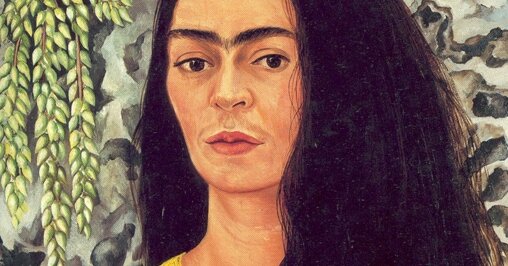
Kahlo paints herself in different guises and states of being — hovering dreamlike and pierced by the pole that went through her in the bus accident, or with her neck encircled by thorns that prick and draw blood.
She also paints the politics of her Mexican identity in still lifes of fruits and traditional relics, and even on the things that physically confined her, like “Hammer and Sickle (and Unborn Baby),” one of the many orthopedic casts she transformed into works of art. Kahlo suffered numerous miscarriages and infertility problems, and here she shows us an unborn child in the womb, curled beneath the international symbol of communism. (She was a lifelong Marxist, and in the 1930s she sheltered the exiled Russian revolutionary Leon Trotsky, with whom she also had an affair.)
In Emin’s work, personal narrative opens a door for others to witness, and perhaps identify with, painful and taboo experiences. At Tate Modern, I saw many people sit through entire video works and stay as they looped back to the beginning. The rooms were packed with rapt viewers for “How It Feels” (1996), a 22-minute piece about a botched abortion, and “Why I Never Became a Dancer” (1995), a short film about the sexist and shaming attitudes Emin encountered as a teenager.
Works like these have led many to describe Emin as a “confessional artist.” But I’ve never heard that label attached to prodigious self-portraitists like Hockney or Rembrandt. “I wasn’t confessing anything at all to anybody,” Emin says in an interview in the exhibition catalog. “I was just trying to unravel everything and work out where it all came from, and why this was this, and why that was that.”
Peculiar, then, that Tate Modern’s website invites us to “step into the tender, confessional world of Tracey Emin.” Clearly, we haven’t found better language to discuss women’s autobiographical work.
Likewise, the museum sometimes seems stuck between the rock of art history and the hard place of social relevance when it comes to Kahlo. Its valiant attempt to give contemporary context to her work is undermined by didactic comparisons and scant political discussions. (One wall-text races through the open market, the North American Free Trade Agreement and L.G.B.T. activism in a single sentence.) The gift shop is overrun with Kahlo-face tchotchkes that diminish her status as icon rather than elevate it.
“She painted what she saw — and the fact that she actually saw these things in her imagination is incredible,” Emin wrote of Kahlo in a 2005 essay, “Frida on My Mind.” “She laid herself on the line about the things she believed in.” Emin could have been writing about herself.
The post Natural Bedfellows: Frida Kahlo’s and Tracey Emin’s Parallel Blockbusters appeared first on New York Times.