Coming from the leader of almost any other major museum, the comments made around the celebration of America’s 250th anniversary by Lonnie G. Bunch III, the head of the Smithsonian Institution, would have seemed almost self-evident truths.
The Smithsonian’s mission, Mr. Bunch told CNN last week, is to “ give you questions and answers that will make you understand the complexity of who we are as a nation” using “the best nonpartisan scholarship we have.” On NBC’s “Meet the Press,” he said the institution was like the glue that holds the nation together. “Red states, blue states — whatever your politics, you come to the Smithsonian,” he said.
But after more than a year of intense pressure from President Trump and his allies over what they term “improper ideology” in the Smithsonian’s presentation of American history and culture, Mr. Bunch’s comments amounted to a public glimpse into a far less diplomatic, behind-the-scenes battle for control of the institution.
The inside story of the fight for control of the Smithsonian underscores how Mr. Trump has tried, with varying degrees of success, to impose his own view of American history, erase “wokeness,” influence which artists are worthy of exhibits and oust top leaders of the institution.
Mr. Bunch spent much of the past year seeking to fend off or mitigate escalating demands from the administration to address what a White House report, issued on Saturday amid the July 4 festivities, characterized as a drive that “has moved the museum’s mission away from straightforward historical education and scholarship toward an extreme political activism that seeks to transform our country.”
The blistering report focused on the Smithsonian’s National Museum of American History. It followed a March 2025 executive order from Mr. Trump, titled “Restoring Truth and Sanity to American History.”
Mr. Bunch, the first Black secretary of the Smithsonian, has largely avoided engaging publicly with Mr. Trump’s criticisms. Without mentioning the president, he told CNN on Friday: “It scares me when people aren’t brave enough to face their history. And in some ways you have to face it anyway.”
Vince Haley, the director of the White House’s domestic policy council, said that “the least we owe our founding fathers is an honest and inspiring account of who they were, what they did and what they built.” The Smithsonian declined to comment.
This account of the backstage battle is drawn from reporting for the book “Regime Change: Inside the Imperial Presidency of Donald Trump,” and is based on documents and interviews with a wide range of people with knowledge of the events, most of whom spoke on the condition of anonymity.
The struggle dates to Mr. Trump’s first term, when he and Mr. Bunch, a historian and museum curator who had overseen the National Museum of African-American History and Culture and had taken over at the Smithsonian in 2019, quickly developed a difficult relationship.
Mr. Bunch described in his 2019 memoir the moment he took the new president on a tour of the African-American history museum in early 2017. Mr. Trump appeared uninterested in the history of slavery in the United States, Mr. Bunch wrote. As they passed an exhibit on the Dutch role in the slave trade, Mr. Trump’s only comment was, “You know, they love me in the Netherlands.”
“I was so disappointed in his response to one of the greatest crimes against humanity in history,” Mr. Bunch wrote.
When Mr. Trump won the 2024 election, Mr. Bunch’s allies knew his criticism of the president could come back to haunt him. But at first glance, Mr. Trump seemed limited in what he could do.
Created by Congress in 1846, the Smithsonian is governed by a Board of Regents, made up of 17 members: The chief justice of the United States serves as chancellor and presiding officer, along with three senators, three members of the House and nine citizen members, plus the vice president. The board structure was designed to insulate the Smithsonian from partisan politics.
But a warning sign came just four days after Mr. Trump’s inauguration last year with the appointment of a new regent — a Trump ally, Representative Carlos Giménez of Florida. Mr. Giménez soon made his presence felt, at the traditional dinner in April that the regents held before the next day’s full board meeting.
Seated two chairs to Mr. Bunch’s left at the dinner in the National Postal Museum on April 6 last year, Mr. Giménez listened as the regents, one by one, expressed support for Mr. Bunch. But when it was Mr. Giménez’s turn to speak, his principal message was: I don’t know you, and so I cannot support you. No one rose to defend Mr. Bunch, a painful point that he would make to some board members afterward.
At the board meeting the next morning, Mr. Giménez posed a seemingly benign question: Was there a process for reviewing exhibits?
The answer was complicated. Potential exhibitions had traditionally been assessed through a committee system, with major decisions finalized by Mr. Bunch and the regents. In recent years, the Smithsonian had developed additional reviews taking into account visitor preferences.
But the institutional sprawl of the Smithsonian — 21 museums, the National Zoo and 14 research and education centers — meant there was no flowchart or standard process.
As Mr. Giménez pressed for details of what filters exhibitions and acquisitions went through, it was apparent that the White House and its allies had found an opening.
Within weeks, Mr. Trump declared on social media that he was firing the director of the National Portrait Gallery, Kim Sajet, calling her “highly partisan” and a “strong supporter of DEI.” It soon became clear that Mr. Trump was unhappy about a photograph of himself in the Portrait Gallery. It was awful, he would say to others. He objected strongly to the text on the wall noting his two impeachments.
On June 2 of last year, Mr. Bunch and the regents, including Vice President JD Vance, hastily gathered for an emergency videoconference meeting. Mr. Trump repeatedly phoned Mr. Bunch during the proceedings, forcing him to step away time and again as Mr. Vance and Mr. Giménez echoed the president’s demand for Ms. Sajet’s ouster.
Mr. Bunch eventually stopped taking Mr. Trump’s calls during the meeting, but nothing was resolved and the matter was postponed to a regular board meeting seven days later.
There, at the Museum of American History, the tables were arranged in a U shape and at the closed end of the U configuration, Mr. Bunch sat with Mr. Vance and Chief Justice John G. Roberts Jr., present in his role as the Smithsonian’s chancellor. The other regents sat along the sides, with Mr. Giménez at one end.
Mr. Vance advised the group that it needed to follow the president’s orders about firing Ms. Sajet, adding that it could not refuse him. “He signs the checks,” the vice president added pointedly.
“This should be an institution for everyone,” Mr. Vance said. “I am not demanding we hire someone with right-wing political views. I am merely asking that we not make the face of this institution a left-wing crazy person.”
Before the meeting, several regents had agreed to pass a resolution stipulating that the president had no standing to make personnel decisions. They wanted to make sure their resolution was put to a vote before Mr. Vance and Mr. Giménez could put forward their resolution calling for the dismissal of Ms. Sajet, who was still showing up for work.
Mr. Vance indicated again that if Ms. Sajet was not dismissed, the White House would explore the option of defunding the Smithsonian. The White House did not have the authority to do that, some regents shot back. John Fahey, the former head of Time Life Inc. and National Geographic, and Senator Gary Peters, Democrat of Michigan, were especially emphatic.
When Mr. Vance argued that the Smithsonian was politicizing the nation’s history, Mr. Peters retorted: You’re coming here threatening to cut off funding to the Smithsonian if we don’t paint the picture you want. That’s politicizing it. Mr. Vance disagreed.
The vice president at one point left the room briefly, leaving Ben Moss, his policy director, in his seat. Mr. Moss pulled up an image on an iPad of the Statue of Liberty depicted as a Black transgender woman holding aloft a lamp filled with flowers. It was a painting by Amy Sherald, a renowned Black artist who had painted Michelle Obama’s official portrait for the Smithsonian. It was set to be included in an exhibition of her work at the National Portrait Gallery in September.
“This image,” Mr. Moss declared, “is also a problem.” He held up the digital image of the painting, “Trans Forming Liberty.” “This,” he said, “is not what Americans want to see. “
A stunned silence descended. Chief Justice Roberts steered the meeting to passage of the resolution affirming the board’s authority over personnel, defusing the crisis over Ms. Sajet for the moment. But four days later, Mr. Trump got what he wanted anyway. Ms. Sajet resigned, explaining in a note to staff that it was “the best way to serve the institution.” On July 23, Ms. Sherald abruptly canceled her exhibition; she said the Smithsonian had privately tried to open the painting up to public debate over trans rights.
A few weeks later, the White House sent a letter to the Smithsonian, outlining a top-to-bottom assessment of everything from wall texts on exhibitions to websites and social media content. Current and future exhibitions would be reviewed with particular focus on the 250th anniversary of the Declaration of Independence.
The Smithsonian Executive Committee scheduled an emergency meeting for the next day. Chief Justice Roberts, Mr. Bunch, the three-person executive committee, senior staff and lawyers were all in attendance.
Mr. Bunch proposed issuing a public letter, making plain that any review was the responsibility of the institution alone. But executive committee members promptly voiced concern that this would pit them all directly against the president and would almost certainly become a political fight with Mr. Trump, one that could damage the Smithsonian.
It became clear that the chief justice, who appeared mindful of taking a long-term approach to protecting the Smithsonian’s interests, shared those concerns. His colleagues thought such a letter in this case would set the chief justice himself against the president, and not on points of law, but on cultural interpretations of how a country should see itself. Mr. Bunch’s proposal was put aside.
Mr. Bunch would tell allies he felt disrespected by Mr. Vance and Mr. Giménez. He was also quietly pressed by supporters either to quit or be more outspoken in opposition to the White House. In the end, he chose a less confrontational approach intended to sidestep the immediate tensions while protecting the institution far beyond Mr. Trump’s tenure in office.
But the White House has been biding its time, too. The board has been missing two members since their terms expired in March. The administration, according to a person with knowledge of the discussions, has been hoping to sway who will be chosen as replacements.
The exhibit that Mr. Bunch went on to curate for the 250th anniversary, titled “American Aspirations,” highlighted American ideals such as liberty, fairness, democracy, hope, defending freedom and progress. The pieces included Martin Luther King Jr.’s “I Have a Dream” speech,” Thomas Jefferson’s writing desk and the astronaut Sally Ride’s flight gear.
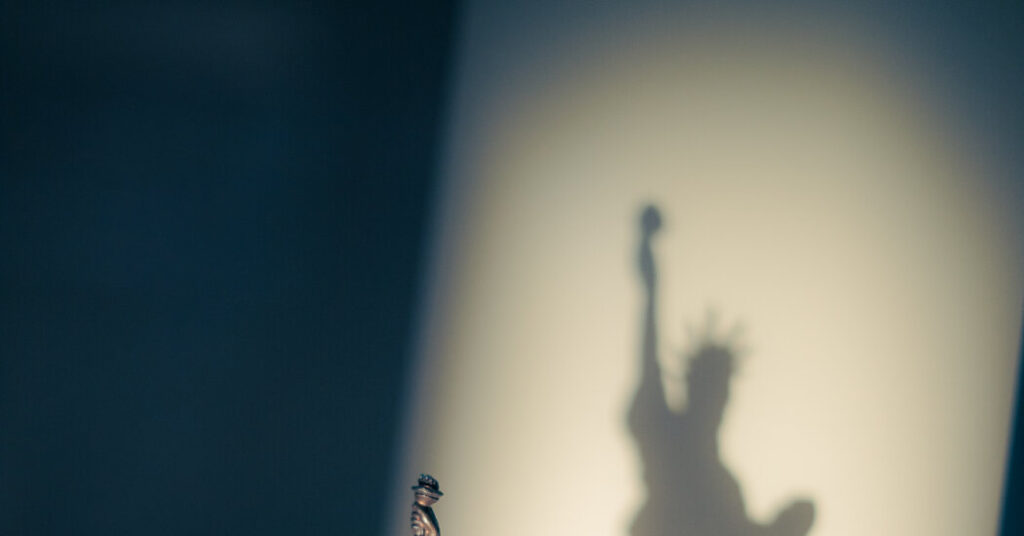
The exhibit includes explicit references to the nation’s history of slavery and inequality: a hymnal used by Harriet Tubman; a reminder that the Statue of Liberty was originally a gift to celebrate America’s end to the brutal practice, with broken chains hidden beneath her robes; and a Plymouth Rock fragment accompanied by words from Malcolm X.
“I love the Smithsonian, and I love thinking creatively about, how do you protect the Smithsonian?” Mr. Bunch said in an interview with The New York Times in May.
“When you’re Black in America, you’ve got to figure out how to get through, right? You’ve got to figure out how to build allies, when to stand firm, when to bang the table,” he said. “So in some ways, all of that prepared me for this moment.”
Robin Pogrebin contributed reporting.
The post Inside Trump’s Ideological Fight With the Smithsonian appeared first on New York Times.