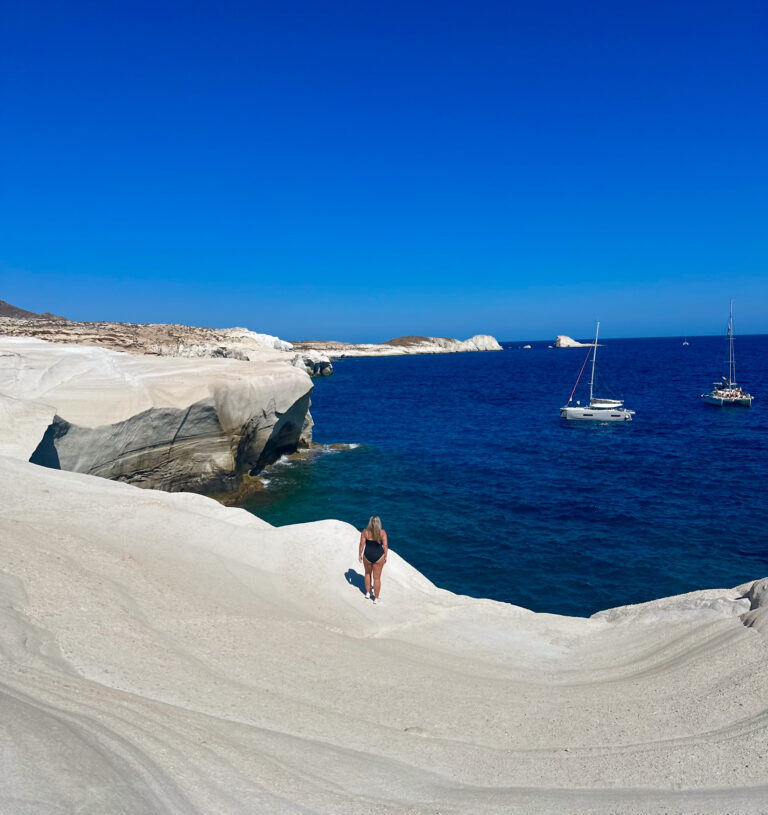
Two years ago, I booked my first solo trip, mid-existential crisis. I had just rung in my 35th birthday home alone, sick with covid. Having spent the last few years white-knuckling through pandemic uncertainty and watching friends disappear into suburbs and parenthood, I realized I couldn’t keep waiting for a partner or a perfectly coordinated girl’s trip to see the world.
Some might say I was late to the game, but if you also live with anxiety, you understand my hesitation. Solo travel can be intimidating — especially for those of us who dabble in worst-case-scenario thinking, decision paralysis and excessive rumination on things we can’t control. Which, as it turns out, is basically everything when you travel.
Two years and five solo trips later, something shifted that I never expected: I’m far less fixated on everything that could go wrong. Uncertainty feels less like a threat and more like the whole point. And I’m actually feeling more excited than anxious in the lead-up to my next trip.
My current theory: Solo travel is a great way to practice all those coping skills you learn in therapy. Here are the two major ones I’ve finessed in the last couple of years.
Letting go of what you can’t control
Anxiety has a way of making worrying feel productive: “If I spend enough time thinking of all that could go wrong, at least I’ll be prepared for it. Maybe I won’t be as disappointed.” But a lot of therapy and solo travel taught me there’s a difference between preparation and rumination.
Preparation is something you can act on, such as picking a longer layover if you’re worried about missing your connection, packing just-in-case antibiotics or hiding AirTags in every crevice of your luggage. Rumination is your mind on a hamster wheel, thinking about the endless combination of things outside of your control that could ruin your trip.
Learning the difference has helped me call out those unproductive thought spirals when they happen.
It’s also helpful to remember that most of the things I spent weeks worrying about never actually happened. And plenty of things have gone wrong that I never could have anticipated. Worrying was never going to affect the outcome, but it can absolutely ruin the vibe before the trip even starts.
Trusting yourself to handle the unexpected
A key feature of anxiety is having a low tolerance for uncertainty. It’s deeply uncomfortable to not be in control of what’s going to happen next.
Traveling is basically exposure therapy for uncertainty. You can’t control the outcome. You can’t even fully control the journey — where your bag ends up, how long the security line will be, whether the person next to you will be coughing for the next nine hours. When you’re prone to worrying like me, these endless “what ifs” can feel paralyzing.
But there’s something about figuring it out on your own — pivoting your whole itinerary around an Italian train strike or navigating the beautiful chaos of Greek ferries solo — that reminds you that you can do hard things. The more confidence you have in your ability to handle uncertainty, the less scary it becomes.
I’m not saying to go looking for chaos. But when things inevitably go sideways, it helps me to reframe it as further proof that I can handle setbacks and still enjoy the trip.
My advice for reducing anxiety around travel
When I think back on the last five solo trips, my only regret is not doing this sooner. If you’re on the fence, here are a few things that might help alleviate your anxiety about it:
Consider solo-ish travel first. This is my biggest tip for anyone who doesn’t know where to start. A small group tour lets someone else handle the planning while you get the experience of navigating something new — surrounded by like-minded people who also got tired of waiting for everyone’s schedules and budgets to align. I’ve had great experiences with For the Love of Travel: small groups, well-designed itineraries with enough free time to actually breathe, and guides who feel like the designated responsible friend who also happens to know all the best spots. Another great way to dip your toes into solo travel: Tack on a few solo days to an existing trip, like a work conference or a friends getaway.
Always spring for travel insurance. I have health anxiety, so my biggest fear is getting sick before a trip and watching the whole thing unravel. Travel insurance doesn’t eliminate that anxiety, but it does take the edge off, knowing that if the worst actually happened, I could at least rebook. I suggest skipping the upcharge offered by your airline or hotel and opting for one comprehensive policy that covers things such as illness, lost bags and the cascade of expenses that aren’t refundable if your flight gets canceled at the last minute (airport pickup, hotel, ferry, tours). I usually compare options on TravelInsurance.com and end up somewhere between $150 and $250 for a full trip.
Keep your coping skills close. There will be moments — a delayed flight, a missed connection, a low-mood afternoon in a foreign city — where you’ll probably feel lonely and frustrated that you don’t have someone to turn to for support. That said, I’ve also stood in airports watching couples and families turn on each other “White Lotus”-style at the end of a long trip, very grateful that the only emotions I’m currently responsible for are my own. My advice is to plan ahead for both scenarios. My go-tos: breathing exercises when anxiety spikes, a cold drink pressed to my wrists when I’m overheated, noise-canceling headphones when I’m overstimulated, comfort movies downloaded when the WiFi fails you and the mental reminder I always come back to: you can do hard things.
When in doubt, plan a side quest. Making the jump from solo-ish to fully solo travel was intimidating. You have no one to answer to on the trip but yourself, which will either feel liberating or so overwhelming that you don’t know what to do with yourself. My advice is to avoid making a whole itinerary for one, and instead pick one side quest per day: the bookstore you saw on TikTok, a farmers market, a specific neighborhood to wander. This gives you a loose purpose and direction for the day while still allowing you to explore and see where you end up.
I’m still someone who needs eyes on my passport every hour or so on travel days. Some things never change. But my relationship with uncertainty has. My whole life, my anxiety made me believe that the unknown was something to brace for.
Now, it’s starting to feel like something worth seeking out.
The post I started traveling solo at 35. It’s done wonders for my anxiety. appeared first on Washington Post.