When a giant earthquake struck Haiti in 2010, the United States mounted an enormous relief effort involving more than $3 billion in aid, 7,000 U.S. troops on the ground and a halt to deportations of Haitians to their devastated country.
That response dwarfs what the United States has promised for earthquake-ravaged Venezuela, a country the Trump administration says it is now running after seizing its leader this year. So far, the U.S. has put forward $300 million, deployed a much smaller force of about 900 U.S. military personnel and not announced a halt to deportations of Venezuelans.
I was one of the first reporters on the ground in Haiti’s capital, Port-au-Prince, in 2010. Big differences mark the disasters: Haiti is poorer than Venezuela, its earthquake death toll appears to have been far higher and, perhaps most important of all, the U.S. approach to the world has fundamentally changed.
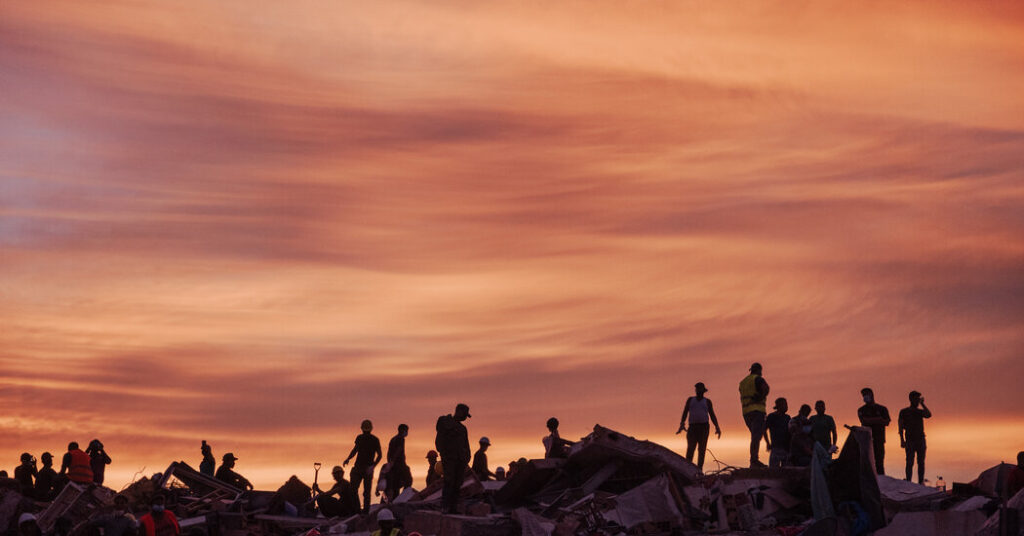
But the parallels between the disasters are also haunting: Pancaked multistory concrete buildings, bodies flooding into overwhelmed morgues, survivors disparaging government responses, and civilians leading desperate rescues of people trapped in the rubble.
Viewed against cityscapes clouded by dust from pulverized structures, the images speak to hollowed-out first-responder agencies, generalized impoverishment and political dysfunction in both Haiti and Venezuela.
But in the years since the United States led an international effort to help Haiti, Trump officials have expressed disdain for foreign aid. They have gutted the U.S. Agency for International Development, the main U.S. agency for distributing foreign aid, and slashed assistance to poorer countries.
At the same time, crisis-plagued Venezuela has gone from being one of Latin America’s largest aid donors to itself requiring large amounts of aid. In 2010, Venezuela was among Haiti’s main donors, providing food, medicine, emergency oil shipments and debt relief.
Before Venezuela’s economy collapsed a decade ago, its socialist leaders framed such aid as a political counterweight to U.S. policy, which blended earthquake recovery with nation-building efforts, channeling most assistance through U.S.A.I.D.
In Venezuela, the Trump administration is now prioritizing immediate search-and-rescue operations and political stability in a country it views as an oil-rich client state where U.S. energy companies can make fortunes.
After raiding Venezuela’s capital and seizing its authoritarian president in January, Mr. Trump said that he was taking control of Venezuela’s oil. Since then, American officials have said they are overseeing billions in Venezuelan oil sales.
The question is, how much of that money will be used to help quake survivors and rebuild Venezuela now that large parts of the country lie in ruins?
Having dismantled U.S.A.I.D. last year, the U.S. authorities are now channeling the $300 million in assistance announced so far through groups like the Red Cross, religious organizations and the United Nations. This U.S. funding accounts for the bulk of global relief efforts, with the European Union and countries like Australia offering much smaller amounts.
John Barrett, the top U.S. diplomat in Venezuela, said last week that the United States expected to remain engaged in Venezuela’s recovery for as long as necessary, with shelter, debris removal, running water and electricity generation the immediate priorities.
But Mr. Barrett also said that the Trump administration’s broader strategy for Venezuela — prioritizing political stability and using Venezuela’s own oil revenues to finance an economic recovery — remained unchanged despite the disaster.
“Reconstruction looks a little bit different, of course, since the devastating earthquake,” Mr. Barrett told reporters while emphasizing that the destruction did not damage Venezuela’s oil industry. “So that production continues, and that continues to increase with the investments that the United States and private enterprise from around the world had already begun to initiate.”
Still, doubts have emerged as to whether the U.S. aid for Venezuela is anywhere close to what the country will need to rebuild. The U.S. Geological Survey has estimated that losses from the earthquakes could reach well into the billions of dollars.
But the amount of recovery aid the Trump administration has announced is just a fraction of the estimated $8 billion in revenues from oil exports it has taken out of Venezuela since the United States deposed the country’s ruler, Nicolás Maduro, in January.
The Trump administration has framed the U.S. control over Venezuela as benefiting both countries. But it has refused to disclose precisely how much revenue it has collected by selling Venezuelan oil or even how it is using these funds.
President Trump has said Venezuelans were happy because of all the money from the new trade between the two countries. But even before the quakes, many Venezuelans were already complaining that life was just as hard as it was before the United States toppled Mr. Maduro — with regular blackouts, a weakening currency and rising prices.
Javier Corrales, a professor of political science at Amherst College, said it would be hard to describe as generous the $300 million in U.S. earthquake aid when the United States controls revenues from Venezuela’s oil industry worth many times more.
“This fits into the prevailing impulse that the United States is going to be helping countries as long as it profits more than others are profiting from the United States,” Mr. Corrales said.
Still, Haiti’s experience showed that bigger isn’t alway better when it comes to disaster aid.
After the earthquake in 2010, U.S. recovery projects included building a power plant and new government buildings, upgrading a port and developing a national police force.
But most infrastructure projects overseen by U.S.A.I.D. were delayed, cost more than planned or had to be scaled back, the U.S. Government Accountability Office found years later. In one case, the agency had planned to build 4,000 houses but completed only 906 because of higher-than-expected building costs.
The huge influx of foreign aid, about $13 billion in total, provided a lifeline but let corruption and political dysfunction go unchecked, leaving Haiti’s government with few incentives to carry out the institutional transformations necessary to rebuild.
Even worse, United Nations peacekeepers in Haiti played a role in a cholera outbreak following the earthquake that left 10,000 people dead.
“The magnitude of that disaster and the magnitude of the failure in the response to it have fed into the anti-aid sentiment we’re seeing today,” said Jake Johnston, a the director of international research for the Center for Economic and Policy Research in Washington.
During his first campaign in 2016, Mr. Trump homed in on the controversies swirling around the Haiti aid by accusing Bill and Hillary Clinton of profiting from the relief efforts. Mr. Clinton, the former U.S. president, was a U.N. special envoy for Haiti, coordinating international aid efforts; Ms. Clinton was secretary of state and running for president that year. Both of them rejected those claims.
“I think people now look back on seeing the state that Haiti is in today, in 2026, and they argue that was not money well spent for the U.S. taxpayer,” said Kenneth Merten, the U.S. ambassador to Haiti at the time of the 2010 earthquake.
“But I would argue that in terms of saving lives and providing shelter, food, and water for people, it was really a very well-run operation by us and our partners,” Mr. Merten added.
As Venezuelans now sift through the rubble of their own disaster, the long tail of what happened in Haiti is still casting a shadow over the relief efforts, said Sam Vigersky, a former U.S.A.I.D. official who led the agency’s disaster assistance response teams and is now an international affairs fellow at the Council on Foreign Relations.
At the time of the Haiti earthquake, “the United States was everywhere, every time, all at once, in terms of how they approached humanitarian aid globally,” Mr. Vigersky said.
By contrast, Mr. Vigersky said, the Trump administration was taking more of an “à la carte approach where humanitarian relief is being directly tied to statecraft.”
Today, he pointed out, there are countries like Somalia, Afghanistan and Yemen with food insecurity and deep humanitarian crises where the United States has made sweeping aid cuts.
In Venezuela’s case, the country matters to Trump officials for various reasons: it is a neighbor in the Western Hemisphere, has some of the world’s largest oil reserves and is currently serving as a test case in which the United States installs a pliant leader at the helm without pursuing overall regime change.
Genevieve Glatsky and Eric Schmitt contributed reporting.
The post From Haiti to Venezuela, Quakes Reveal Shift in U.S. Relief Efforts appeared first on New York Times.