MEN IN LOVE, by Irvine Welsh
Between the book, the play, the films, the prequel, the sequels and the cameo vehicles, not to mention the upcoming musical, “Trainspotting” has evolved from mere literary sensation into a one-man global franchise for its prodigiously gifted author, Irvine Welsh. “Men in Love,” the third sequel to date (though chronologically the first), maintains the brand’s mostly high standards, though delicate readers may find it a little too sulfurous for their liking, and even enthusiasts will probably wonder if, at over 500 pages, it isn’t a touch too long.
Set in the late 1980s and early ’90s, it takes up the story from the last pages of “Trainspotting,” where the protagonist, Mark Renton, absconds with the loot from a heroin deal, betraying his old Edinburgh crew in order to build a better life for himself in Amsterdam. The new book intermittently traces Renton’s quest for personal growth in the budding rave scene of his adopted city, but aside from being the object of vengeful fantasies among the mates he ripped off, he is no longer the central figure. The focus here is on those mates, principally the shamelessly manipulative Lothario and aspiring pornographer Simon Williamson, better known as Sick Boy.
At a rehab session (which he attends strictly to advance his various predatory endeavors), Sick Boy meets Amanda, or rather Amanda Genevieve Coningsby, the rebel daughter of a posh family with a grand house on the Thames. Despite her obliviousness to Sick Boy’s scheming, Amanda turns out to be more than a match for him, and to his amazement he finds himself falling in love.
Something similar happens to Renton in Amsterdam (hence the book’s Lawrentian title) but whereas Renton embraces the vulnerability of the condition, Sick Boy strives to maintain the upper hand. A jaunt to Paris for some remedial infidelity, however, fails to dislodge the unaccustomed feeling, and after 18 months without any dimming of ardor (“not even a whiff of hole-complacency,” as Sick Boy tastefully puts it), the sworn rake decides to make a strategic concession to romance. He will propose marriage and thereby take a win for his social ambitions (almost as keen as his sexual ones), with the added bonus of sticking it to Amanda’s snobbishly horrified parents.
If this sounds like an updated Victorian melodrama, that’s because (as Amanda’s surname indicates) it is at some level a travesty of Benjamin Disraeli’s classic novel of arrivistes and toffs, “Coningsby.” The difference here is the reductive perspective Welsh applies to all sides. His caricaturing can be very funny, shrewdly nailing the precise cultural, material and libidinal interests operating at any given moment, but it’s hard to care very much about which of his equally unlovable parties is going to end up in command of Cantley Lodge.
What keeps the book interesting (and saves it from turning into generic British class comedy) is mainly the appearance of the other two members of the old crew, Francis Begbie and Daniel Murphy, or Spud. Begbie and Spud are surely two of the greatest comic creations of any writer in recent memory. In fact, they don’t seem “written” so much as summoned, surging into the narrative like a pair of archetypes from some fantastical Nordic cosmology.
Begbie the psycho: a rampaging battle-god in the mortal guise of a low-level street thug, permanently primed for violence and yet perversely endearing, if only for his delusionally high self-regard and magnificent pettiness. (Among the murderous feuds he pursues through these pages is one that originated with his rival leaving the top off a toothpaste tube.) Spud the patron saint of sweet-natured losers everywhere: a sneak thief sabotaged by his own decency (there’s a wonderful sequence in which he steals an old lady’s purse and then, worried she’ll be unable to pay her electricity bill and freeze to death, tries to give it back to her). He is too wounded by life to succeed in love or keep off drugs, and yet invincibly alert and curious, snatching at any crumb of opportunity to nourish his obstinately inquisitive mind.
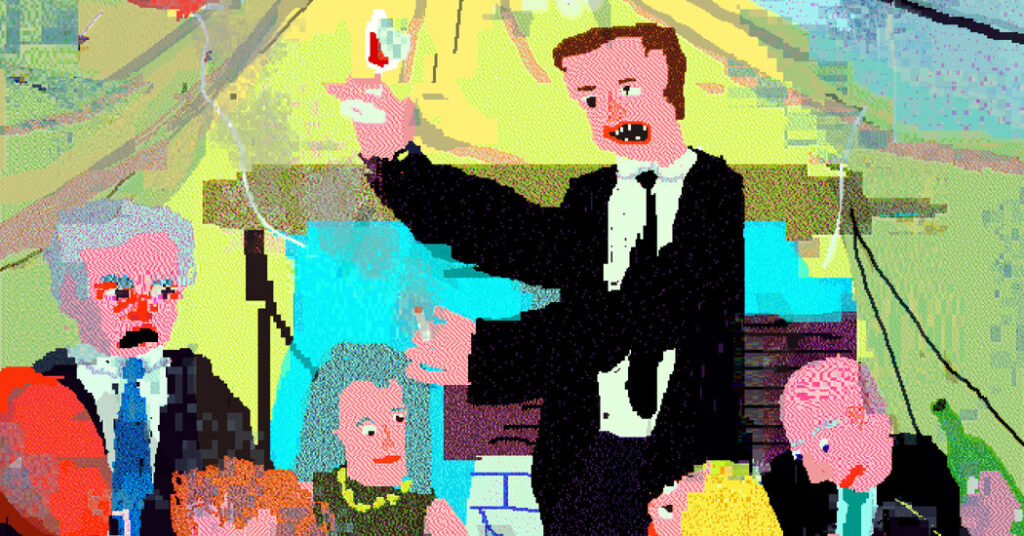
As terrifying to his friends as he is to his enemies, Begbie erupts back into Sick Boy’s life when the two meet in their old neighborhood of Leith. Sick Boy has unwisely been pranking the homophobic Begbie by anonymously sending him gay porn in prison. In a panicked attempt to deflect suspicion, he invites him to be best man at his wedding. The ruse, typical of Sick Boy’s short-term cunning, more or less guarantees long-term disaster. In due course Begbie’s descent on the nuptials sets in motion the kind of black farce at which Welsh excels, turning the decorous Thames-side reception into a fiasco of foul-mouthed speechmaking and Berserker-level bodily mayhem.
Begbie and Spud, like most of Welsh’s characters, are voiced rather than described, coming to life through dialogue and interior monologue, each with his own very specific Scots/English idiolect. With these two in particular the Lothian slang is fairly hard-core, which at first sight might be daunting for an American reader. But its stinging expressiveness is an essential part of the characters’ vitality, and it inducts you quickly into the meaning of its “radges,” “gadges,” “peeves” and so on.
Here, for a taste, is Spud reflecting on the enviable high-mindedness of London students compared with his own cohort: “They cats must have a barry life, likesay, tae be able tae jist sit around n discuss things, real things, aboot life. How is it wir here? Whaire dae wi go when wi die? Does God exist? … No like, whae’s been shaggin whae? Whae’s chibbed whaes brar? Whae got pished last night?”
“Trainspotting” articulated the energies of an entire culture seething under the Thatcherite ice of 1980s Britain. “Men in Love” doesn’t aim so high, and its centering of Sick Boy, with his “essentially transactional” worldview unaltered even by love, both narrows and skews its vision. Imagine “Lear” rewritten from the point of view of the bastard Edmund, whose own ruthless transactionality set the terms for this particular type. It makes for a cynically entertaining ride, but it leaves you feeling a bit battered.
MEN IN LOVE | By James Lasdun | Pegasus | 536 pp. | $29.95
The post Are the Lads in ‘Trainspotting’ Ready to Settle Down? appeared first on New York Times.