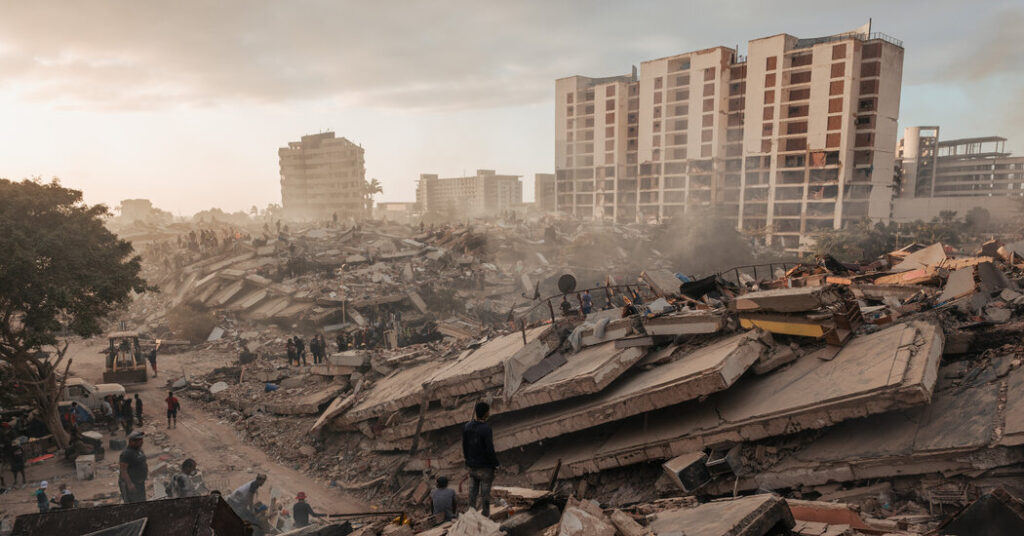
The soaring high rises between the mountain and the sea were a deliberate statement, built by Venezuela’s socialist president, Hugo Chávez, as a promise to house the poor in dignity.
But now, as residents claw through the rubble of the buildings after back-to-back earthquakes, many have turned their anger toward the government, accusing it of building shoddy apartments for political gain.
When the earthquakes ripped across Venezuela’s northern coast last month, public housing in the state of La Guaira, a gateway to Caracas, the capital, became some of the densest pockets of death.
Massive buildings, home to thousands of people, crashed to the ground, leaving valleys of dust and destruction. Town homes in a sprawling complex named for Mr. Chávez crumbled like toy houses. Some burst into flames.
The devastation has raised questions about the government’s role in the loss of so many lives in structures that building experts had been warned for years could not withstand a major earthquake.
Construction experts who know La Guaira have revived long-running concerns about the terrain the complexes were built on, the quality of their materials and the integrity of their design. Plans for the buildings began in 2011, just ahead of an election, and construction proceeded hastily, with design details and information about soil tests largely withheld from the public.
In 2017, Enzo Betancourt, then president of the Venezuela College of Engineers, called the structural integrity of the government-built units “a state secret.”
Two days after the quakes hit, Juan Manuel Chirinos stood at the edge of a collapsed tower at one housing unit, looking for his son, also called Juan Manuel, 32. All around him, people were hammering away at the rubble, desperately trying to find signs of life.
“These people weren’t killed by the disaster,” said Mr. Chirinos, who was also searching for his son’s wife and their two children. “They were killed by the government because they built these buildings like garbage.”
The apartments were built under a state program named Misión Vivienda. It was a showcase piece of Mr. Chávez’s revolution, meant to “break the capitalist logic that commodified the home,” according to a state website.
The Venezuelan government, now run by Delcy Rodríguez, a leading figure in Mr. Chávez’s movement, says that more than 5.5 million homes were built, with more in the works.
“Beyond the number of homes,” says the site, “it is about quality.”
In La Guaira, where some buildings are now marked in red paint for demolition, Misión Vivienda buildings are far from the only apartments to have fallen. Homes built by private contractors for the wealthy and middle class, with names like Coral Beach and Coral Mar, also crashed to the ground, killing many and raising questions about their integrity.
A representative of Ms. Rodriguez’s government declined to respond to questions about the Misión Vivienda buildings. At a news conference on Thursday, Ms. Rodríguez said that the majority of the buildings that collapsed in La Guaira had not been built by the state.
But the Misión Vivienda complexes stand out because of the extensive amount of destruction in an enormous public-works project that had been a source of concern for years. There were hundreds of apartments in the badly damaged concrete complexes known as OPPE 25, OPPE 26, OPPE 27 and OPPE 33 and roughly 2,500 in the battered Hugo Chávez development. In many cases, large extended families with deep political ties to Mr. Chávez inhabited a single apartment.
The Misión Vivienda buildings that fell in La Guaira were built at a time of state largess, when Venezuela was still relatively flush with oil money. Yet, for more than a decade before the quakes, residents, seismologists and watchdog groups publicized cracks in the walls, problems with safely installing gas lines, and the risk of collapse in the case of an earthquake. In other parts of the country, Misión Vivienda buildings were so poorly constructed they had to be destroyed years ago.
Many were built by foreign companies with opaque contracts, raising questions about whether designs and materials had been adapted to fit the region’s geographic vulnerabilities.
“There was no technical interest there,” said Guillermo Rivas, the owner of a construction company who has worked in La Guaira for more than 40 years. “The interest there was populism.”
Juan Manuel Chirinos, the missing son, had moved into a Misión Vivienda apartment just four days before the temblors. But many others had lived in public housing complexes for years, and had been given their homes as a reward for their loyalty to Mr. Chávez.
Now these buildings are scenes of chaotic searches and desperate calls for more help from the state.
“We have no tools,” said Willy Bermúdez, 38, a police officer who had lived in OPPE 26 for 13 years. “We’re scraping by with our fingernails.”
On Tuesday, sitting in the rubble of his building, he said he had spent nearly a week digging for his wife and their two boys before finding his family’s furniture and his son’s middle school diploma. Then, from below, he heard “cries and taps,” he said.
That night, rescuers — a mix of paramedics, firefighters and volunteers with no clear command structure — were trying to dig a tunnel toward the noises.
Mr. Bermúdez cried as he spoke. The operation went long into the night. And the next day, he sent a text message: “My entire family died.”
Mr. Bermúdez lived in Tower G of the OPPE 26 complex. Next door, Tower F is damaged but still standing.
The picture was much the same in the Hugo Chávez development — some of the low-slung buildings with blue vinyl siding crumbled completely. Others, while now uninhabitable, merely buckled and leaned. It will take time to understand why this happened.
Mario Lieghio, the president of La Guaira’s construction chamber, said that the state’s enviable position between the mountain and the sea also made it vulnerable to disaster, as silt from the mountain accumulates and softens the earth. While building in La Guaira is possible, he said, it must be done carefully, with detailed soil studies, deep foundations if necessary and materials and designs that can resist quakes.
On Wednesday, he drove through the Hugo Chávez development, pointing to the mountains of flimsy metal and particle board that were used to build the apartments.
“This has to be a lesson,” he said, “a truly gigantic lesson.”
The state had hired a Turkish company, Summa, to build the complex.
“Those people finished a building in less than a week,” said José Luis Sarmiento, a union leader and a construction worker who helped build the Hugo Chávez complex. “We were doing well because we went fast.”
The Turkish firm did not respond to a request for comment.
Burak Pelenk, an architect who worked on the Hugo Chávez project, helping to secure building approvals, said that he believed the project was designed with earthquakes in mind.
“In Turkey we have experience with earthquakes,” he said in a text message.
“The problem could stem — I am an architect, not an engineer — from flawed soil analysis or the foundation.”
Just blocks from the Hugo Chávez buildings, the sea sparkled. Some of the development’s residents had relocated to a nearby baseball field, where they had been sleeping in tents.
In other public housing complexes, the search for survivors and the vigil for the dead continued.
In the remains of the rubble, Mr. Chirinos told his wife that he had watched rescuers recover what appeared to be the bodies of a family of four — possibly his son, his son’s wife and their boys, 8 and 11.
“I saw them,” he said. “They brought them out. They were embracing each other.”
But officials had taken the bodies away, he added, and would not tell him where they were going.
Amid the broken concrete at OPPE 26, Oswaldo Tovar, 45, had used a small hammer to find his wife and 8-year-old daughter.
By the time he reached them, they were dead.
At the same development, María de los Ángeles Sevilla, 59, said that she was convinced her missing daughter, Yorlin, was alive: “A mother can feel it in her body. I feel my daughter is alive.”
Days later, Yorlin was also found dead, as were two grandchildren, including an 11-month-old baby.
At the OPPE 27 complex, Sergio Castillo, 28, spent three days digging for his cousin, Diego Tovar, 16.
“He never abandoned his cousin,” said Diego’s mother, Milagros Hernández, 43.
On Tuesday, Mr. Castillo emerged from the rubble drenched in sweat, carrying Diego’s body.
It was late at night, and he hugged his aunt, her body lit by his headlamp.
“They built this all wrong,” Mr. Castillo said. “This shouldn’t have been here; they shouldn’t have put us here.”
Sheyla Urdaneta contributed reporting. Drone piloting by Andres Conde.
The post Venezuelans Warned That Public Housing Towers Might Crumble in a Quake appeared first on New York Times.