Plates of oysters, prawns and sushi sat on Ashwin Reynolds’s table. A singer performed soothing R&B, bartenders poured sparkling wine, and the guests in this suite at a horse racing track wore fitted suits and fancy floral headpieces.
As a child who used to record horse racing bets for his grandfather, Mr. Reynolds, who is 52 and owns a construction company, never could have imagined enjoying such opulence at a racetrack in Durban. Until South Africa’s apartheid system was dismantled in the early 1990s, people of color like him were barred from such elite spaces.
But there he was on Saturday, alongside a racially diverse crowd at Durban July, the most lucrative horse racing event in Africa. In 2021, he became the first person of color to own the horse that won the main race.
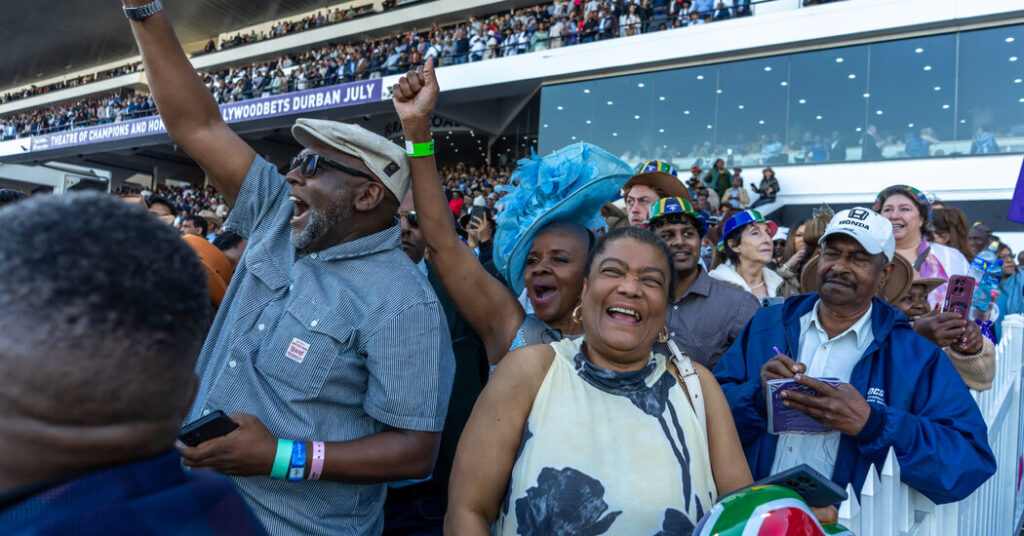
This year is the 130th running of the Durban July horse races, in this sprawling city on South Africa’s south coast. The daylong event has become about much more than racing. The music, fashion, food and ostentatious displays of wealth make it possible to briefly forget the economic and social hardship that continues to define life for many South Africans.
More than a dozen V.I.P. tents, known as marquees, sprawl across the grassy infield of the 2,800-meter, pear-shaped track. The marquees charge hundreds of dollars to book a table offering sleek banquettes, bottle service and buffets. Some marquees become hubs for networking, gathering people from particular industries like fashion, music and politics. Up-and-coming artists may rub elbows with an established producer; entrepreneurs seeking government contracts may try to butter up politicians.
Each year, attendees are encouraged to dress to a theme. This year’s was “country allure.”
Many Black attendees see Durban July as a celebration of their place in high society in a country where, for hundreds of years, they were robbed of resources and prevented from building wealth.
This is no longer “just a white man’s event,” said Teddy Geldart, a South African television producer, sporting a white feathery top as he lounged on a sofa in a marquee where the American R&B singer Bryson Tiller was the headline act.
“It’s now ours,” Mr. Geldart, 40, added. “That’s a great feeling, that we can enjoy luxury in our own country.”
During apartheid, nonwhite spectators were allowed to attend Durban July, but they were confined to a small section of the grandstand known as the silver ring, said Anita Akal, 83, who was in her 55th year photographing the event. White guests sat in the gold ring, near the finish line.
But spectators at that time could still move around and mingle across racial lines, an uncommon display for the apartheid era, said David Thiselton, a South African horse racing journalist who has been attending since 1990.
Today, the grandstands mostly attract those interested in horse racing, who buy an $18 ticket and don’t necessarily wear the same elaborate outfits as those who come to party. Many in the grandstand crowd are South Africans of Indian descent, a community in which horse racing is wildly popular. Behind the grandstands, inside the ring where the horses parade before races, most people are white; they still own most of the horses. The V.I.P. hospitality areas in the infield tend to be mostly Black.
“It’s an event that everybody leaves everything behind for this day — the racial tension, the bickering, the fights that we have,” said Vishal Ramlakan, a 50-year-old from Durban who works in trucking and was attending for the third time.
Muzi Yeni, 39, said he was pleased that more Black people were attending Durban July than in previous years, but he wished that more of them were interested in the racing. Mr. Yeni, a jockey for 22 years, is one of a handful of Black jockeys at Durban July. Diversification of the ranks of jockeys has been slow, he said, in part because most trainers are white and they may not always give Black jockeys a chance.
Three Black jockeys have won Durban July’s main race, and Mr. Yeni said he hoped to add his name to that list to show other Black riders that they could do it, too. (Mr. Yeni finished seventh in Saturday’s race.)
One Black attendee who came for the racing was Doris Mataboge, 55, attending for the fifth time. She grew up in a rural area and developed a love for horses from seeing them in the fields. Ms. Mataboge, who teaches nursing, said she bet about $1.85 and, for the first time, won, getting just under $10 after the horse she backed was victorious.
Before the races started, the crowd focused its attention on a group of models.
One of them, Karabo Bapela, 18, said the event is helping her gain confidence.
“We’re not that good yet,” she said.
And she does not take the opportunity for granted.
“It’s very freeing to be able to do this,” she said, “knowing that our grandmothers, back in the day, couldn’t go out in public or hang out with people of a different color.”
The post The Main Attraction at Africa’s Most Lucrative Horse Race? Black Wealth. appeared first on New York Times.