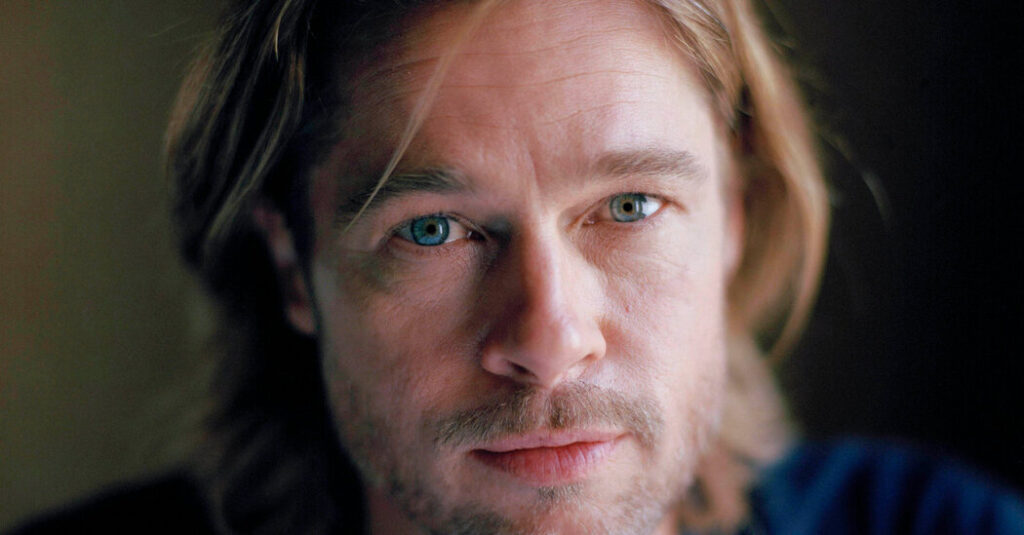
THE FACE: A Cultural History, by Fay Bound-Alberti
From a young age my son demonstrated a keen ability for facial recall. As we watched movies and television shows, he might blurt out — at seeing Ray Milland guest-star as a murderous botanist in a “Columbo” episode — that the same actor had played a villainous husband in “Dial M for Murder,” released two decades earlier, and which we’d watched more than a year prior. But actors making vanishingly brief cameos left equally striking impressions.
According to Fay Bound-Alberti, a professor of modern history at King’s College in London, the 2 percent of the population who possess this skill, one that apparently cannot be taught, are known as “super recognizers,” a term coined by Harvard researchers.
As we learn in “The Face,” a cultural unpacking of our most scrutinized organ, another 2 percent, on the other side of the bell curve, manage prosopagnosia — or face blindness — a condition that makes remembering faces and the identities attached to them a persistent challenge. Bound-Alberti counts herself among the affected (so does Brad Pitt). Once, she failed to recognize her own daughter in a nursery school classroom.
Though the social fallout of living with this sort of limitation is surely not negligible, Bound-Alberti refrains from lingering on the tarmac of the affliction memoir. Her interests residing outside her own neurology, she has produced an ambitious, entertaining survey of human perception: how we consume images of ourselves and one another and how that process has evolved over thousands of years via art technology, medicine, psychology and bureaucracy.
Along the way, the book chronicles many relevant firsts. The beginning of facial surveillance in this country can be traced to the mandate for passport photographs, implemented in 1914 in response to World War I. For more than a decade Americans could supply a casual snapshot of themselves; by 1926, the government insisted on the now-familiar headshots in which all identifying features are visible.
But it is aesthetics and self-objectification that trouble and compel the writer. Before we had commerce (and by extension advertising) telling us how to evaluate ourselves, we had art. Bound-Alberti starts at the very beginning, with the 25,000-year-old Venus of Brassempouy, a sculpture usually thought to be the first depiction of a human face. Carved from mammoth tusks and presumed by archaeologists to be female, the face presents without a mouth — as if to presage the next many several thousand millenniums of silenced womanhood.
Renaissance painting brought expressiveness to portraiture and the idea that faces rendered on a canvas were no longer mere representations of personal status or power but could convey the essence of an individual — which, in turn, helped to feed the rise of assumptions and prejudices based on appearance.
In terms of superficial fixations, however, the most profound development may have been the mainstream availability of mirrors. Before the 17th century, most people’s own faces were likely foreign to them. “What did it mean to an individual’s sense of self or self-consciousness,” Bound-Alberti asks, “that they saw their face infrequently if at all?”
An entire book might be devoted to answering this question. The trouble with analytic histories that situate themselves across all recorded time is that a unifying argument can seem elusive — or, conversely, all too obvious. But here the richness of the research more than compensates for whatever rhetorical weaknesses.
Bound-Alberti arrives at the project with a particular set of concerns. To cite one, she is an expert in the ethics of face transplants, and the final chapters of her book outline worries about the dubious promises of a surgery undertaken by those who have suffered severe disfigurement.
Bound-Alberti asks us to question “the very premise of facehood,” the “idea that our faces are who we are,” a conceit largely of her own derivation. In turn, she cautions a resistance to any impulse toward cosmetic surgery and photo filters and recommends that we “work to create a world that values human worth beyond appearance.” But have the prospects for such a utopia ever seemed so grim?
According to the American Society of Plastic Surgeons, roughly 79,000 face lifts and more than 27,000,000 procedures involving fillers, Botox, lasers or dermabrasions were performed in this country in 2024. Social media directs young women toward a specifically pillow-lipped, pert-nosed geometry; the proliferation of such uniform standards will presumably one day challenge even the most gifted super recognizers. If anything, we are moving toward a world where more and more of us will identify as face blind, unable to determine whose stretched, perfectly flushed skin belongs to whom.
Sometime between 85 and 43 B.C., the Roman writer Publilius Syrus arrived at a judgment that would gain traction never. In a poetic phrasing, he called a beautiful face a “mute recommendation.” Alas, no one told Instagram.
THE FACE: A Cultural History | By Fay Bound-Alberti | Grand Central | 255 pp. | $27.99
The post Did Mirrors Ruin the World? appeared first on New York Times.