Victoria Cruz, a matriarchal figure in the New York transgender community who was at the Stonewall Inn in 1969 when a police raid set in motion the gay liberation movement, and who later worked as an advocate for survivors of anti-trans violence, died on June 25 in Manhattan. She was 79.
Her partner, Charles Wright, confirmed the death, in a hospital, and said the cause was liver cancer.
Ms. Cruz spent 17 years working for the New York City Anti-Violence Project, which provides counseling and other services for L.G.B.T.Q. and H.I.V.-affected survivors of violence. There, she focused on domestic abuse, but her role in the organization — and in the community — extended far beyond her official duties.
She understood the intersectional threats that trans people faced in areas like housing discrimination and workplace harassment — expertise that made her a unique resource to thousands of trans New Yorkers.
“People would come into the office and just ask for Miss Vicky,” Catherine Shugrue-Dos Santos, a former deputy executive director at the organization, said in an interview. “They wouldn’t give their names; they wouldn’t talk to anybody else. She really had the trust of the community.”
She was especially effective because she came to the group as a survivor herself: In 1996, while working at a nursing home in Brooklyn, she was repeatedly harassed and assaulted by four co-workers.
“I was very angry. Very angry,” she told Vanity Fair in 2017. “The worst part of it is that I couldn’t feel the ground beneath me.”
One day she brought a knife to work, intent on fighting back, but then thought better of it. A friend suggested she contact the Anti-Violence Project, which at the time was run by Christine Quinn, who later became the first female and first openly gay speaker of the New York City Council.
The group helped her file police reports and led protests outside the nursing home. Eventually, two of the four co-workers were convicted of harassment — one of the first times that someone was held legally accountable for anti-trans violence in New York State.
Ms. Quinn brought Ms. Cruz on as a volunteer, then hired her to manage the front desk. The job also had her answering the organization’s hotline, a task that connected Ms. Cruz with countless at-risk New Yorkers.
“She was perhaps the strongest person I have ever met,” Ms. Quinn said in an interview. “She was part of the birth of the modern L.G.B.T. rights movement in New York, and therefore across the country. She was someone who had survived a terrible sexual assault and transformed that horrible moment into beacon-like strength that you felt whenever you were around her.”
Ms. Cruz was a central figure in David France’s 2017 documentary, “The Death and Life of Marsha P. Johnson,” about the 1992 death of a trans activist that police ruled a suicide but many, including Ms. Cruz, suspected was murder.
The documentary tracks her search for answers, and ends with her conclusion that Ms. Johnson was murdered by the mafia.
Ms. Cruz did not know Ms. Johnson, but their lives overlapped. Both were at the Stonewall Inn on the night of June 28, 1969, when police conducted one of their routine raids at the bar. This time, though, the largely transgender clientele inside fought back, and a riot ensued.
Ms. Cruz had been outside with her boyfriend, one of the bar’s bouncers. As the violence escalated, he told her to go home. When she returned in the morning, she found the bar in ruins. She grabbed a beer sign and other memorabilia, and also took home the bar’s dog, Rusty.
The Stonewall riot sparked the beginning of the gay liberation movement, which had a strong trans presence. Ms. Johnson and another well-known community figure, Sylvia Rivera — a friend of Ms. Cruz’s — became particularly active, ensuring that trans people had a place within the movement.
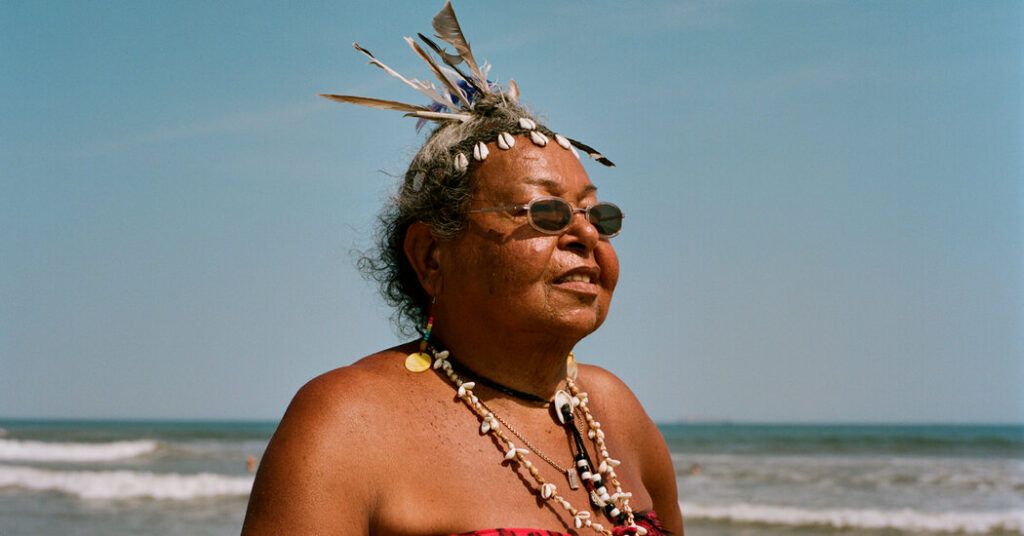
Ms. Cruz played a quieter role, but over time she became a central figure as well — and a recognizable one, with her homemade outfits topped with a headband adorned with feathers and cowrie shells, in honor of her heritage as a descendant of the Taíno people of Puerto Rico.
“She was an elder in that community,” Mr. France said in an interview. “She was a transgender woman of color who had lived into old age, which is so rare.”
Victoria Cruz was born on Sept. 19, 1946, in Guánica, on Puerto Rico’s southwestern coast. When she was 4, her family moved to the Red Hook section of Brooklyn, where her father worked as a longshoreman; her mother was a seamstress.
She identified as female from an early age, and her family was strongly supportive. Her mother made her dresses, and her father, who affectionately called her “El Negro,” on account of her dark skin, switched to using the word’s feminine form, “La Negra.”
She studied cosmetology in high school and worked as a model, but soon found both routes closed to her because she was trans.
After high school, she found a doctor in Coney Island who provided her with the medical treatment to help her transition.
Through the 1970s she was a sex worker and a dancer in West Village clubs. She also developed an addiction to crack cocaine, though she eventually became sober.
She enrolled at Brooklyn College in 1978 and graduated four years later with a degree in theater.
But she continued to struggle financially, and ended up on public assistance. The program required her to work, which is how she ended up on the staff at the Brooklyn nursing home.
Her survivors include Mr. Wright and her sister Hedye Cruz. A complete list of survivors was not immediately available.
In 2012, Ms. Cruz received the National Crime Victims’ Service Award from the U.S. Department of Justice.
In an interview for the Anti-Violence Project in 2022, Ms. Cruz explained why she committed her life to counseling.
“If you have been in that situation — everybody’s situation is different but similar,” she said. “If you have the empathy to help out people, that’s half the ordeal. Just having the empathy and letting them know that you’re there to help them, not to judge them.”
The post Victoria Cruz, Veteran of the Trans Rights Movement, Dies at 79 appeared first on New York Times.