When NATO leaders gather in Ankara, Turkey, on Tuesday, they will offer familiar words of resolve on Ukraine, reiterating that Russia poses a threat to their collective security.
The statements will be welcome, but they will not end the war. For more than four years, NATO has sought to manage the conflict in Ukraine rather than win it decisively. At Ankara, the alliance members must set their sights higher than another declaration of allied unity.
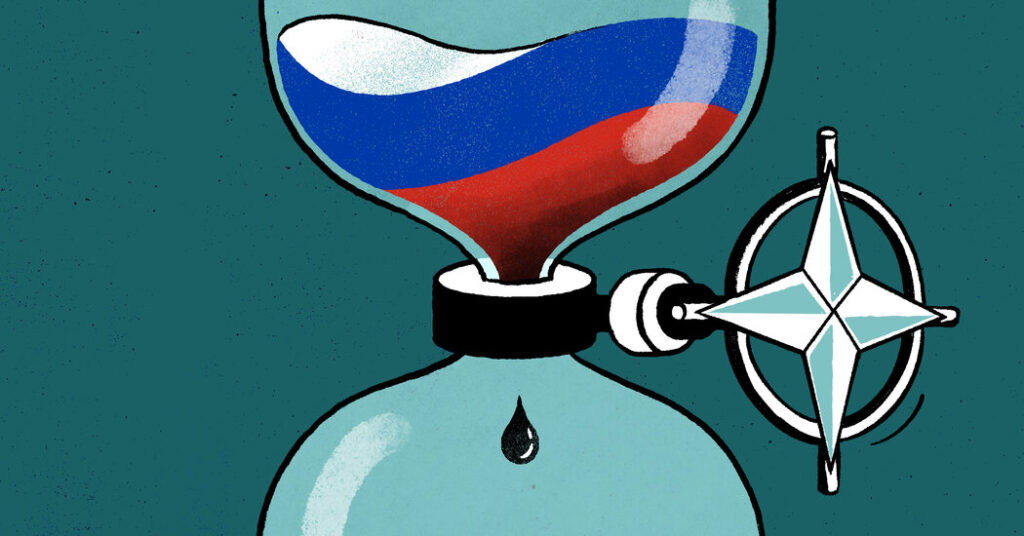
The NATO summit should commit to breaking the Russian war economy and ending Moscow’s ability to fight abroad. That requires admitting an uncomfortable truth: Western sanctions have constrained Russia, but they have not cut off the fossil fuel revenues that sustain President Vladimir Putin’s war machine.
The numbers show the scope of the failure. In May, Russia’s daily fossil fuel export revenues rose to roughly 726 million euros, or around $830 million, up 2 percent from April. Crude oil alone generated about 362 million euros daily. The European Union, despite real progress since 2022, remains the largest buyer of Russian gas. Turkey, a longtime NATO member and this year’s summit host, still counts as a major buyer of Russian oil products.
It’s not that allies have failed to support Ukraine. Europe has cut its dependence on Russian gas from roughly 45 percent of imports before the invasion to about 12 percent in 2025 and is moving toward phasing out Russian gas entirely. It has banned Russian coal. Turkey has supplied Ukraine with drones and helped broker safer navigation in the Black Sea. These efforts deserve recognition, but they sit uneasily with its continued imports from Russia that let the war drag on indefinitely.
The hesitancy has been understandable. NATO leaders flinched at taking a tougher approach in the immediate aftermath of Russia’s full-fledged invasion in 2022, worried that the disruption in energy markets would be too costly. But the costs of indecisiveness have been worse, with more than 15,000 civilians killed and nearly $600 billion expected to be required to rebuild Ukraine.
Recent events offer an opportunity to act. At roughly nine million barrels a day, Russia’s crude production represents less than 9 percent of global oil demand. With the Strait of Hormuz reopening and Persian Gulf supplies slowly returning to the market, the economic and political effects in NATO countries of cracking down on Russia will be softened. NATO allies have endured much greater impacts from markets constrained by the Iran war and are positioned to absorb the fallout from tougher sanctions on Moscow.
The United States has reimposed sanctions it temporarily lifted on Russian oil during the war. Allies that still rely on Russian energy should use the Ankara meeting to commit to a rapid, orderly exit, backed by alternative supplies from the United States and other partners. But the transition must be swift; it must not become another way to delay.
NATO should then set its sights on non-Western buyers like China, the largest importer of Russia’s crude and coal and the second-most-important purchaser of its gas. Countries like China rely on financial institutions willing to process these transactions, which Western banks and insurers refuse to touch. As Russia’s export economy adapts to sanctions imposed by NATO countries, non-Western enablers are giving it oxygen.
NATO allies should agree in Ankara to impose sanctions on the support apparatus that facilitates Russia’s energy trade, from financial institutions in China and India to Middle Eastern trading houses. These so-called secondary sanctions would sever those institutions from access to the dollar and euro. The choice would then become stark for their home countries: They can do business with the West or with Russia, but not both.
Congress has already shown that it’s ready to endorse this approach. The House Committee on Financial Services, which I chair, passed a secondary sanctions bill, the PEACE Act, last year by a vote of 53 to 1. If passed into law, it would punish financial institutions facilitating Russia’s energy deals.
This would be a significant escalation from the West’s current approach. A NATO-wide push modeled after the PEACE Act would change the calculation for foreign financial institutions, including those in China that can’t afford to risk shutting off trade or causing a bank run just to ease the way for a shipment of Russian crude.
The threat of losing access to the Western financial system will change behavior from Shanghai to Delhi to Dubai. Financial institutions in those cities should not be given a free pass when they enable energy sales that fund the destruction of Ukrainian cities.
The PEACE Act would also seize $5 billion of Moscow’s sovereign assets and allow the funds to be used for Ukraine’s defense and reconstruction. Five billion dollars won’t win the war by itself, but it would encourage allies in Europe — where about 210 billion euros in Russian funds are held — to do the same. Just freezing assets, as they have done, is not enough; we must use them. It should be Russia, not taxpayers in NATO countries, that pays the costs of Russian hostilities.
French Hill represents the Second Congressional District of Arkansas.
The Times is committed to publishing a diversity of letters to the editor. We’d like to hear what you think about this or any of our articles. Here are some tips. And here’s our email: [email protected].
Follow the New York Times Opinion section on Facebook, Instagram, TikTok, Bluesky, WhatsApp and Threads.
The post The West Has Let Russia Off the Hook. Time to Tighten the Screws. appeared first on New York Times.