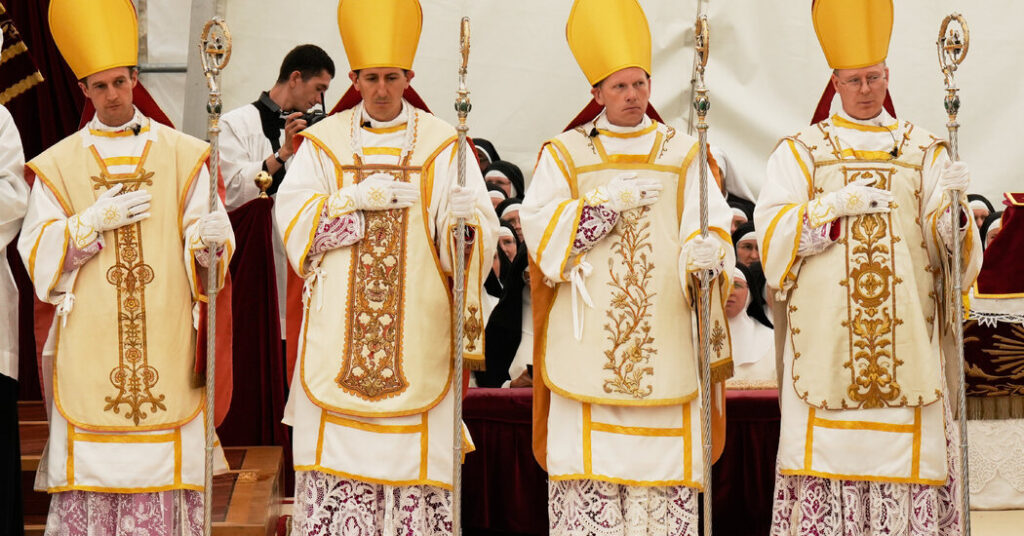
The Vatican on Thursday excommunicated the clergy of a breakaway conservative faction of the Roman Catholic Church, as well as any worshipers who do not leave the group. The expulsion came a day after the faction’s leaders defied a personal plea from Pope Leo XIV and consecrated four new bishops without his permission.
The decree against the Society of St. Pius X excommunicated at least 750 priests. It could also affect thousands of worshipers who have not been immediately expelled but, according to the Vatican, might still be punished if they do not leave the group and confirm their loyalty to Pope Leo, and adhere to the church and its teachings.
Historians said it was the biggest schism in the Catholic church since at least 1870, when a much smaller group of Catholics in Germany broke with the Vatican. The Society of St. Pius X does not keep full records of its followers, but officials estimated that they number between 300,000 and 600,000 people.
In an explanatory note about the decree, the Vatican said the society was barred from officiating marriages and hearing confessions, and it warned the society’s followers to stop attending its Masses and participating in its events.
The Vatican’s note added that all formal followers of the society “are to be considered schismatics and excommunicated” after its leaders consecrated the bishops in a ceremony in Switzerland on Wednesday “against the will of the Holy Father and in open violation of canon law.”
The society did not immediately comment on the excommunication.
The schism is the biggest internal crisis within the Catholic church since Leobecame pope in May 2025. It is also a blow to his stated efforts to bridge divisions between Catholics who want to modernize the church, including by ordaining female priests, and conservatives, like followers of the Society of St. Pius X, who hold fast to tradition.
Experts said Leo’s decisiveness revealed that he would not maintain a superficial unity at all costs.
“He has learned from twenty-plus years of make-believe reconciliation and rapprochement that never went anywhere,” said Massimo Faggioli, a professor of theology at Villanova University in Pennsylvania, where Leo studied. “He’s drawing some conclusions” that “there’s a schismatic reality and we have to say what it is,” Professor Faggioli said.
The Vatican’s decision heightened a decades-long standoff between the Church’s leadership and the society, which is widely known by the acronym S.S.P.X.
The society was founded in 1970 by Archbishop Marcel Lefebvre in protest against the Church’s efforts to modernize after the Second Vatican Council, held between 1962 and 1965, including by allowing priests to hold services in vernacular languages instead of only in Latin. The society also objects to the council’s efforts to soothe tensions between Catholicism and other Christian faiths, and to take part in interreligious dialogue. And it insists on the primacy of the Roman Catholic Church even as it accuses the modern leaders of heresy.
Those tensions came to a head in 1988, when the society first consecrated four bishops without the permission of Pope John Paul II, who swiftly excommunicated them and Archbishop Lefebvre.
Relations thawed somewhat in 2009, under Pope Benedict XVI, who lifted the excommunications of the surviving bishops in a gesture of outreach to all Catholics still attached to celebrating the traditional Latin Mass. But one bishop had provoked outrage by denying the Holocaust.
That rapprochement ended on Wednesday, after the society defied Leo by proceeding with a consecration ceremony that the group said had brought some 17,000 worshipers to Écône, a small village in Switzerland where the society installed its first seminary in 1970.
The Vatican’s reaction on Thursday was harsher than in 1988, when it excommunicated only the society’s five senior prelates.
This time, the excommunication applies to all of the society’s priests and formal followers. The Vatican added that the sacraments administered by the society’s priests, including confession and matrimony, were invalid, reversing concessions that Pope Francis had made to the society in recent years.
“There was a lot of debate in the church about the real effect of that unilateral lifting by Pope Benedict in 2009, so now there’s full clarity,” said Professor Faggioli.
The Vatican’s decree left open the possibility of reconciliation for those who agree not to take part in the society, saying that “the Church, as a caring mother, will welcome with sincere affection and lively solicitude all those who wish to return to full communion.”
On Thursday afternoon, the Vatican’s doctrine office issued a document with instructions for priests and faithful who wanted to return to communion with the church. For priests this included writing a letter asking for “the remission of the censures incurred as a result of having been ordained by an excommunicated or irregular bishop,” and would involve a trial period in a diocese.
In the case of lay worshipers, they are not automatically excommunicated, but would be evaluated “case by case,” the Vatican wrote. As with priests, removing the sanction would require signing a profession of faith — written in Latin.
The Rev. Ian Andrew Palko, an S.S.P.X. priest in Texas, said he did not expect the excommunication to lead to many defections. “There may be some who are uncomfortable with” excommunication, he said. But, he added, if the faithful “were worried, it would have already pushed them away.”
And the Rev. Paul Robinson, the society’s prior in Denver, said “I think there will still be contact with Rome,” as there was after the 1988 excommunications.
The Rev. Roberto Regoli, a church historian, said that the society was well-placed to survive because it had so many outposts across the world, including universities and schools.
The post Vatican Excommunicates Breakaway Group, in Biggest Schism in 156 Years appeared first on New York Times.