On Wednesday morning, Hailey Simko was in a fire engine on the way to the Babylon Fire, raging across southeast Utah. As a forest firefighter, Ms. Simko, 21, is used to extreme heat: “It’s incredible how hot it gets,” she said.
With the United States experiencing staggering temperatures, driven by a large, slow-moving heat dome that is stretching from the central plains to the East Coast, I reached out to her and a handful of other unofficial experts, for advice. How do people whose jobs expose them to high temperatures daily handle the heat? Here’s what they said.
Ridgeland, Miss.
Roofer
Grady Ladner, 34, is a site leader for Watkins Construction and Roofing, based in Ridgeland, Miss. As a result he is out on a variety of construction sites every day — sometimes on the ground, but often up on the roof.
And the heat is worse on the roof. When the ground temperature is 95 degrees, the localized temperature on the roof can reach 140 degrees, he said, because of the asphalt shingles. “You can fry an egg on most of them in the middle of the day once you get them installed,” he said. And it’s not just the heat: “It’s the humidity that sucker punches you right between the eyes every single day.”
To keep up with the hot conditions, Mr. Ladner said his crew of seven or eight goes through more than 60 bottles of water per day. He also said taking shade breaks is crucial: “About every hour we all come down and take a 10- or 15-minute break.”
“The quicker we get it done, the quicker we can get into the air-conditioning, so a lot of people don’t want to take breaks,” he said. “But it’s just not worth it.”
Austin, Texas
Food-Truck Chef
Charlie Rajeh, 57, is the chef and owner of Austin’s Beirut food truck, known for its Lebanese specialties like shawarma and shish tawook. After immigrating from Lebanon in 1989 and running a catering and sandwich business, he opened his trailer in 2015 — and quickly realized his air-conditioning unit would not be enough to keep him and his employees cool.
“We have the grills and fryers going, and even when you run the A.C., the exhaust fan just takes most of the air out,” he said. “And fans don’t help much, especially in the Texas heat, so we get super hot.” He estimates that inside the truck, temperatures reach over 110 degrees, especially if you’re working the grill.
Hydration is key: Mr. Rajeh and his employees try to drink as much water as possible. They also often gather in the corner of the trailer by the air-conditioner. “But other than that, you can’t do much about the heat,” he said.
South Walton, Fla.
Beach Lifeguard
David Vaughan, 50, has been battling the heat his entire career. He is now the beach safety director of the South Walton Fire District on the Florida Panhandle, and his department supports lifeguards who work for nine hours or more on the 19 lifeguard towers along 26 miles of beach.
Summer months bring a surge in beachgoers, which means more heat-related emergencies. “We’ve probably had a half a dozen safety calls today,” he said on Tuesday, as an emergency chime rang in the background.
Because of the area’s white sand, the light reflection can create dangerous conditions even on cloudy days. “We see little sunburns all the way up to heat stroke, and it is often just because people don’t come prepared,” he said.
He recommends beachgoers use the same protections as his fellow lifeguards: electrolyte powders, hats, sunscreen, UV-protection shirts and small fans.
He also suggests buying a long-sleeved fishing-style hoodie with UV protection and spending the extra money for good sunscreen; he swears by zinc-based products.
Many beachgoers don’t want to heed his advice on what not to bring: “You can’t tell people to not drink alcohol, and alcohol is allowed on our beaches, so we just advise people to balance and compensate with fluids,” he said.
Death Valley National Park, Calif.
Park Ranger
Abby Wines, a ranger and deputy superintendent at Death Valley National Park, said that people who live in the famously hot area have one big advantage: They acclimate to the heat between spring and summer.
Ms. Wines has two air-conditioning systems in her house. Even so, she said one of the biggest problems is the water temperature. “There is nothing I want more on a hot day than a cold shower, but I can’t get one in my house because the sun heats up the ground, the ground heats up the pipes, and the water comes out of my cold-water tap at a temperature you would set a water heater to,” she said.
Still, she encourages travelers to visit Death Valley in the summer, as long as they plan ahead. “Things like drinking water and eating salty snacks or wearing a hat to shade yourself are helpful. But here in Death Valley, on a hot day, those are not enough.”
The way to be safe is to limit the amount of time spent outside in the heat. She suggests driving only on paved roads, making quick, five minute stops at scenic overlooks and then hopping back into your air-conditioned vehicle. “And if you want to go a longer hike, go up into the mountains, where it is much cooler,” she said.
Amite city, La.
Farmer
Along with his wife and children, Joe Fekete, 59, runs the eight-acre Joe Fekete’s Family Farm, in Amite City, La., 90 miles north of New Orleans. He grows crops like Irish potatoes, yellow squash, zucchini, cucumbers, jalapeños, tomatoes and okra.
He spends most of his days out in the Louisiana heat. Unlike many other people who work outside in hot conditions, Mr. Fekete does so shirtless, wearing shorts and an old hat that “keeps the cancer off my ears,” he said, adding, “You just learn how to deal with it.”
To cope, he said he works outside for an hour or two and then comes in to take a half-hour break. “Drinking water is good, but you’re losing stuff besides just water, so you need Liquid I.V.,” he said, referring to a brand of electrolyte powder. He said he has grown so used to overheating that he notices another sign: “Whenever my voice starts getting hoarse, that’s when we come in,” he said. “You have to pace yourself.”
Hawaii
Volcano Hiking Guide
Erik Storm, 49, the owner and lead guide of Kilauea EcoGuides, runs tours to visit the island of Hawaii’s famous Kilauea volcano. For the last 18 months, the volcano has been sporadically erupting, shooting lava over 1,000 feet into the air. Mr. Storm guides tourists through Hawaii Volcanoes National Park to get as close to the summit as they safely can, which means hiking through hot conditions. “Lava is 2,000 degrees, so that’s about as hot as it gets,” he said.
To protect his guests, Mr. Storm offers gloves and, in some cases, face coverings. Even so, the hikes can be extreme: 10 miles over an old lava field, which he described as looking like Mars, with no plants or shade. “You have the heat of the lava plus the heat of the sun and no shade,” he said, “and you are hiking around with a 40-pound pack.” Hydration, he said, is crucial, since there is no source of water once they are out on the hike. But he also raised the issue of mental stamina: “When people have never been around that kind of heat, we try to make sure they are mentally prepared.”
To help guests, he said he uses Liquid I.V. and coconut water. He also encourages visitors to adopt a Hawaiian state of mind by respecting the power of the lava from a safe distance.
Decatur, Ga.
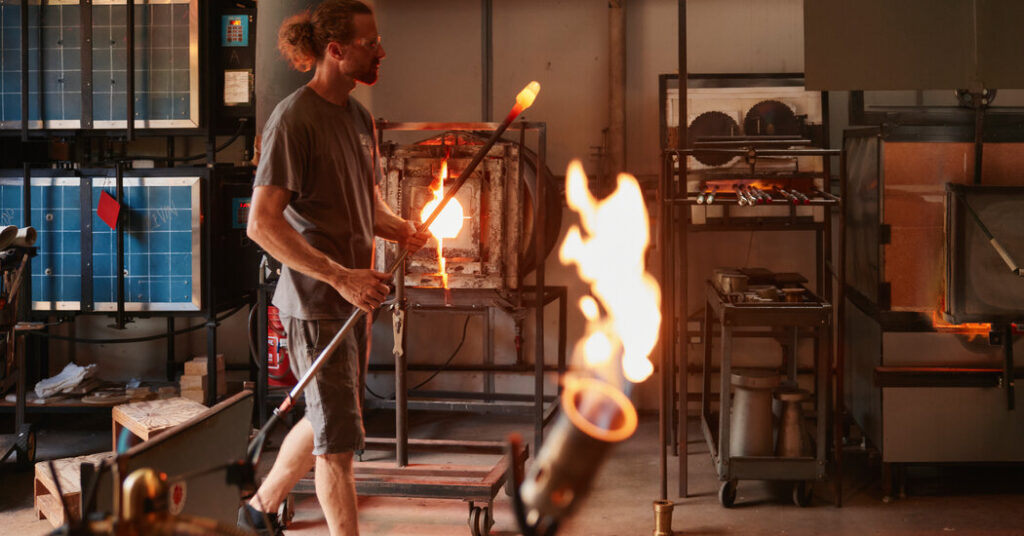
Glassblower
An orange warning message on the website for Decatur Glassblowing makes clear what visitors can expect: “It is extremely hot in the shop this time of year,” it reads. “If you are sensitive to the heat, we recommend waiting to schedule during a cooler part of the year.” The owner, Nathan Nardi, 45, described the environment. “We are standing in front of a 2,000-degree furnace, working with glass over 900 degrees,” he said. Air-conditioning can’t tackle that kind of heat, and even when it is 100 degrees outside in the Georgia sun, he and his staff depend on ventilation by opening up the studio’s garage doors.
Mr. Nardi schedules classes in the early morning or late at night — “and if people don’t feel good about being in the heat, then we stop,” he said.
Mr. Nardi, who has been working in glass for 25 years, said he is used to the heat and has in fact become cold-sensitive. Still, he takes breaks in the air-conditioned gallery area, and he offers an ice water machine in the work area. “It’s all about staying hydrated and taking breaks,” he said.
Spanish Fork, Utah
Forest Firefighter
Hailey Simko, 21, is a new member of Engine 381, a fire crew in the Spanish Fork Ranger District of the Uinta-Wasatch-Cache National Forest in Utah. As part of her job, Ms. Simko helps carry the hose packs and hauls five-gallon bladder bags of water toward the fire. The engine carries 300 gallons of water in total for firefighting. “It’s a lot,” she said en route to a fire. The combination of hiking, hauling and then being near the flames can overheat someone very quickly. Plus, there’s the sun. “After being around flames, you start to ignore the heat coming from the sun,” she said.
“What you really feel is the heat around your face — you feel like you’re being sunburned.” To keep up with it, she carries six liters of water for her personal use at all times. “Water is really your lifeline,” she said. She added that her supervisor makes sure the team takes breaks. “We will try to find some shade and rest up a little bit, and drink some electrolytes.”
Follow New York Times Travel on Instagram and sign up for our Travel Dispatch newsletter to get expert tips on traveling smarter and inspiration for your next vacation. Dreaming up a future getaway or just armchair traveling? Check out our 52 Places to Go in 2026.
The post How to Handle a Heat Wave? Advice From Glassblowers, Death Valley Park Rangers and Firefighters. appeared first on New York Times.