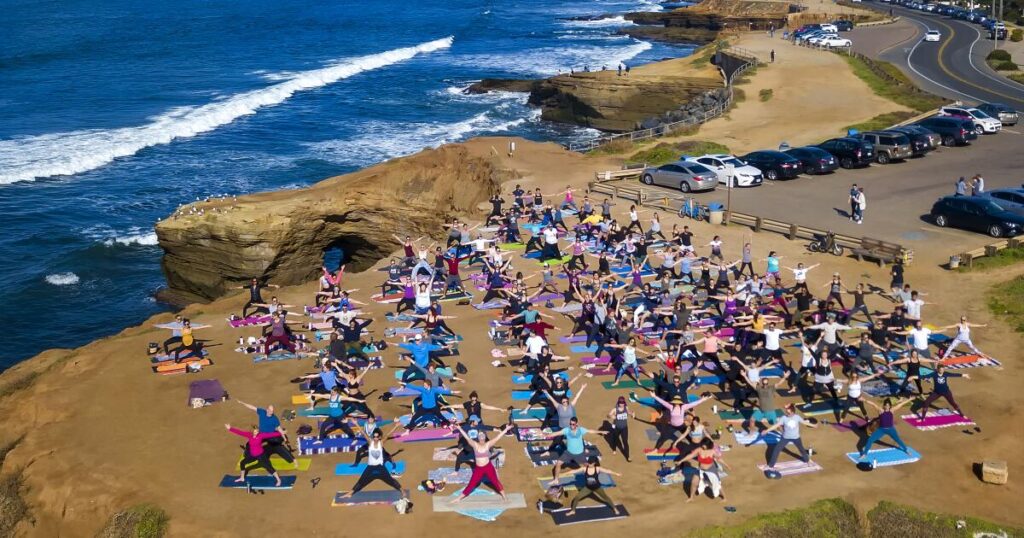
The battle between a yoga teacher and the city of San Diego is heating up.
Steve Hubbard, known as “NamaSteve,” recently filed a third lawsuit alleging the city has violated his rights by citing him for teaching free public yoga classes.
And in a separate ongoing civil case, the city has issued nearly two dozen subpoenas seeking a broad array of GPS and social media data on Hubbard and his associates, according to his attorney Bryan Pease.
“Free speech is the bedrock of our democracy,” said Pease, who filed the most recent lawsuit on Hubbard’s behalf June 22 in San Diego County Superior Court. “If you start chipping away at it and preventing people from doing something as simple as speaking in a public park, in this case about yoga, you create a dangerous precedent.”
The San Diego city attorney’s office declined to comment, citing the pending litigation.
At the center of the controversy is a sidewalk vending ordinance San Diego adopted in 2024 that also prohibited yoga classes of four or more people at shoreline beaches and parks without city permission. A federal appeals court last year found the prohibition to be unconstitutional.
Hubbard and another yoga instructor, Amy Baack, first sued San Diego in federal court in June 2024, alleging the ordinance violated their 1st Amendment rights. One section bans providing services without a permit and includes yoga as an example. Another prohibits giving lectures in public parks without city permission.
In January 2025, a federal judge ruled that portion of the ordinance overburdens free speech rights by prohibiting anyone from providing any lecture in any San Diego public park or beach.
Yet park rangers continued to cite Hubbard under that section, issuing two misdemeanor citations in May 2025, as well as a third that cited a different section of the ordinance, the most recent lawsuit alleges.
Hubbard received one of those citations for teaching yoga from his backyard and streaming it live on YouTube, the lawsuit alleges. Park rangers responded to his home on May 24 and called for him to come out to his driveway, then cited him, said Pease, who believes his client was unfairly targeted.
The ordinance that restricts yoga instruction at city parks does not outlaw teaching other subjects including tai chi and Shakespeare, the city has conceded in court proceedings.
When a law singles out speech for its particular content — in this case, yoga — it must serve a substantial government interest and be narrowly tailored to meet that interest, Pease said. In this case, he said, “the city has never said what their interest is or what they’re trying to accomplish here.”
“It’s very bizarre,” he added.
The city has argued in court filings that the ordinance didn’t specifically ban teaching yoga in its parks, but required people seeking to engage in commercial activity or lectures to obtain a permit. Still, the way the ordinance is worded also prohibits teaching yoga for free, Pease pointed out.
The city also has argued that teaching yoga is not protected by the 1st Amendment.
But in June of last year, a three-judge panel of the 9th Circuit Court of Appeals ruled to the contrary. The panel found Hubbard and Baack were likely to succeed in their 1st Amendment claim and granted a preliminary injunction barring the city from enforcing the ordinance as it had been. The case is continuing to work its way toward a final judgment, Pease said.
In April, the Superior Court dismissed the three citations Hubbard received in May 2025 when no park ranger or city attorney appeared for the prosecution, his lawsuit states. Hubbard is now seeking damages for those citations.
He and Baack also previously filed another lawsuit in state court in January of last year to lodge claims under the California Constitution.
In that case, the city issued 22 subpoenas to financial and social media companies seeking information regarding the two instructors and their associates, according to court documents. Both accept donations at their classes, and the subpoenas include requests for the GPS coordinates of students who have paid them, as well as virtually everything the instructors have ever posted online, said Pease, who has filed a motion to quash the subpoenas. A hearing on the matter has been set for July 17.
Pease called the requests “extremely invasive” and said he believes they represent an attempt to harass his clients.
“There are some severe civil liberties infringements going on,” he said.
The post Battle over free public yoga classes pits ‘NamaSteve’ against a SoCal city appeared first on Los Angeles Times.