On a recent summer day at Crossroads School for Arts & Sciences, students ambled through yawns, braces and acne into their creative writing class. The day’s lesson tackled “style,” that elusive, ultra-subjective choice of expression.
“Who was the first author you encountered to do something different on the page?” asked the teacher, Clarke E. Andros.
They named Dr. Seuss, Shel Silverstein and Lemony Snicket before moving on to a précis of Joy Williams’ flash fiction. “These stories are weird — she’s weird,” Andros warned.
In some ways, high school looks much the same as it did 20, even 100 years ago: sleepy eyes either light up or glaze over when a teacher poses a Socratic question. Nervous laughs and unexpected insights emerge as young people use stories to make sense of themselves and the world around them.
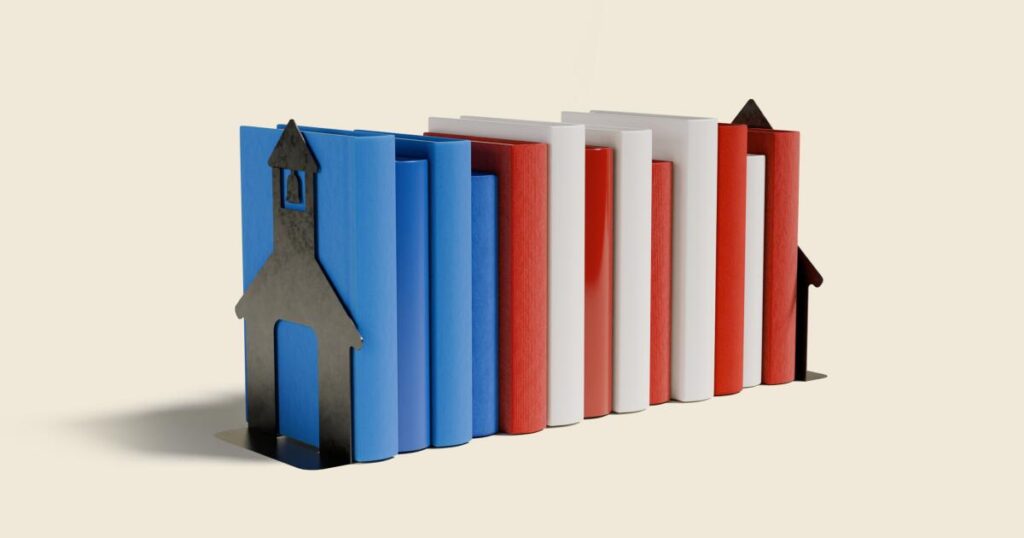
The idea of the “Great American Novel” took shape in the aftermath of the Civil War, when a fractured nation looked to literature to define itself. As classrooms evolved, so did the canon that reflected America’s changing identity.
But the syllabus today is at a tipping point. Forces — some visible, some harder to see — are upending literature and education itself. American students are in a decade-long reading recession, while fewer students are reading for pleasure than in previous generations.
Reading scores among high school seniors are at their lowest in decades, according to federal testing data, while schools across the country are grappling with how to respond to waning attention spans and artificial intelligence. The Los Angeles Unified School District has begun a course correction, voting to limit student use of laptops and tablets during class — the first major American school system to do so.
We spoke with five high school English teachers across the city — three from LAUSD, one from a charter and one from a private school — to find out what literature belongs in today’s classroom, and which stories can help us understand America, past and present.
Interviews have been edited and condensed for clarity.
Raquel Olvera, Roosevelt High School, Boyle Heights
What books in the American literary canon are you teaching (old and new)?
In 11th-grade American Literature, as part of the LAUSD-approved Odell curriculum, we read four book options: “Friday Night Lights,” “Beloved,” “The Great Gatsby” and “The Warmth of Other Suns.” For my 10th-grade World Literature course, I like “Antigone” and “Things Fall Apart.” I also teach “In Cold Blood,” using it to explore Americans’ fascination with true crime and what the genre reveals about race, gender, class and the justice system.
What’s one work from the canon adults should revisit today?
“The Great Gatsby.” When I read it in high school, I wasn’t engaging with its undercurrents of racism, xenophobia, antisemitism, gender or sexuality in the way I do now. Its themes of power, wealth, consumerism and American identity remain as relevant as ever.
What are English teachers up against in the classroom in 2026?
Besides large class sizes and underfunding, I think public educators are largely battling apathy. Students and young people aren’t engaging with books like they used to. A side effect of that is a lack of empathy and curiosity. At the very least, you can model what it means to be a reader and a writer, and hope that years later, students remember that one nerd English teacher who showed them what humanity can look like.
Schehrezade Lodhy, Da Vinci Schools, El Segundo
What books in the American literary canon are you teaching (old and new)?
Students really enjoy Arthur Miller’s “The Crucible” — it’s all about the human condition and cancel culture, forbidden love and lies and deceit, with witches in the forest. In poetry, we explore a range of American voices, from Walt Whitman and Langston Hughes to Amanda Gorman, and sometimes even song lyrics. I also use “The Moth: Storytelling” podcast when students are working on personal essays. The goal is to make literature, poetry and storytelling as accessible as possible. At a charter school, we have quite a bit of autonomy with what we teach.
What’s one work from the canon adults should revisit today?
James Baldwin’s “Giovanni’s Room” and “Go Tell It on the Mountain.” I read Baldwin a few summers ago, and that was quite an education for me. Unfortunately, some of the content is a bit too mature for high school, but I do talk about Baldwin a bit in my classes when we cover African American authors.
What are English teachers up against in the classroom in 2026?
Artificial intelligence, big time. I really pared back technology in my class, and we’ve pivoted back to paper and pencil. Going into my 18th year of teaching, my biggest goal is re-creating that experience of thinking critically for oneself and studying literature through a critical lens. We’re in this era of going back to the basics. With decreased attention spans, teachers are being forced to become even more creative. It feels like we’re reinventing ourselves every year.
Aiden Brown, John F. Kennedy High School, Granada Hills
What books in the American literary canon are you teaching (old and new)?
From an educationally traditional background, I still believe in canon disruption — mixing the new and old. In American Lit, I’ve taught “Their Eyes Were Watching God” 11 times now. It’s a hard one to get on the first try because the vernacular is so particular, but when we read it physically while also listening to the audiobook, it’s such a great novel to hear. I pair it with bell hooks’ “All About Love.” I teach “Macbeth” from a performance-based lens, making it less intimidating. My favorite book is “Frankenstein,” written by a teenage girl who invented science fiction. My ninth-graders’ favorites were “Fahrenheit 451,” “The Odyssey” (Emily Wilson translation) and “Persepolis,” a graphic novel about a girl discovering punk rock and rebelling against the established order.
What’s one work from the canon adults should revisit today?
All of the lonely young men need to reread “The Great Gatsby,” and anyone freaked out by the state of the world should read “Parable of the Sower.” One quote from the book hangs on a poster board in my classroom: “A community’s first responsibility is to protect its children — the ones we have now and the ones we will have.”
What are English teachers up against in the classroom?
Teenagers are still the funniest people on the planet. As the world around them becomes more atomized, I find that they’re increasingly interested in connection. In the classroom, we are seeing skill loss and a decreased ability to focus on a task. I don’t think that’s just because of AI or the pandemic — it’s also phones, screens and the world kids are growing up in. One thing teachers seem to agree on is a return to pen and paper.
Clarke E. Andros, Crossroads School, Santa Monica
What books in the American literary canon are you teaching (old and new)?
A newer addition I would recommend is “Hunger: A Novella and Stories” by Lan Samantha Chang. Especially in California, we have a lot of great Asian American literature, including works by Amy Tan, but I enjoy the writing level in Lan’s — it’s accessible to students but pushes them, all about intersectional identity and the first-gen experience. A lot of the Latino students I’ve taught in Los Angeles also connect with that book.
What’s one work from the canon adults should revisit today?
“Of Mice and Men.” Revisiting it today opens up deeper conversations about labor, social conciousness and power. Steinbeck creates a microcosm of American society, where disability, gender, race and class are all represented and shaped by an economic hierarchy. The characters are left navigating a world where people often turn on each other rather than challenge the systems around them. It’s novella-length, so you could read it in a Sunday morning.
What are English teachers up against in the classroom in 2026?
We’re up against systems that often prioritize ed-tech and third-party vendors over smaller class sizes and more teachers. When I was at LAUSD, it was clear from our superintendent — who just stepped down over his fraud investigation — was just in bed with tech. It’s hard for me to imagine the folks in power didn’t look at [the failed AI chatbot venture] and see it as a grift.
On the flip side, at hyper-competitive, elite schools like this, students are approaching high school with college in mind rather than with high school in mind. When students understand the value of the process, they’re less likely to look for an easy shortcut like AI.
Adam Tan, Los Angeles Center for Enriched Studies, Mid-City
What books in the American literary canon are you teaching (old and new)?
With independent reading, memoirs are big, like “Crying in H Mart” and Sylvia Plath’s fictionalized “The Bell Jar.” Younger kids gravitate to “Musashi,” a celebrated epic based on a famous samurai. We have a lot of Korean American students here, so they like “Pachinko,” dealing with racism and the Korean population in post-World War II Japan. I’ll also throw in “The Bluest Eye.”
In ninth grade, we read “Slaughterhouse-Five,” “Of Mice and Men,” “The Thief and the Dogs” and “Romeo and Juliet,” with the film adaptations to use media literacy. In American Literature, the major texts are “The Great Gatsby,” “The Things They Carried” and “The Crucible.” We also read nonfiction articles, including pieces on AI and robots, while focusing on rhetorical devices.
What’s one work from the canon adults should revisit today?
“The Catcher in the Rye” benefits from the distance of adulthood. It’s a novel about disillusionment and the search for identity, but when you revisit it, you also see that it’s very much a love story. I often encourage students to look for forms of love beyond romance — love for family, friends and fellow human beings. Even today, students can tell you that the biggest phony in the book is Holden himself. The novel reminds us that while literature may not have answers to the world’s problems, it can help us examine our wounds and find solace in art.
What are English teachers up against in the classroom in 2026?
A lack of accountability in the modern world. In general, we have a school district focused on 100% graduation rates, no F’s. [LAUSD] wanted everything on computer, and now they want less computer time, which is great, but not everyone at top management is on the same page. Teachers are often trying to balance what the district wants with what we know our students need.
What I try to instill instead is an intrinsic desire to grow as a thinker. How do you make sure students are reading without taking the joy out of it? A lot of us are going back to pen and paper. Despite all the concerns about AI, I still think the soul and spirit of young people is as strong as ever. The core is not rotting.
The post What literature belongs in today’s classroom? 5 L.A. high school teachers weigh in appeared first on Los Angeles Times.