Yesterday, Freddy woke up in a hotel room in downtown Boston that had been paid for by the celebrity chef Gordon Ramsay. Draped over one chair was an autographed chef’s coat and a personal note from the Hell’s Kitchen star: “Dear Freddy, Welcome to Boston!” For the past month, the German man who went by @FreddyLA7 on X was on the ride of his life. Crisscrossing the United States on an epic World Cup road trip, the pseudonymous soccer fan posted about the beauty of big-box chain stores and gas stations, projecting an infectious enthusiasm for American mass culture. Along the way, he racked up hundreds of thousands of followers; met famous singers, wrestlers, and astronauts; and was showered with swag and free hotel stays.
Then, within a span of 24 hours, Freddy’s American fever dream ended as abruptly as it began. On Monday night, he watched his home country fall to Paraguay in a stunning upset. “Oh no Freddy …,” lamented JJ Watt, the former NFL star who had gifted him and his traveling companions a luxe hotel stay in Houston last month. Not everyone was as sympathetic. “Now that Germany is out, we can all admit Freddy is a fake account, right?” one user posted. Others suggested—either seriously or in jest—that Freddy was a CIA operative: “Back to Langley I’m afraid.” Last night, he deactivated his X account.
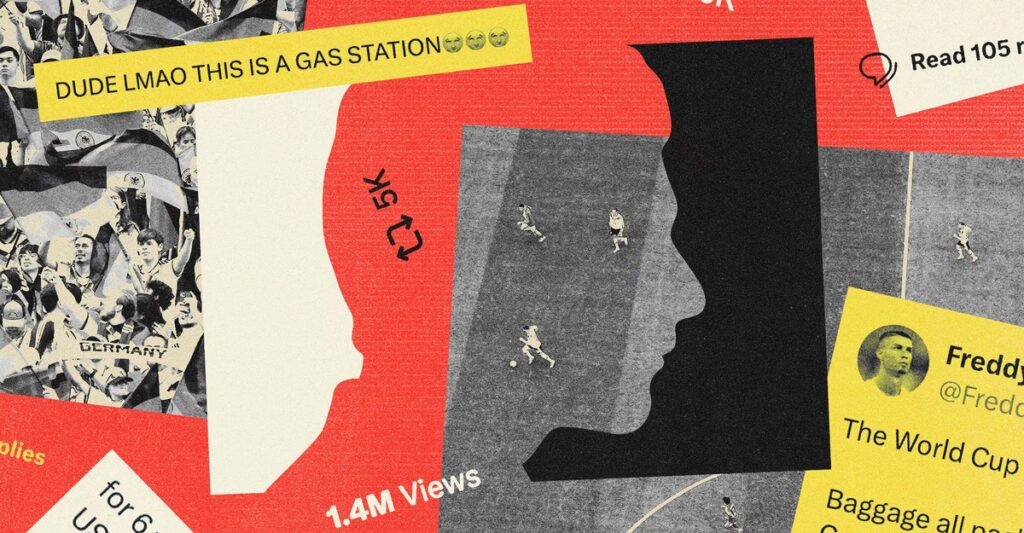
No one has produced compelling evidence that Freddy was anything other than what he claimed. Yet something about him always seemed too good to be true. Behind the everymensch image was a skilled poster who knew which cultural signifiers would strike a chord with Americans. Behind each seemingly off-the-cuff post (“DUDE LMAO THIS IS A GAS STATION ”) were careful choices about how to compose the shot for maximum virality. Atlanta, he observed, was “so green it’s crazy. It feels like you’re in a forest the whole time.” A Taco Bell, where he sampled an electric-blue soda and nacho cheese, was “the Holy land.” His starry-eyed enthusiasm held an obvious appeal: Here was a foreigner showing us with fresh eyes what’s still to love about a country riven by anxiety that it’s in decline.
Many of the other accounts that capitalized on the “overly enthusiastic World Cup tourist” trend were quickly revealed to be less than genuine. But Freddy, who didn’t respond to several requests for comment, never quite fit the mold of the crypto-shilling influencer. He remained stubbornly anonymous and claimed to have no interest in monetizing his social-media success. Though he seemed to post casually and freely—capturing his meal at a Chili’s in Chattanooga, Tennessee, and the view from his front-row seats to TNA Wrestling’s Slammiversary—he omitted any details that would reveal his identity. He covered his face with an image of his favorite soccer player, the Portuguese star Cristiano Ronaldo.
Eschewing fame and fortune, however, turned out not to spare Freddy from the same scrutiny that awaits any other viral sensation. As the novelty of his appeal faded, it gave way to a backlash; tearing Freddy down became more interesting than building him up. While Freddy was in Boston mourning Germany’s defeat, online sleuths excavated the least-savory tidbits from his X posting history. They unearthed a 2023 post in which Freddy had alluded to attending “some concerts in the USA,” indicating that the World Cup trip was not his first visit to the country. The discovery, meant to stoke doubts about the authenticity of Freddy’s wonderment at basic aspects of American life, soon led to a more damaging one. Freddy had defended a livestreamer who used a racial slur when singing along to rap lyrics. After deleting his X account last night, Freddy posted an explanation of sorts on Instagram. He said that things had turned “too toxic,” and that people were digging through his past posts to “make me look like a bad person.” He claimed that ultimately removing the account had been “the plan all along.”
It’s possible that Freddy really was just an ordinary guy. That could explain why none of the many officials and celebrities who met with him saw fit to unmask him. Spokespeople for the mayor of Houston and the Houston Police Department confirmed that Freddy was a real person, but declined to offer any more information about him. Representatives for Ramsay, Watt, and the country-music star Ella Langley—all of whom apparently interacted with Freddy—did not respond to requests for comment. An email to the astronaut Jessica Meir, who FaceTimed with Freddy from the International Space Station, returned an auto-response: “Please resend after I’m back on planet Earth!”
He does at least seem to have been from Germany. In late June, Freddy told the German newspaper Hamburger Abendblatt that he’s a student in his 20s from Hamburg’s Bergedorf district who is majoring in media management. He asked the publication to keep his name private so that he and his friends could continue their trip without being mobbed. Freddy’s pre-viral social-media history appears more or less consistent with that backstory. He posted on X mostly in English but sometimes in German, occasionally commented on German politics, and in 2024 posted excitedly about a big soccer match in “my hometown Hamburg.” At least twice, he posted receipts that blacked out his last name but revealed the first name Frederik. I did find a LinkedIn profile that matched the broad contours of what we know about him, but the profile’s owner did not respond to a message. Nor did the CEO of a German sports-marketing firm where he had interned.
Freddy’s anonymity fueled his success. A real person has a profession, a past, and politics. “Freddy from Germany” was less a person than a persona. One of Freddy’s savviest decisions may have been to quietly turn down an invitation to the White House. He told the German newspaper that he would have liked to accept but didn’t want to get involved in politics. Another internet-famous World Cup fan, Shaun from Scotland, got blowback from liberals for posing with Florida’s Republican governor, Ron DeSantis.
Staying faceless made Freddy a mirror. Conservatives saw a reflection of American greatness. Liberals detected a sly continental wink at American excess. Optimists saw hope in a figure who had managed to unite the country in something other than outrage. Cynics saw an opportunist pandering to the gullible masses. Conspiracy theorists, of course, saw a CIA psyop.
Whether or not Freddy deserved to be hounded off the internet didn’t really matter. By the time he had been Milkshake Ducked he had become polarizing in the way that everything popular on social media eventually must. Divisiveness doesn’t have to be fatal; for canny influencers, it can be a path to even greater success. But the way for Freddy to prove his sincerity would have been to reveal his identity, and that would have made him real-world famous in just the way he apparently was trying to avoid. The rarest thing about him was his decision to forgo all that and return to the road with his friends.
Fittingly, the day before Freddy disappeared, another German World Cup fan began to go viral on X. “America, I am inside you! 
 ,” posted Finn Agostinelli, a.k.a. Fiago. By yesterday morning, he was already gleefully cribbing from the Freddy playbook. “What is this sauce?” Agostinelli captioned a photo of himself holding a bottle of A1. “Never seen that one before is it like HP or Worcester Sauce?” Unlike with Freddy, there’s no mystery over his identity—or his motivations. A soccer influencer with a popular YouTube channel, Agostinelli posted today that he’s putting his sports analysis on hold until the German club season starts: “Until then I’m a full-time travel creator exploring the United States.”
The post So Long to America’s Favorite Everymensch appeared first on The Atlantic.