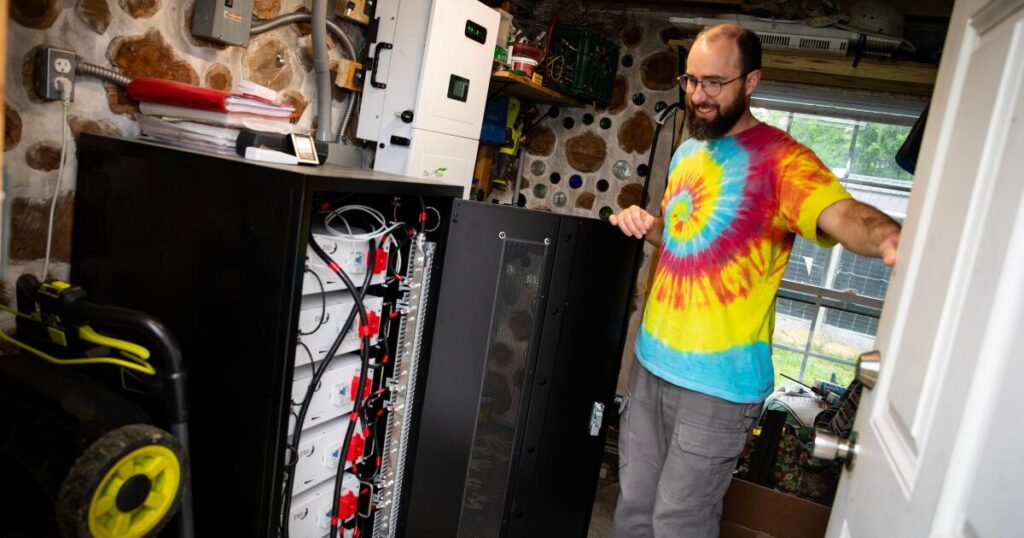
Americans can no longer get federal tax credits to install solar panels at home, but a growing number are using state incentives to add home batteries.
Homeowners installed a record 673 megawatts of battery storage in the first quarter of 2026, according to data from the U.S. Energy Information Administration.
States with high electricity prices and policies that encourage battery installation drove the surge. California and Hawaii led the country in new storage. Texas and Arizona also saw significant increases.
“You’re seeing state policy demonstrate its importance,” said Ari Matusiak, founder and chief executive officer at Rewiring America, a nonprofit that advocates for home electrification.
The battery boom comes as the residential solar industry is slumping after the Trump administration terminated a tax credit giving homeowners a 30% break on solar panel installations. The elimination of the benefit drove down new installations 10% in the first quarter of 2026 compared with the same period last year.
State policies, however, have boosted battery storage installations to new highs.
“The fact that California, Hawaii, Texas and Arizona are incentivizing battery adoption is the main reason for the trend,” said Cosmo van Steenis, a solar and storage analyst at BloombergNEF.
The first-quarter increase in battery installations was sharper than the firm had originally expected — and could trigger a revision to its 2026 forecast were the trend to continue, BNEF said.
In 2023, California added incentives to motivate solar customers to buy batteries by offering more favorable pricing for electricity exported from homes to the grid after sunset. In the first quarter of 2026, the state installed 1.2 megawatts of residential storage for every 1 megawatt of solar, according to a BNEF analysis.
Hawaii, where electricity can cost over three times the national average, launched a new program last year that offers homeowners a one-time $400 cash incentive for every kilowatt of battery storage added.
“The economics have suddenly shifted toward batteries because if you add on a battery to a system, you can access all these extra revenue streams,” said Van Steenis. “And solar on its own is no longer as economic as it was.”
The shift is transforming how solar and battery installation companies do business. Martyna Kowalczyk, founder and CEO of Solartime, a family-owned solar installer in the Dallas area, said she’s had to move her business away from solar installations because of the slump and toward panel maintenance and battery additions.
“Three years ago we would sell three batteries for 10 systems that we sold,” she said. “Right now it’s more like eight homeowners out of 10 are electing to do a battery.”
Some renewable energy companies are already vying to tap into growing home battery storage. Last week, home solar provider Sunrun Inc. announced a partnership with Tesla Inc. and Renew Home, an energy management company, to use stored power in hundreds of thousands of home solar batteries to supply artificial intelligence data centers and PJM Interconnection LLC, the largest power grid in the United States.
Maxwell writes for Bloomberg. Will Wade of Bloomberg contributed to this report.
The post More Americans are installing solar batteries at home. Here’s why appeared first on Los Angeles Times.