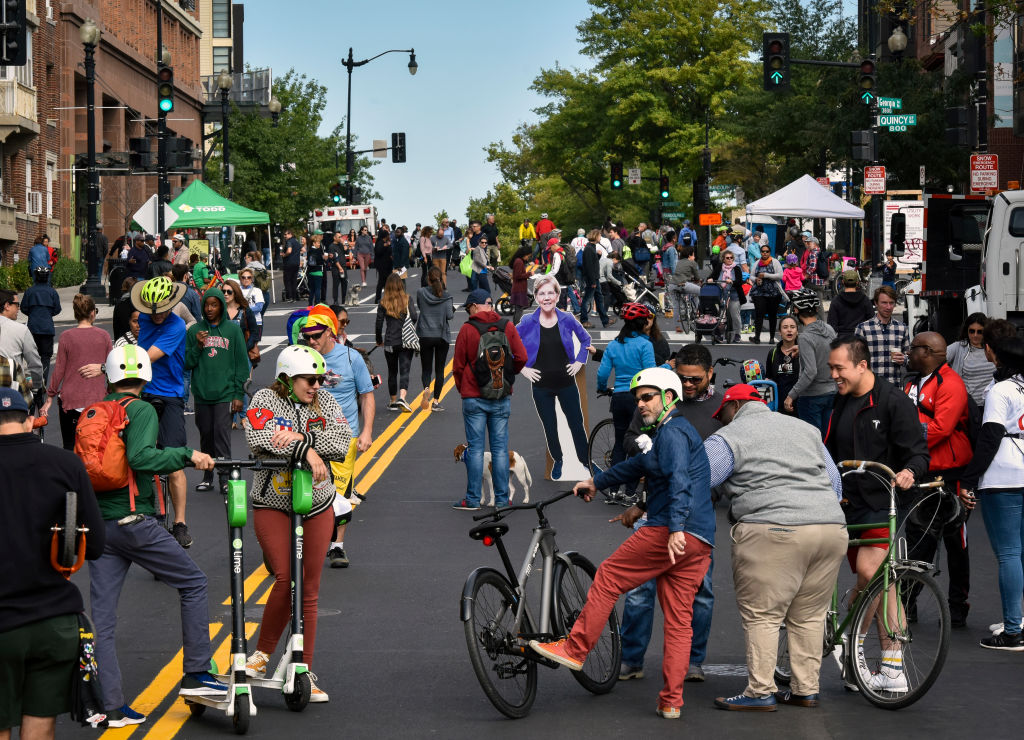
Every summer, a number of streets around New York City transform on Saturdays—with honking cars and slow moving traffic replaced with families with strollers, friends out for a walk, bikes weaving through. It’s part of the city’s “summer streets” program which turns busy city streets into a walker’s paradise, providing open space for one of the most densely populated cities in the U.S.
It’s not just New York. Around the world, a growing number of cities are reclaiming roads from cars. In San Francisco, a “Slow Streets” program initially started during the pandemic continues to provide an alternative to driving—and a way to build community. Over 100 streets in Paris have permanently become car-free—and city residents voted last year to add 500 more. A number of roads in Singapore close for “car-free Sundays.” Barcelona is ramping up adoption of its “superblocks” which permanently close off a number of blocks to vehicles.
The initiatives come with big environmental and health impacts.
A study published last month examined Ottawa’s summer weekend closure of Queen Elizabeth Driveway, a scenic, 3.5 mile parkway that runs alongside the side of a canal, and found that pedestrians and cyclists experienced an approximately 60% reduction in combined air pollution and noise exposure when vehicle traffic was removed.
“The presence of cars could make the difference between being able to hear your friend you’re walking or running with, for example, and not being able to hear them clearly,” says Liam O’Brien, professor of civil and environmental engineering at Carleton University and lead author of the study.
When it comes to reducing air pollution, a major benefit is lowering the amount of harmful fine particulate matter, known as PM 2.5, that is in the atmosphere—which is often emitted into the air as car exhaust. “The principal benefits are in local air quality—much fewer particulates go out into the atmosphere,” says Greg Marsden, professor of Transport Governance at the University of Leeds. One study in 2021 found that car-free Sundays in Rwanda produced an average reduction in PM 2.5of 15% and overall traffic activity decreased by 27% compared to normal traffic levels on Sundays. It’s a significant decrease—especially considering that the transition to electric cars alone won’t necessarily mean no particulate matter in the air. “We still have lots of particulates from breaking tire dust, stuff that’s on the road that gets picked up by cars,” says Marsden. “When you take cars off the road, you get rid of a lot of that.”
Spaces without cars also provide opportunities for safe exercise in urban environments that often lack open space. “A lot of people use pedestrian streets for the sake of relieving stress and getting exercise, especially in urban environments…and so to bring cars into those spaces where people are seeking exercise, stress relief, a chat with a friend, etc. is really problematic,” says O’Brien. As an added benefit, people get to enjoy fresher, less polluted air.
Car-free zones also bring more foot traffic to local businesses. When New York City opened streets up to pedestrians during the pandemic, restaurants on “open streets” saw more business than those on nearby, car-friendly streets.
The change isn’t limited to major metropolitan areas. Smaller towns can do it too—whether it be closing off the inner roads of a city center on a weekend, or a couple blocks surrounding a school.
These car-free days can serve as a reminder that, despite how ingrained cars have become in the modern world, they don’t have to be a necessity—there are other choices that can be better for both our health and environment. “People have just accepted this slow-drip growth of cars and are now living in neighborhoods that are overwhelmed by cars, but they can’t see a way out of it,” says Marsden. “As an individual, you can’t make a different choice. You getting the bus does not solve the traffic problem in your area. What these car-free days do is to say, look, when we’ve got all this space, you have children independently cycling around, people are walking in the street. We can reimagine some of the areas as mini parks, places to sit and chill out…It gives us that opportunity to have a different discussion about, is that really what we want for the future?”
The idea is becoming increasingly popular. In New York, a group of 29 current and former elected officials in March asked the city’s Department of Transit to expand the car-free streets program into a cohesive network to “create a continuous car-free backbone for walking, biking, and recreation.” Mayor Zohran Mamdani, meanwhile, campaigned on funding and expanding the city’s year-long open streets program, and plans to allocate a baseline funding of $6.4 million per year for open streets through the 2030 fiscal year.
It’s proof that a future does not have to be car-dependent, says O’Brien. “We can provide alternatives that are not only more sustainable, but also more desirable.”
The post How Communities Thrive When City Streets Ditch Cars appeared first on TIME.