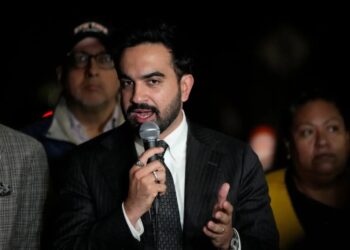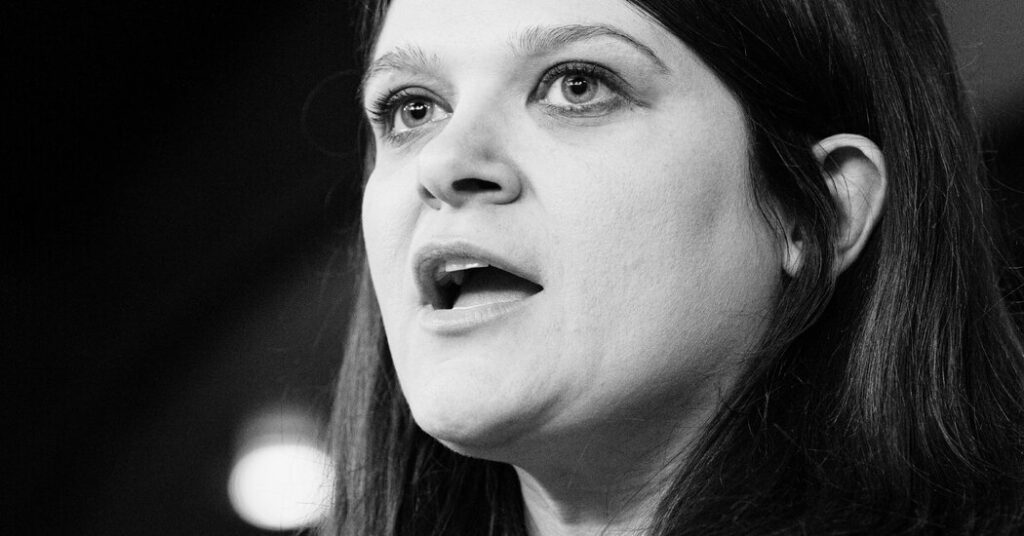
The three-way Democratic Senate primary in Michigan is a remarkably precise microcosm of the divides within the Democratic Party. Representing the Bernie Sanders wing is Abdul El-Sayed, a proponent of Medicare for All who supports abolishing ICE and cutting off arms to Israel. The candidate of the Democratic establishment is the passionately pro-Israel congresswoman Haley Stevens, backed by the Senate minority leader, Chuck Schumer. Between them is the liberal state lawmaker Mallory McMorrow, endorsed by progressive senators including Elizabeth Warren and Chris Murphy.
Most recent polls show El-Sayed ahead, reflecting a Democratic electorate that’s increasingly furious with party leaders and open to left-wing insurgents. His lead has panicked some centrist Democrats. According to The Wall Street Journal, Michigan’s retiring Democratic senator, Gary Peters, is telling people that McMorrow, running a distant third in recent polls, should consider leaving the race so that Democrats can coalesce around an alternative to El-Sayed. “The chatter is growing louder that you should drop out,” a CNN host told McMorrow last week.
Behind that chatter is the assumption that Stevens represents the Democratic Party’s best hope of holding a crucial Senate seat. But while the case for her candidacy rests on electability, it’s far from clear how electable she really is. Mainstream Democrats like Schumer have a theory about the kind of candidates who can win in purple states, but that theory might be outdated.
Conventional wisdom holds that moderates outperform progressives in competitive elections. Though there’s a robust academic debate about whether this is really true, it’s easy enough to find anecdotal evidence. The most progressive candidates generally come from deep-blue districts, while candidates who flip Republican-held seats — like Marie Gluesenkamp Perez in Washington State and Tom Suozzi in New York — tend to be more centrist. In a May New York Times/Siena poll, Democrats and Democratic-leaning independents wanted to see their party move left on economics, but become more moderate on crime and immigration.
So all things being equal, an air of moderation is likely an advantage in purple states. But in Michigan, all things are not equal. Stevens is not a particularly adept politician. Many of her views are out of step with both Democratic and independent voters in ways that could hurt turnout. She’s a creature of the Democratic establishment at a moment when that establishment has never been more reviled.
In 2022, Stevens defeated Representative Andy Levin, a Jewish liberal Zionist targeted by AIPAC for his support for a Palestinian state. AIPAC spent heavily in the race, and when Stevens won, the group crowed, “Being pro-Israel is both good policy and good politics!” In office, Stevens has been a consistent champion of the Jewish state. “Israel comes to me in my dreams!” she shouted in a viral 2023 speech.
Whatever your views on policy, however, it’s increasingly hard to argue that being pro-Israel is good politics. A February Gallup poll found that, for the first time since at least 2001, more Americans — including more political independents — sympathize with the Palestinians over the Israelis. In Michigan’s Senate primary, AIPAC is once again spending lavishly on Stevens’s behalf, but its support could become a liability, particularly in a state with the country’s highest share of Arab Americans. It’s not hard to imagine that some of the voters who declined to back Kamala Harris in 2024 because of the war in Gaza might also refuse to vote for Stevens.
This month, a poll done for Common Defense, a progressive veterans group that has endorsed El-Sayed, tested each of the three Democratic primary candidates against the presumptive Republican nominee, Mike Rogers. It found each of them narrowly ahead, but Stevens’s margin — 43 percent to Rogers’s 42 percent — was the thinnest, a result of weak support among the most left-leaning voters.
Obviously, polls by interest groups need to be taken with several grains of salt. But Adam Carlson, whose firm Zenith Research conducted the survey — and who had been a vocal supporter of McMorrow on social media — insists that he doesn’t shape his research to fit his clients’ narratives. (If clients don’t like his results, he says, they can refuse to release them.) His poll for Common Defense showed El-Sayed faring best against Rogers, with 45 percent of the vote. It was a finding in keeping with what he’s witnessed in focus groups nationwide. “I have never seen this level of anger, frustration, discontent and anti-elite, anti-billionaire populist sentiment,” he said.
Stevens is on the wrong side of this sentiment in several ways. Unlike El-Sayed and McMorrow, she accepts money from corporate PACs, including those in the finance and insurance industries. While both of her opponents have released ambitious plans to regulate artificial intelligence, Stevens offers optimistic bromides about the technology. “We know that we’ve got to compete against China, and the way we are going to win the future is from a place called Michigan,” she said during a debate last month.
It makes perfect sense for people who agree with Stevens about salient issues to vote for her. What makes less sense is the conviction that she’s uniquely well positioned to win in November. Michigan currently has six Democrats in the House. As the writer Matt Yglesias, usually a strong advocate of centrism, pointed out, in 2024 Stevens had the worst wins-above-replacement rating — a measure which uses partisan dynamics to compare candidates’ expected margin of victory to their actual performance — of any of them. “I think moderation and policy positioning are incredibly important, but they’re not all that matters in politics and Stevens is literally a worse performer than Rashida Tlaib,” the left-wing congresswoman from Detroit, he wrote last year.
It’s perfectly understandable for mainstream Democrats watching this race to be anxious. I’m anxious. But when the electorate is this unhappy, it’s not necessarily safe to stick with the status quo.
The Times is committed to publishing a diversity of letters to the editor. We’d like to hear what you think about this or any of our articles. Here are some tips. And here’s our email: [email protected].
Follow the New York Times Opinion section on Facebook, Instagram, TikTok, Bluesky, WhatsApp and Threads.
The post ‘Moderate’ and ‘Electable’ Are Not Synonyms appeared first on New York Times.