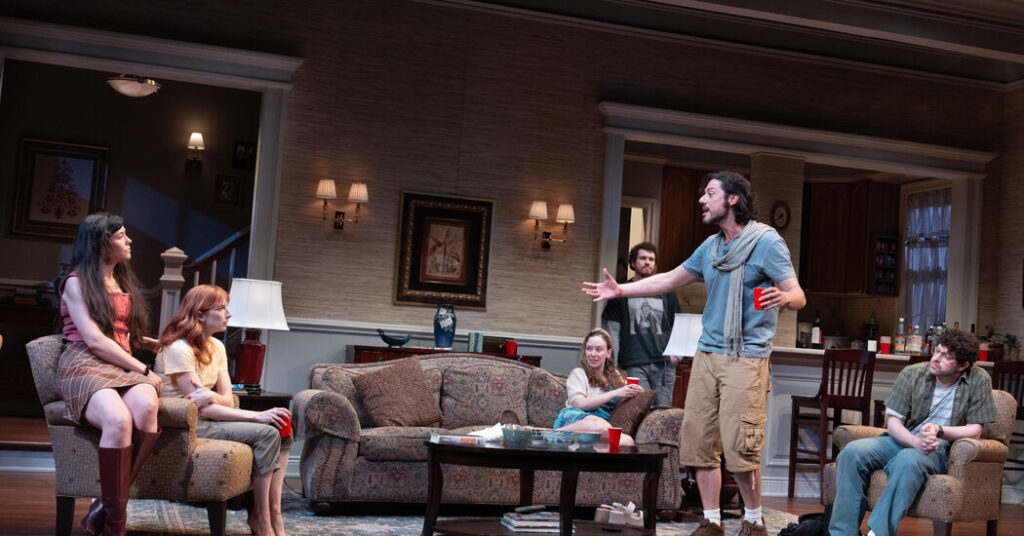
In Jonathan Spector’s “Birthright” — a thrillingly constructed drama about six Jewish American friends — the whole world is built out of conversation. More than three hours of overlapping speech race along without our feeling the passage of time, even as nearly two decades of the characters’ lives go whizzing by. Reminiscence piles on confession, argument on exegesis. We witness the characters’ major life events only second hand, since, Spector’s climaxes are reserved for actions like quoting and synthesizing and, in one long-delayed move, profoundly listening.
The initially tight-knit group forms in 2006, on an all-expenses-paid educational trip — one of the Birthright tours, which are offered to young Jewish adults to foster their connection to Israel. We meet the new friends as they gather just three weeks after the 20-somethings have come back to the United States. They curl up on couches in a suburban Virginia living room, drinking booze out of red Solo cups, trying to recreate the intensity of the 10 days they’ve shared.
Or did they share them? From the outset, there’s a “Rashomon” quality to their accounts of Israel-via-Birthright: Some saw beauty, others saw propaganda. “Anytime I try to talk to anyone about the trip, it’s like … it’s like telling someone about your dream,” says the fierce Izzy (Molly Bernard).
Spector is best known for his Tony Award-winning comedy “Eureka Day,” in which a progressive school’s parent-led board tears itself apart over vaccines. In the larger, sadder “Birthright,” directed by Teddy Bergman, he uses similar strategies: a periodic structure — we check in on the group via their irregular reunions — and video images of the characters’ social media posts and group chats. (David Bengali did the impressive projection design.)
Again Spector beautifully orchestrates his complex dialogue, which includes both tart, percussive comedy and a certain pianissimo melancholy. Here, though, his thematic ambitions have been multiplied and deepened.
Birthright Israel is depicted as one part heritage tour, one part keg party. In the first act (called “Two Jews, Three Opinions”) the take-charge Chaya (Zoë Winters) has invited the other five over to her parents’ home, where she and Izzy gossip about all the binge drinking and hooking up that the Americans squeezed into a week and a half.
The play teaches the audience a glossary too: The fervent Alona (Molly Ranson) is considering making aliyah (moving to Israel), and, in worrying about her, the others decide they are one another’s mishpucha, by which they mean “extended family.” (Definitions are important: Nearly 20 years later, this mishpucha will fight over the word “genocide.”)
Most are from tradition-keeping Jewish households — there’s an odd bro out, Emerson (Nate Mann), who’s only celebrated Passover once — but Spector gives each of them a tempestuous, quasi-romantic relationship with their faith and with Israel. This sensation of volatile yearning pervades: Noah (Eli Gelb) adores Chaya unrequitedly, and everyone seems enchanted by the group’s true seeker, Lev (Hale Appleman). In Act I, Lev arrives after having disappeared in Israel, mid trip. He walked away from Birthright to look for an unmediated Israel, and Spector’s own big-r Romantic tendencies align with Lev’s roving, curious spirit.
In a company of rigorously realistic performances, Appleman plays Lev as a man who hears other music: He’s a tall, willowy guy, and he sort of drifts when he walks. Spector is sparing with Lev’s presence throughout, since both the play and the characters regard him as a moral authority. (Emerson’s late-breaking quotations of rabbinical wisdom cannot compete, though Chaya’s chatty mother, played with sweet ditziness by Liz Larsen, does have her own wisdom to offer.)
The third act is set in 2024, and its air of agitated mourning partly reflects the group’s abraded state since the Hamas-led terrorist attack on Oct. 7, 2023, and the ensuing war. The play fully broaches the estranged friends’ attitudes about modern Israel: Alona has started a family there, but Izzy’s anti-Zionism and fury over Palestinian deaths in Gaza have whetted each other like blades.
In one of Spector’s few transparently manipulative twists, he ensures that Lev never weighs in on their disputes. Instead, the others cite him, Talmudically, to one another, claiming him first for one side, then the other. (The only “birthright” Lev has ever claimed is the immense, shared pain of trying to reconcile the “miracle of a Jewish homeland” with the suffering surrounding it.)
Spector seems to hate, above all things, the impervious mind, so his plays incorporate controversies (vaccines, say, or Israel) partly because they let him explore the poetics of argument. Spector, for instance, is clearly not a fan of what the smartphone has done to in-person conversation. The director Bergman and sound designer Lee Kinney fill the room with a buzzing drone whenever a character looks at a screen: Alona misses a greeting because she’s rating her Uber driver; Chaya and Izzy score points in their escalating quarrels while compulsively checking Google for a slam-dunk reference.
And another discourse surrounds the play itself. We learn a lot about it just from walking through the theater’s front door: The audience can’t enter the MCC complex without first going through a metal detector or putting its phones in a sealed pouch.
The second precaution has to do, I assume, with the occasional nudity that takes place thanks to Chaya’s parents’ hot tub. (Scott Pask’s handsome set design requires two intermissions so that the scene can shift from indoor to outdoor and back again.) But that metal detector, the one I’ve never encountered at MCC before? The theater invites us to think about danger, perhaps from antisemitic violence, perhaps from reactionary protest. Or both.
Of course, regardless of the risks of having these public conversations, playwrights keep having them. Recent plays like “The Ally” by Itamar Moses and “A Prayer for the French Republic” by Josh Harmon also featured impassioned, intra-community fights about Israel. Spector appears less involved than either Moses or Harmon in the specifics of the Jewish diaspora’s Zion-or-not debate — in “Birthright,” salvos on this topic are delivered at speeds that are deliberately impenetrable. Instead, Spector keeps his focus on his heartsick Americans, safe, for the moment, in Chaya’s comfortable living room. His drama isn’t really political, as such; he’s most interested in whether any group can survive once it abandons debate.
As an answer he posits Judaism itself, even though it seems to be the friends’ most contested ground. At one point, Lev quotes the (real) historian Yosef H. Yerushalmi on the religion’s relationship to collective memory, which must be preserved through repetition and tradition. In the play, ritual emerges as a correction to the centrifugal forces in modern lives; each wedding or shiva or reunion is a chance to gather and not fly permanently apart.
Something Chaya’s garrulous mother Deborah says in Act II — the play’s strongest — may actually be the play’s advice and consolation. “It’s just such a blessing to have this community,” she says, smiling, to two women who have just shouted cruel things at each other. Deborah doesn’t think the two aren’t fighting. Fight, don’t fight, what’s the difference? She just knows that if they keep fighting, year after year, they’ll stay together. There is more than one way to give a blessing.
Birthright Through July 26 at MCC Theater, Manhattan; mcctheater.org. Running time: 3 hours 20 minutes.
The post ‘Birthright’ Stages a Thrillingly Complex Conversation on Conversation Itself appeared first on New York Times.