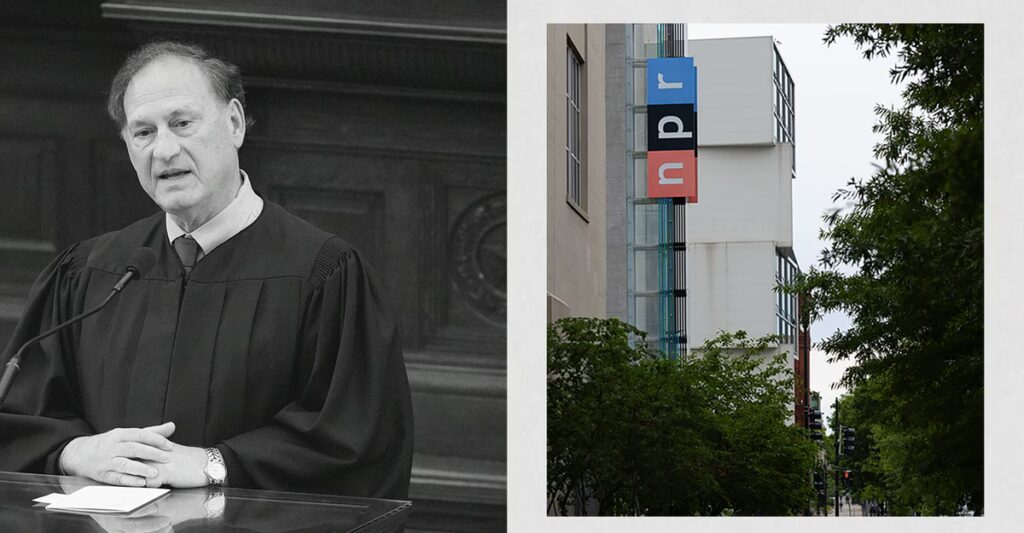
It was all a “misunderstanding.” That’s the word that NPR Editor in Chief Thomas Evans used to describe why, today, the outlet erroneously published a report by the veteran Supreme Court reporter Nina Totenberg that Justice Samuel Alito had retired. According to an archived copy, available on the Wayback Machine, the 1,186-word story was published at 10:51 a.m. eastern time. In the story, Totenberg attributed her reporting to the Court itself, not to an anonymous source. Minutes later, the Supreme Court’s public-information office said that the Court had not made any such announcement.
NPR, to its credit, quickly retracted the story, issued a correction, and apologized. Because NPR syndicates its reporting to hundreds of public-radio affiliates across the country, the incorrect news of Alito’s retirement was picked up by numerous stations before needing to be retracted by them as well. At least one publication—Vox—followed NPR’s reporting and also had to retract a story. The result: roughly an hour of speculation and unnecessary chaos on what was already an intense day of rulings for the Court, including a decision allowing states to bar transgender athletes from girls’ and women’s sports and a rejection of President Trump’s executive order on birthright citizenship.
So what really happened here? NPR’s public editor, Kelly McBride, wrote this afternoon that Totenberg had listened to Chief Justice John Roberts announcing retirements at the Court and misheard the statement. She then contacted her intern at the Court and the NPR executive editor who published the story. (NPR and the Supreme Court press office did not respond to a request for comment.) The New York Times reported that the story lacked extra steps of verification because it cited an announcement instead of an anonymous source.
According to McBride, much of the story had been prewritten in anticipation of Alito announcing retirement. This is a common practice for reporters who cover a specific beat; in some cases, as with high-profile elections, reporters write two versions of the same story, anticipating either outcome. Prewriting is also a common practice for obituaries. The archived story includes at least one flagrant typo, suggesting that perhaps the story was published before it was ready.
This is a scenario that reporters lose sleep thinking about. There are numerous potential lessons here: that a breakneck news cycle is forcing even the best reporters and editors to move too fast, that modern beat reporting itself has become too consumed with being first to report stories where the “exclusive” title adds little value. (Totenberg’s story, which was packed with expert context and analysis, would have been valuable even if it had been published five minutes after a competitor.) You could also make an argument that such errors have never been costlier in an era when trust in media has never been lower, or that the very dynamics that push legacy news outlets to rush and lose credibility are the very ones that reward shock jocks and those peddling misleading information.
But, attempting to document the fallout from the NPR story, I’m struck by how little there was. Outside of a confusing few minutes, very few people other than media critics and Court observers have seemed to care about the mistake. The right-wing media feeds I monitor—full of people whose livelihoods depend on disparaging the mainstream media as “fake news”—barely registered the error, aside from a half-hearted post here and there. A few explanations seem to exist for this: First, NPR’s quick retraction makes it harder to spin a convoluted conspiracy theory. Second, MAGA media is far more focused on the Court itself and the rejection of Trump’s birthright-citizenship executive order. Third, it’s just possible that on an internet dominated by gambling sites, news influencers, propagandists, slop, and gossip, the error is not nearly as scandalous as it once was to be colossally wrong for a few minutes.
NPR’s mistake is, by journalistic standards, a massive blunder. A valid question though is how many people still care about those standards. The lack of handwringing from outside legacy media may indicate a bigger shift. NPR sits squarely in what is known as the “mainstream” media. But the moniker is outdated for our current age. From newsroom missteps to swift, public corrections and contrition, the codified standards and practices of outlets such as NPR—namely, obsessions with accuracy, fairness, and public correction—are no longer quite so mainstream in a world dominated by nimble new media.
On my feed this afternoon, I saw one person post that perhaps Totenberg “was just trying to time the story release to hit just after placing her Kalshi bet on when Alito would retire.” The post appears to be in jest, and, to be clear, there is absolutely zero evidence to suggest this. But the joke is not really about Totenberg. It is about the cynical nature of our current moment and the broader feeling of living in a low-trust society—one in which a U.S. soldier can be charged with betting on prediction markets using classified information and where news organizations such as CNN, Dow Jones, and CNBC are partnering with those same companies for polling insights. In a world where everyone is now constantly suspicious of insider trading, manipulation, and ulterior motives, it makes sense that NPR’s mistaken report would barely register as a news story. For NPR, perhaps the only thing more unnerving than a giant misstep like this one is few people paying attention to it—and to the organization—at all.
The post A Tough Day for NPR appeared first on The Atlantic.