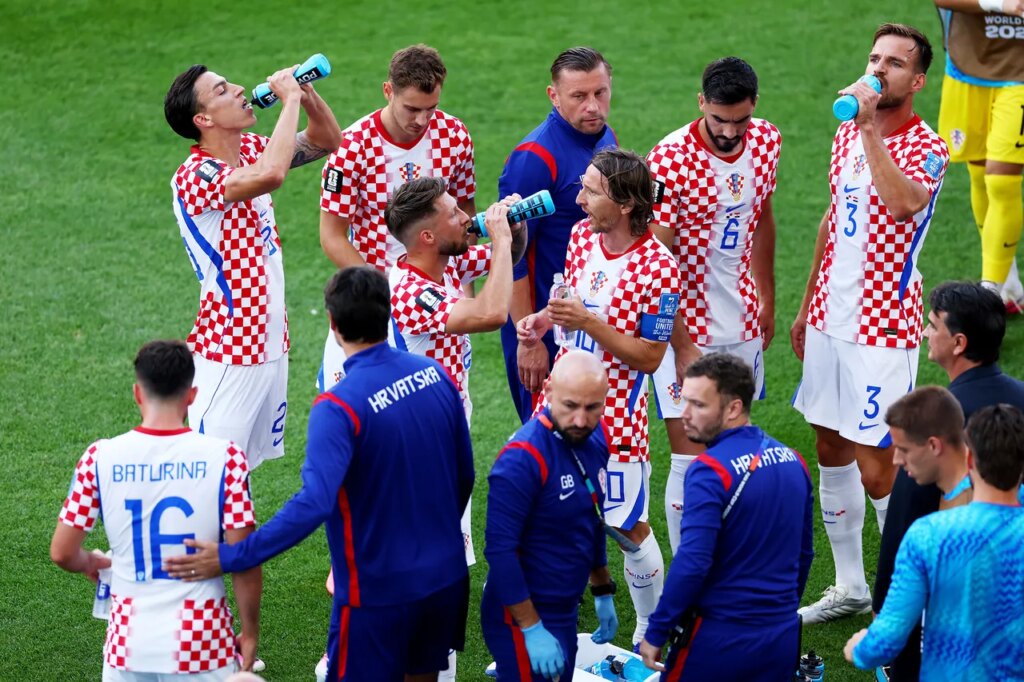
Tune into any World Cup match in the US, Mexico, or Canada this summer, and you will find that around the 22nd and 67th minute of any game, the plays will stop. For the first time ever, FIFA has introduced three-minute hydration breaks, which are officially framed as a player welfare measure to combat extreme heat. The breaks will take place regardless of the weather outside, even on relatively mild days in New York or Los Angeles.
While FIFA does not break down exactly how much revenue is tied to these new in-game stoppages, the intermissions introduce predictable and guaranteed commercial windows into live broadcasts, creating new advertising inventory. There has been backlash from fans and players, with many arguing that the commercial interruptions disrupt the flow of a sport defined by continuous play.
Ghazi Saoud, a 26-year-old half-Lebanese, half-Norwegian football fan living in Chicago, who is rooting for Norway and Morocco this World Cup, describes the hiatuses as “concealed advertisement breaks.” Saoud argues that part of what makes football unique is that it has been played largely the same way for more than 150 years: 90 minutes, two 45-minute halves and predictably continuous play. Water breaks have always existed, he says, but only when they were actually needed; Saoud, like many others, believes scheduled breaks change the rhythm of the game.
Here’s WIRED’s complete guide to the 2026 FIFA World Cup.
“I see the argument under conditions of climate stress, but you need a break, you need an extra drink—you don’t need three minutes,” says David Goldblatt, one of soccer’s leading historians and the author of The Ball Is Round: A Global History of Football. “Nobody needs three minutes to drink a glass of water. Why are they three minutes?” Fox, he notes, is estimated to be making about $250 million in the US on commercials that run during hydration breaks, according to expert analysis given to BBC Sport.
The tension over these breaks is really a fight over what the World Cup is becoming. Around $3.9 billion is expected to come from broadcast rights alone, meaning networks like Fox in the US or the BBC in the UK are paying FIFA to stream the World Cup, and another $1.8 billion is expected from sponsorship and marketing. Based on forecasts from WARC Media, a UK-based advertising research and intelligence firm that tracks global media spend, the tournament is expected to inject around $10.5 billion into the global advertising market in 2026.
For some sports experts, this broader commercialization effort by FIFA reflects something else: a shift toward American-style sports entertainment. “I think you do see a definite Americanization in this particular World Cup,” says Mark Dyreson, professor of kinesiology and sports history at Penn State. “I think what FIFA is doing is sort of normal and natural in the course of business although it offends a lot of longtime soccer connoisseurs.”
Goldblatt cautions against treating the 2026 World Cup as a sudden turning point. “Football’s been commercializing like crazy for 40 years,” he says. “It’s been taking lessons from the United States sports market in a hundred different ways for the last 30 or 40 years.”
In many ways, the trend was already visible in Qatar. The 2022 World Cup was reported as the most-watched tournament on record, engaging with more than 5 billion viewers, which helped FIFA generate $7.5 billion across the 2019-2022 cycle. Broadcast rights brought in roughly $2.96 billion in 2022 alone, compared with the nearly $3.9 billion FIFA is projecting for 2026.
Still, some experts to argue the hydration breaks are less about money and more about adapting the World Cup to a changing media landscape.
Simon Chadwick, a professor of sport and geopolitical economy at SKEMA Business School, says FIFA is actively trying to stay competitive in an increasingly crowded sports and entertainment market, where leagues from the NBA to Formula 1 are all competing for the same audiences, attention, and screen time. “In some ways, what is happening with FIFA is FIFA’s attempt to maintain market share and stay relevant,” he says.
The focus on the US market is no accident, Chadwick adds. “FIFA’s intention was always to reap the commercial benefits of hosting a tournament in the biggest domestic sporting economy in the world,” he says.
Hydration breaks also come amid an undeniably warming climate. FIFA defended the hydration-break policy in a statement, saying the stoppages will take place in every match regardless of temperature “to ensure equal conditions for all teams, in all matches.” The player safety measures are only likely to become more relevant as climate scientists predict the hottest year ever recorded could arrive by 2030. Chadwick says he sees a practical logic behind the blanket policy, arguing that it is easier for FIFA to apply the same rule to every match than debate where the temperature threshold for a break should begin.
FIFA rejects the idea that the breaks were introduced to create new advertising inventory. A FIFA source says most broadcast deals were signed before the hydration breaks were announced in December 2025, arguing the policy was instead a response to player complaints about competing in extreme heat during last summer’s Club World Cup in the US.
Hydration breaks are only one many shifts soccer fans are contending with during this year’s World Cup. FIFA has already priced many fans out through dynamic ticket pricing, despite opposition from Football Supporters Europe (FSE), and is now bringing another Super Bowl staple to football’s biggest stage with a halftime show. Shakira, Madonna, and BTS are set to perform at the World Cup final in New Jersey on July 19, adding another entertainment layer to a tournament increasingly focused on the spectacle beyond the match itself. For the final 104th match, nosebleed tickets are going for around $25,000 on Ticketmaster, while a relatively “good” seat will cost you north of $30,000 from a reseller.
Taken together, the changes have fueled comparisons to the Super Bowl, where the sport itself shares the spotlight with celebrity performances, premium ticket packages, and some of the most expensive advertising slots in television. Yet for all the similarities, soccer remains a very different broadcast product. A typical Super Bowl features around 60 to 70 commercials spread across roughly 20 scheduled ad breaks, while the World Cup is still built around 90 minutes of largely uninterrupted play in comparison.
“It’s completely insane to compare [the World Cup] to the Super Bowl,” Goldblatt says. “Nobody cares about the Super Bowl outside of the United States, apart from a few Israelis and Germans, or expats in London, who like to watch the NFL.”
And while the experts say the World Cup and Super Bowl are fundamentally different products, Dyreson argues it would be a stretch to say FIFA isn’t borrowing some tactics from the NFL playbook. “The television-show approach that the NFL does is attractive to FIFA,” he says.
At the same time, he is skeptical of the idea that football is suddenly being corrupted by commerce. “There never was a ‘Golden Age’ when sports weren’t commercial,” he says. “You will never find such a period in world history.”
From alcohol and gambling to sponsorships and festivals, Dyerson explains the sport has always been tied to business. The first alcohol advertisement on a European soccer shirt appeared in 1973, when German club Eintracht Braunschweig wore the logo of liquor brand Jägermeister after finding a way around the country’s sponsorship rules.
Chadwick says that fans should expect features like hydration breaks to remain part of future World Cups, especially as games get hotter and hotter due to climate change. Fans may also see more shifts like the one in Qatar, where the 2022 World Cup was moved to November and December to avoid extreme summer temperatures.
With the 2030 tournament set to be hosted across Spain, Portugal, and Morocco, Chadwick argues football will increasingly have to adapt to a warming world. “Damned if you do, damned if you don’t,” he says about FIFA’s changing policies. Goldblatt suspects the compromise in future tournaments may be shorter hydration breaks, but not more frequent ones, adding that it is unlikely FIFA would introduce additional stoppages beyond what already exists.
Dyreson is less concerned. “You will always have the purists arguing that they’re diluting the game in pursuit of profits,” he says. “[But] none of the purists are tuning out, maybe they’re going and getting a snack when the hydration break is going on, but they’re still sitting there watching.”
This article originally appeared on WIRED Middle East.
The post Everyone’s Mad at the World Cup’s New ‘Hydration Breaks’—Except Mr. Moneybags Over Here appeared first on Wired.