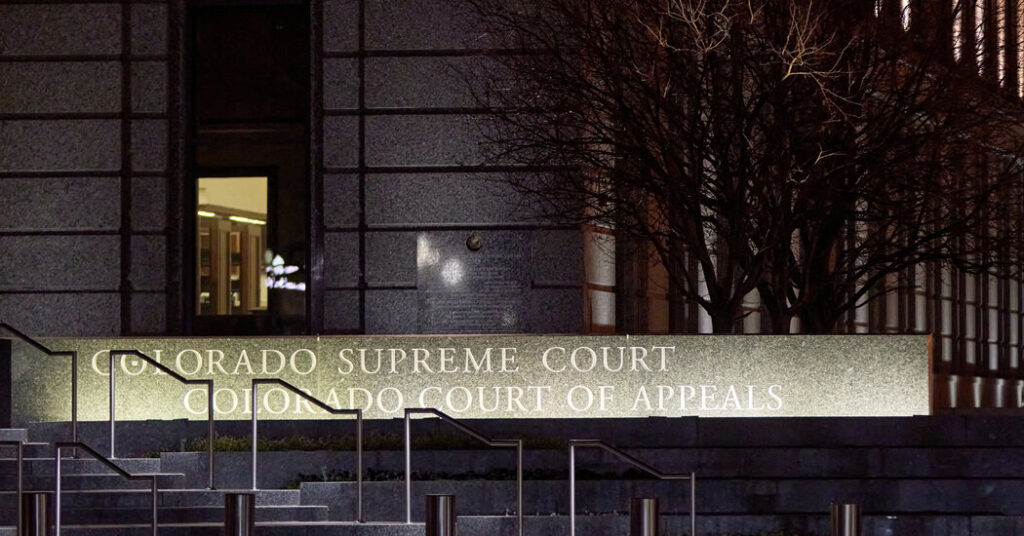
The Colorado Supreme Court dealt a significant blow to Democratic hopes to redraw the state’s congressional maps ahead of the 2028 election, finding that the twin ballot initiatives they had sought in order to redistrict in an off year had violated the state constitution.
The court found that the two ballot proposals violated the “single subject requirement” governing such measures in Colorado law. Democrats had sought to satisfy that mandate by submitting two separate questions — one to conduct an off-year redistricting and the other to temporarily suspend the state’s independent redistricting commission.
However, each initiative included a clause stating that it would take effect only if the other proposal were also approved by voters this November. That amounted to disqualifying evidence that the Democrats were trying to sidestep the single-subject rule, the state’s high court ruled.
“We conclude that the result is not different and that when a measure’s effectiveness is expressly contingent on the passage of a separate and independent measure, the measure contains multiple subjects, just as if the measures were combined into one,” Justice Richard L. Gabriel wrote.
The decision throws the entire redistricting effort into doubt. Democrats were already working on a tight deadline to collect the necessary signatures and get the ballot proposal before voters this November.
Colorado was one of Democrats’ top targets in the next phase of the national redistricting wars, which resulted in a flurry of redrawn maps for the 2026 midterms but have since moved on to what more can be done in time for 2028.
Democrats had hoped to draw as many as three new blue-leaning districts ahead of congressional elections in 2028. Only Virginia and New York could provide a bigger haul of newly gerrymandered seats for Democrats for the next election cycle. Without Colorado, Democrats’ plan to draw even with — or possibly ahead of — Republicans in 2028 congressional lines faces an unknown future.
“The success of this partisan attempt to sideline Coloradans from responding to Donald Trump’s unprecedented mid-decade redistricting scheme is disappointing,” said Curtis Hubbard, a spokesperson for Coloradans for a Level Playing Field. “While Trump and his MAGA allies regularly sidestep the law and ignore voters, efforts to respond have once again been dealt a legal setback over a technicality.”
Democrats now must start over to try to change state law and under an incredibly compressed timeline. To place a fresh ballot initiative before voters this November, organizers will need to obtain signatures from roughly 125,000 registered Colorado voters before Aug. 3.
Because signature gathering can be a wildly unpredictable process, the Democratic organizers had been aiming to file roughly 200,000 signatures per initiative. And they still had a ways to go: According to a legal brief filed last week, organizers had accumulated roughly 43,000 signatures per initiative.
Leaders of the redistricting effort said on Monday that it was too soon to determine whether a path forward remained.
Republicans in the state, who had challenged the proposals as unconstitutional, celebrated the decision.
“Eight years ago, Colorado voters strongly supported an independent redistricting commission,” said Scott Gessler, one of the lawyers representing the Republican challengers. “Today, the court soundly rejected the Democratic efforts to manipulate the ballot process to overturn Colorado’s nonpartisan redistricting process.”
The post Colorado Supreme Court Rejects Democratic Redistricting Plans appeared first on New York Times.