Every year, a million people wander through the temple-like rotunda of the National Archives and peer through a thick glass case to glimpse the document upon which this country was founded.
They are struck by awe — and also by the toll that time and negligence have taken on the Declaration of Independence.
The ink, including John Hancock’s defiantly oversized signature, has faded to near invisibility. It is further disfigured by creases, water stains, and a grimy handprint covering part of its lower right corner.
The document looks even shabbier next to the nearly pristine Constitution, with its legible typeface, displayed yards away and written only a decade later.
Yet in their own way, those marks of time on the 250-year-old parchment, and the stories behind them, tell the history of the country — its flaws, its aspirations and its perseverance.
Two and a half centuries ago, the newborn United States did not yet reflect the “self-evident” truths that “all men are created equal,” with rights that included “Life, Liberty and the pursuit of Happiness.” Nearly three-quarters of the 56 signers of the Declaration of Independence were slaveholders. And only property-owning men had the right to vote.
But the power of the Declaration impelled the country toward making what it espoused a reality.
Sun, smoke and a mysterious handprint
The people entrusted to take care of the Declaration had two duties that were often in conflict: preserving it and making it accessible to the Americans who owned it. Many of their well-intentioned efforts only rendered it more delicate.
By 1820, Secretary of State John Quincy Adams was so alarmed by the document’s physical decline that he commissioned master engraver William J. Stone to make an exact copy. But the process of producing the facsimile — creating a copperplate through a “wet sheet transfer” from the parchment — lifted much of the original ink.
Fewer than 50 of Stone’s roughly 200 copies are known to exist; billionaire philanthropist David Rubenstein has bought a dozen, the most recent from a descendant of James Madison, its original owner.
“They degraded it purposely to make these replica copies, and so that’s why it’s so degraded now,” Rubenstein said.
Then came two more enemies: sunlight and carelessness. The Declaration spent 35 years in the mid-1800s on a south-facing wall of the Old Patent Building (which now houses two Smithsonian art museums), absorbing the sun’s rays and exposed to fluctuations of temperature and humidity. It was then moved to the State Department library, where it was subjected to diplomats’ second-hand cigar and cigarette smoke and an open fireplace, for 17 years.
The mysterious handprint and other finger marks appeared some time between 1912 and 1924, a span when the document was transferred from the State Department to the Library of Congress, said National Archives historian Jessie Kratz.
Kratz hopes to crack the century-old cold case, with help from the FBI’s historic fingerprint database.
“In the forties, they had a million fingers already,” Kratz said. “So I would like to get imaging to the FBI, to try to see if they can do the fingerprint — just to find out whose it is. Because we blame the State Department. We blame the Library of Congress. Who was it?”
But she acknowledged that, unless the archives can figure out a way to produce a clearer image of the print, it may not be possible to track down the culprit.
The Declaration demands all this attention because it is more than a mere relic. “It’s a time machine that brings us back to that moment when the world was going to be new, and when all of our best hopes were possible, and signed by the men who brought this country into being,” said historian Michael Auslin, author of a new, deeply researched book titled “National Treasure: How the Declaration of Independence Made America.”
Rubenstein, owner of the Baltimore Orioles, has made copies of his replicas, framed them and sent them to the owners of every major league baseball and basketball team. He plans to do so with National Football League owners as well, in hopes the Declaration will go on display in stadiums across the country.
“What I’m trying to do is explain why the document is so important,” he said. “Any civilization should know about its past if it’s going to avoid some of the mistakes the past and do better things in the future.”
A clandestine journey with an unsung hero
So why was the nation’s founding document so fragile to begin with?
The original, signed by the founders, was penned by hand on parchment, which is treated animal skin, usually from a goat or calf.
Parchment was used in those days to make important records because it was durable, and mistakes could be scraped off and corrected. But it is also unstable and vulnerable to temperature and humidity; if not treated with care, parchment expands, contracts, buckles and becomes moldy.
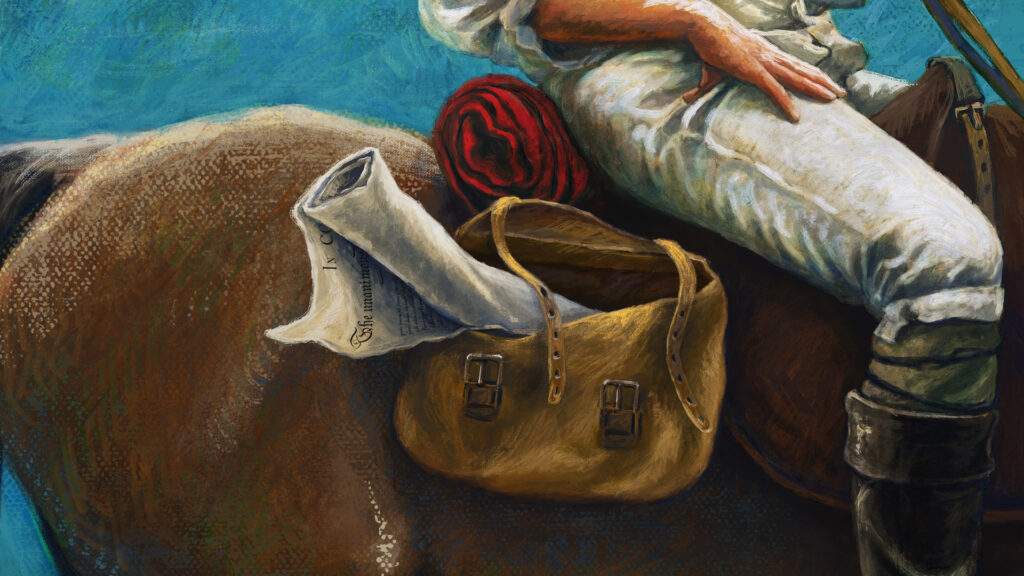
During the chaotic years of the Revolutionary War and afterward, as the government was taking shape, the Declaration traveled from city to city with the Continental Congress — unrolled, re-rolled, crushed and folded along the way, and possibly jammed into saddle bags. It arrived in the District of Columbia, the young nation’s new capital, in 1800, aboard a sloop that had carried it from Philadelphia, packed among furniture and trunks.
There was at least one moment when its very survival was in jeopardy.
During the War of 1812, a State Department clerk named Stephen Pleasonton spirited the Declaration, and other valuable documents, out of the building. He wrapped them into bags of rough linen, put together a convoy of wagons that escaped the city by dirt roads and found a hiding place for the documents in the cellar of a deserted house in Leesburg, Virginia. The frantic move to temporary quarters was a fortunate one for the Declaration; the British burned the State Department building to the ground.
More than a century later, during World War II, officials at the Library of Congress made a similar calculation, fearing the Germans might bomb Washington. They secretly dispatched a train full of national documents to the vaults of the Bullion Depository in Fort Knox, Kentucky, where much of the nation’s precious metal reserves are held. But the Declaration was hauled out of its hiding place to be put on display for several days at the dedication of the open-air Jefferson Memorial in 1943; photographs indicate it was guarded only by two Marines.
What’s really written on the back of the document
Not until the middle of the 20th century, with the development of modern preservation techniques, was the Declaration — by then in its permanent home at the National Archives — housed in an airtight enclosure pumped with inert gases.
The Declaration is finally safe, preserved for the future generations who have yet to see and be inspired by it.
The process for guarding it is so sensitive that no one from the public is allowed to know the precise details. Each night, around 6 p.m., the cases that hold the Declaration, Constitution and original Bill of Rights are lowered by a machine from the dimly lit rotunda and stored until the following morning in a vault whose exact location the archives does not reveal.
“We don’t like to talk about security,” archives historian Kratz said.
That mystique has made its way into pop culture. In the 2004 action film “National Treasure,” the Declaration is stolen because its other side holds a map to a long-hidden fortune. The premise was entirely fictional, but tourists who visit the archives still ask whether there is a treasure map behind it.
There is indeed writing on the back of the parchment. What it actually says is: “Original Declaration of Independence date 4th July 1776″
A historic day, followed by running errands
WWhen 33-year-old Thomas Jefferson, a Virginia lawyer and planter, began drafting the Declaration in mid-June 1776, he did not set out to do something radical. What he intended, Jefferson would later write, was “an expression of the American mind.”
The Revolutionary War had been going on for more than a year by then, and it had become clear that reconciliation with Britain was impossible. Earlier that month, the Second Continental Congress had taken up a resolution “that these united colonies are and of right ought to be free and independent states.”
The Declaration’s principles were not new. Jefferson borrowed from Magna Carta; English common law; Virginia’s Declaration of Rights, penned by George Mason; and from Enlightenment thinker John Locke, who conceived of the proposition that people have been given natural rights to life, liberty and property.
But how Jefferson expressed those ideas was breathtaking. His draft was further improved by editing from a “committee of five,” that included John Adams and Benjamin Franklin. At Franklin’s suggestion, Jefferson’s “sacred and undeniable” truths became “self-evident;” Adams is believed to have injected the theological assertion that people’s rights are “endowed by their Creator.”
On July 2, the delegates to the Continental Congress voted to declare the colonies free and separate from Britain. Two days later — the date that would be called Independence Day — they adopted the draft, which had undergone still more changes. The delegates cut its length by nearly a quarter, including deleting Jefferson’s passionate denunciation of the “execrable commerce” that was British slave trade. (Jefferson enslaved more than 600 people over his lifetime.)
Once approved, the unsigned draft was dispatched to a printer, to produce and distribute nearly 200 copies throughout the colonies. There was no celebration, or even a public reading. “The delegates turned to other business, meeting on their various committees or heading off on personal errands,” Auslin wrote.
It took weeks to draft and sign the formal document, which was marred by spelling errors that had to be corrected by hand. Most of the 56 signatures at the bottom are believed to have been put there on August 2.
Jefferson and his co-writers were proud of their work and understood its importance, Auslin wrote. But “they would have been astonished to learn that a quarter of a millennium later, the parchment they signed would still exist and that millions of people would patiently wait hours in line to view its faded script.”
That is in no small part because Americans recognize how the words of the Declaration have inspired the nation to move closer to its ideals. Abolitionists and suffragists, among them Frederick Douglass and Susan B. Anthony, quoted its most famous passages. What was written “four score and seven years ago” echoed in Abraham Lincoln’s 1863 address at Gettysburg, in which he redefined the purpose of the Civil War to be a struggle for the unfinished business of equality and freedom.
It would take the course of time — and, as Jefferson put it, human events — for the Declaration to be fully understood and appreciated. It defined what it meant to be American. While the words on the parchment have faded, the country’s progress has made their meaning more vivid.
The post Why the nation’s founding document is barely legible appeared first on Washington Post.