Last year, the Trump administration paused or canceled 7,840 research grants, the journal Nature found — and those were just the scientists funded by the National Science Foundation and the National Institutes of Health. Each week seems to bring a new proposed cut to the Forest Service or to NASA. These cuts betray not just America’s future but its past — because big public investments have strengthened our nation from the start. Consider the men who received what was arguably the first major federal research grant: Meriwether Lewis and William Clark.
In 1804, the men set out to find a trade route up the Missouri River, across the Rocky Mountains and to the Pacific Ocean. But the president, Thomas Jefferson, had to convince Congress to fund the expedition first. America’s politicians, it turns out, have been arguing about research funding from the start. It took a few tricks for Jefferson to secure the funding. He asked for $2,500, but he knew the expedition would cost more. When Lewis and Clark returned in 1806, the War Department calculated their cost at $38,722.25. If you include all of the documented expenses, including the Native diplomats Lewis and Clark sent to Washington on the government’s dime, the total rises to $100,000 or more. During this period, the federal budget ran to about $10 million per year. That means the expedition consumed the same percentage of annual federal spending that all of NASA does today.
Much of that money went to science. Jefferson directed Lewis to gather a staggering quantity of data while he searched for that trade route. The president wanted specimens and written descriptions that would occupy a whole campus’s worth of modern specialties: botany, zoology, geology, climatology, anthropology, economics and linguistics, among others. Before he left, Lewis met with America’s leading scientific minds, in part because Jefferson didn’t think those minds could handle a punishing expedition. (Scientists, Jefferson wrote, were “used to the temperature and inactivity of their closet.”) It was easier to make a soldier a scientist than the other way around.
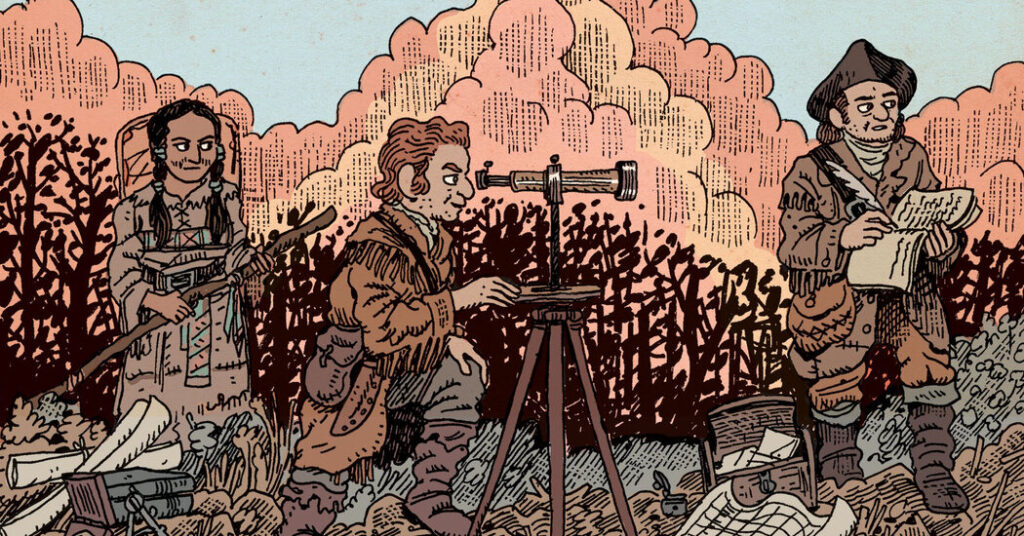
Once the expedition began, all of its members pitched in on the research. Clark drew maps and helped record measurements for calculating latitude and longitude. (The expedition’s 278 astronomical observations remain remarkably accurate.) Sacajawea, a Shoshone woman, gathered botanical specimens. York, a Black man enslaved by Clark who was known by a mononym, collected invertebrate specimens. But most of the work came from Lewis, whose temperament — intense, precise, self-aware — made him a formidable observer. He noticed when pregnant antelope began to show. He described a squirrel’s fur as “the color of tanner’s ooze.” He collected mineral samples, including one Clark guessed was cobalt or arsenic. Lewis needed to know for sure. He pounded it into powder and examined it until the toxic fumes made him sick.
Lewis’s findings — the flowers he pressed, the bird calls he rendered phonetically, the grizzly bears he shot and then sliced open so he could measure their hearts — were their own reward. But part of the expedition’s agenda was always imperial. In the Enlightenment, one could never quite separate science from statecraft. Jefferson knew the expedition’s data would reach experts around the world and fortify America’s future claims to Native land. The captains were also thinking about expansion, though they didn’t dwell on the Native suffering that would accompany it. On the way home, at the edge of the Rockies, the party followed a Native road. Clark noted that, once someone cut down a few trees, it would make “an excellent wagon road.”
The research produced by Lewis and Clark boosted America in countless ways, starting with the fur trade. One trader followed Lewis’s advice and opened a trading post near the Pacific Coast. But the expedition also revealed how unpredictable research can be. Clark thought he’d found a good road. But the one that made the real difference for American expansion — the Oregon Trail — relied on a mountain pass far to the south. Then again, the trader who initially identified that pass was an employee of a post founded on Lewis’s advice. He was in the West because of the expedition’s work.
This circuitous route — the accidental benefits that follow research funding — helps explain why, sometimes, it takes a historian to justify scientific work. We should remind the public and politicians who are inclined to cut research funding on the grounds that it’s wasteful or ideological that progress is contingent, that research may take decades to pay off. Jefferson could not have forecast the twists and turns that led from Lewis and Clark to the Oregon Trail, just as no one today could have forecast the events that led from federal funding to the internet and mRNA vaccines. But in each case, public investments created the conditions for innovation. Those investments funded possibility.
That’s how research works. The timelines are long. The breakthroughs are impossible to anticipate. The variables include human vulnerability and emotion. Once again, Lewis is a good example. He struggled with depression and died by suicide in 1809, before he could publish his scientific prose. Jefferson wrote a short remembrance of his dead friend. The explorer’s hope for Americans, Jefferson wrote, was simple: Lewis wanted “to extend for them the boundaries of science and to present to their knowledge that vast and fertile country which they are destined to fill.”
The Library of Congress still has Jefferson’s draft of this document, complete with his edits. As he read over the text, thinking about science and its schedules, Jefferson paused on the line “they are destined to fill.” He crossed out “they” and replaced it with “their sons.” Jefferson knew that the timing of ambitious projects could be unpredictable. He also knew that they could transform a nation.
Craig Fehrman is the author of “This Vast Enterprise: A New History of Lewis & Clark.”
The Times is committed to publishing a diversity of letters to the editor. We’d like to hear what you think about this or any of our articles. Here are some tips. And here’s our email: [email protected].
Follow the New York Times Opinion section on Facebook, Instagram, TikTok, Bluesky, WhatsApp and Threads.
The post Trump Could Learn a Thing or Two From Thomas Jefferson appeared first on New York Times.