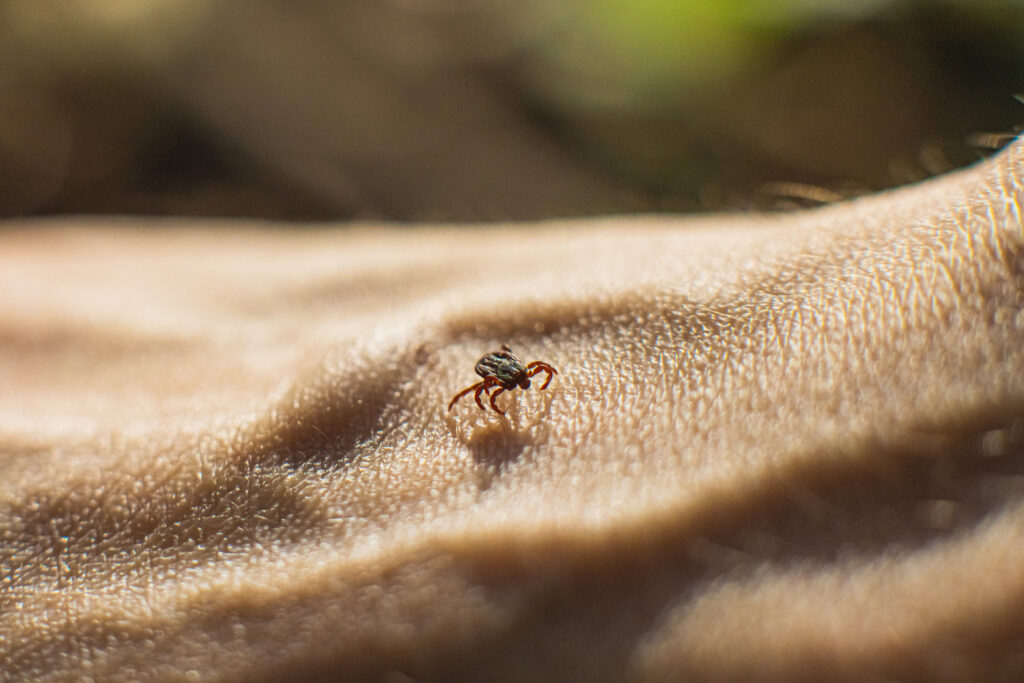
If a tick latches onto your skin — an increasingly common occurrence in much of the United States this time of year — your first concern might be Lyme disease, the most frequently transmitted tick-borne illness. But the same ticks that carry Lyme, deer ticks, are also vectors for other pathogens, one of which can pose an even more serious threat: Powassan virus.
Cases of Powassan virus disease in New Jersey and New Hampshire have made national headlines in recent months because of the potential severity of the symptoms, which can include neurological problems such as memory loss, difficulty speaking and seizures. That’s because Powassan can enter the central nervous system and cause encephalitis, which is inflammation of the brain, or meningitis, which is inflammation of the tissues surrounding the brain, said Saravanan Thangamani, professor of microbiology and immunology at SUNY Upstate Medical University and director of the SUNY Center for Vector-Borne Diseases.
Though Powassan virus disease is quite rare, there’s been an uptick in cases in recent years. Centers for Disease Control and Prevention data shows seven reported cases in the United States in 2015; in 2025, that number was 76.
Here’s everything you need to know about the disease, including why experts think it’s becoming more prevalent and how to protect yourself.
How and where Powassan virus spreads
Powassan is named after the town in Ontario where it was discovered in 1958. In the U.S., it’s been recognized primarily in the Northeast and Upper Midwest. The deer tick (a.k.a. blacklegged tick) is the one that most commonly passes the virus to humans. Groundhog ticks and squirrel ticks are known to spread it, too, but they reside in deep wooded areas where people are less likely to go, Thangamani said.
The virus can transmit from tick to human quite rapidly. “Unlike with Lyme disease — where the tick generally needs to feed on your blood for 16 to 24 hours to transmit the disease — with Powassan, it seems like the tick does not have to be attached to you for much longer than 15 minutes or so,” said Catherine Valentine, a clinical assistant professor in the division of infectious diseases at NYU Grossman School of Medicine.
The more time a Powassan-carrying tick spends feeding on you, the more of the virus gets transmitted to you, and the sicker you may become, Thangamani said.
Symptoms and potential complications of Powassan virus
Experts hypothesize that most people who get infected with the virus do not experience symptoms, Valentine said. Those who do typically get a fever first and may feel like they have the flu. That could look like muscle aches, fatigue or generally feeling unwell, Valentine said. For some, that’s where the Powassan story ends.
But in others, the virus wriggles into the central nervous system, infecting the spinal cord and brain, typically within a few weeks. That’s the point at which symptoms become neurological and may include confusion or cognitive issues, garbled speech, loss of coordination, and even seizures or paralysis. “It wouldn’t be unreasonable for someone to think they’re having a stroke,” Valentine said. A key distinguisher is that during a stroke, neurological deficits come on very quickly; symptoms of a brain infection manifest over the course of a few days, she explained.
Among symptomatic patients, the fatality rate is as high as 15 percent, and half of survivors are left with long-lasting neurological fallout, which can range from “I keep forgetting the car keys” to difficulties with speech, walking and sometimes even eating, Valentine said.
There is no treatment for the condition nor vaccine to prevent it. Managing the severe cases typically involves supportive care, such as intravenous fluids and respiratory or feeding support if needed, Thangamani said. Some physicians may prescribe steroids to reduce brain inflammation, Valentine said. Survivors with long-term neurological issues can also benefit a great deal from rehab services such as physical, cognitive and occupational therapy.
Why Powassan is on the rise
Climate change is the primary factor: Ticks thrive in hot, humid weather, so warmer average temperatures have drastically extended the season for them to be active, Valentine said. “We’re seeing cases [of tick-borne illnesses] now in March and as late as November.” People also spend more time outdoors when it’s warmer, making tick bites — and in turn tick-borne diseases — more likely.
Milder winters may also contribute to growing rodent and deer populations. Ticks feed on these animals, which then carry the ticks into new geographic areas, Thangamani said. More ticks across different regions could facilitate the spread of Powassan, too.
Better surveillance and reporting of Powassan virus disease could also play a part in rising case counts — but Thangamani still suspects that it’s under-recognized more than over-recognized. Asymptomatic cases and those that result only in flu-like symptoms can easily fly under the radar. And even those cases that involve meningitis or encephalitis may not always be accurately diagnosed, particularly if the patient doesn’t mention a tick bite (or even know they had one), or the doctor doesn’t connect the dots and order blood or spinal fluid tests, Valentine said.
Avoiding tick-borne illnesses
The best way to steer clear of Powassan is to avoid getting bitten by a tick in the first place. So forget fashion, and tuck your pants into your socks when hiking or spending time in wooded areas, Valentine said. Wearing clothing treated with the insecticide permethrin and using an Environmental Protection Agency-registered tick repellent on your skin can help, too.
When you come home, run your clothes in the dryer on high heat for 10 minutes, Thangamani said. The dry environment will kill any ticks that may have hitched a ride.
Also check for ticks immediately after any outdoor activity, not just at the end of the day or before you go to bed. “You go for a walk, you come in, you check yourself; you go out to work in the garden, you come back in, you check yourself again,” Valentine said.
If you do spot a tick, pluck it off, ideally by grasping the head near its mouthparts, using a tweezer. Then be vigilant for symptoms of an infection, namely a fever, for 30 days, Thangamani said. Should you feel sick, see a health care provider, as it could be Powassan or another tick-borne illness — and ticks can transfer multiple pathogens in a single bite, Thangamani said.
His hope is that more people become aware of — and take seriously — the threat of tick-borne diseases such as Powassan. “It’s rare,” Thangamani said, “but it actually has a high human health consequence.”
The post This rare tick-borne disease is on the rise in the U.S. appeared first on Washington Post.