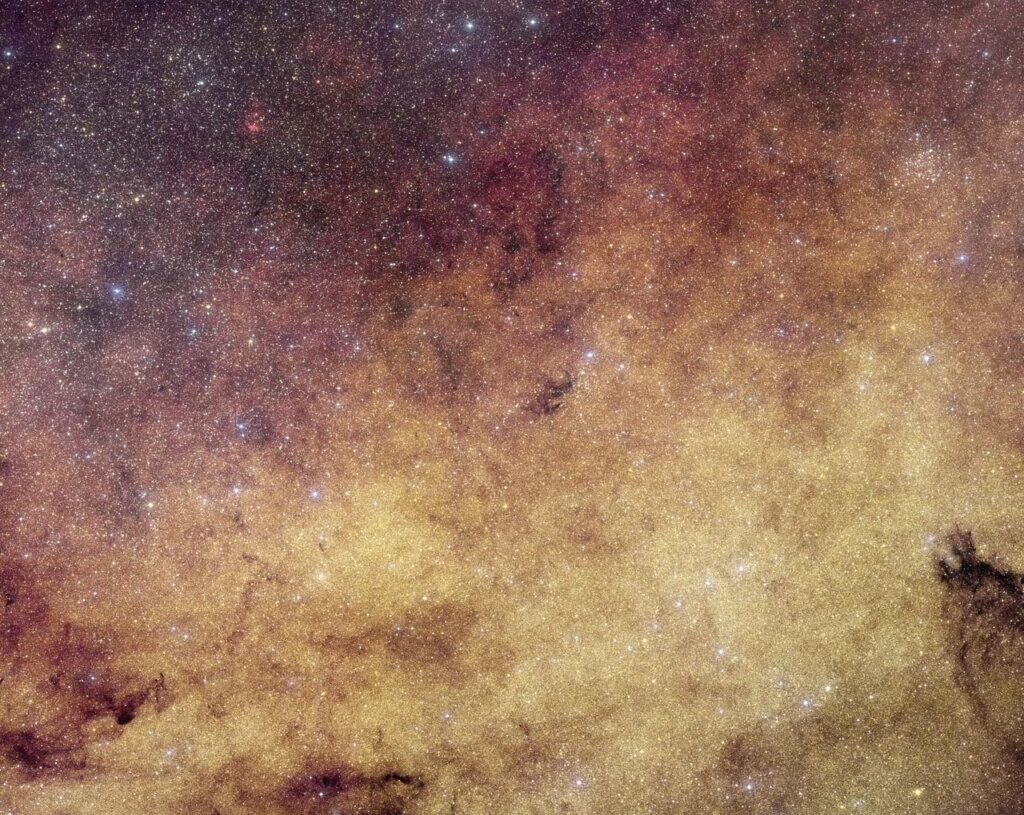
The European Space Agency’s (ESA) Euclid space telescope has captured the largest and most detailed visible-light image ever obtained of the Milky Way’s galactic bulge, the central region of our galaxy.
The image is a mosaic containing more than 60 million stars, as well as nebulae and star clusters. It will allow scientists to confirm the possible presence of exoplanets using a microlensing technique and measure their masses with greater precision.
The Power of Euclid
Although Euclid was designed to observe billions of distant galaxies, its visible-light camera is sensitive enough to resolve individual stars at the center of the Milky Way—a region that is both extremely bright and densely populated—without being overwhelmed by the intense light.
On March 23, 2025, Euclid turned its gaze toward the galactic bulge, capturing this enormous image in just 26 hours of observations. The result was remarkable: a mosaic composed of nine separate “pointings” (exposures) by its visible-light camera, each covering an area of sky larger than the full moon.
While the quality of Euclid’s visible-light images is comparable to that of the Hubble Space Telescope, there is one major difference: Each pointing that Euclid captures in just a few hours covers an area 270 times larger than Hubble’s field of view. It is also much faster. To put this into perspective, the Keck Observatory would require roughly 2,000 hours to observe the same mosaic.
The Image of the Milky Way
The new Euclid image captures more than 60 million stars, along with nebulae and star clusters, in one of the Milky Way’s most crowded regions—a location ideally suited for searching for exoplanets through gravitational microlensing.
“To catch microlensing, you need to observe parts of the sky that are crowded with stars, such as close to the centre of our galaxy,” said Jean-Philippe Beaulieu, who led the observing campaign, in a press release. “During the last 20 years, almost 300 exoplanets have been discovered using this technique, all with ground-based telescopes and all towards the center of our galaxy. This image from Euclid includes 51 known planetary systems—and it will assist in studying many more that will be found.”
Measuring Planetary Masses
Although detecting a microlensing event requires several weeks of observations—meaning Euclid could not identify any new events during its relatively short observational campaign—what makes this image so valuable is that it provides the data needed to measure the masses of already known planets, as well as planets that have yet to be discovered.
“In 24 hours, Euclid has already captured the stars involved in all the future microlensing events that the Roman space telescope will detect, but before the stars and planets involved have aligned,” said Natalia Rektsini, who led the publication of the data, in a press release. (The Nancy Grace Roman space telescope is slated to launch later this year.) “This means that anyone who detects a microlensing event in the same region, for example with Roman, will be able from now on to use Euclid data as a time reference in the past and see how the stars looked before they overlapped.”
In effect, Euclid’s observations will serve as a reference archive for future missions, enabling more detailed studies of exoplanets and more precise measurements of their masses.
“In just 24 hours, Euclid has delivered unique data on the Milky Way’s center, with a large and sharp view of this region,” said Valeria Pettorino, ESA’s Euclid project scientist, in a press release. “This data can also be used for other scientific applications, from brown dwarfs and binary stars to stellar motions and dust across our galaxy.”
This story originally appeared on WIRED Italia and has been translated from Italian.
The post This Is the Most Detailed Image Yet of the Milky Way’s Center appeared first on Wired.