Are Americans one people, or many? Our national motto, “e pluribus unum,” seems to offer the definitive answer to the question: We are many, but one. Even on the verge of the Civil War, Abraham Lincoln insisted in his first inaugural address that Americans were united by “the mystic chords of memory” stretching back to Revolutionary battlefields and Patriot graves. In the aftermath of the war, as millions of Irish, English, and German immigrants swarmed to our shores, Frederick Douglass began delivering a talk titled “Composite Nation,” which celebrated both the pluribus and the unum. “Gathered here from all quarters of the globe,” Americans are bound to one another “by a common aspiration for national liberty as against caste, divine-right government and privileged classes,” he declared—with premature optimism, to say the least.
Others regard the unum as a pious myth. In Who Are We? (2004), the political scientist Samuel Huntington mocked the beloved shibboleth of “a nation of immigrants” as “a misleading falsehood”; America was in fact an “Anglo-Protestant” nation at risk of disintegration due to the pressures of multiculturalism. In a similar vein, Vice President Vance has claimed that Americans who can trace their ancestry to those who fought in the Civil War are more American than those who can’t.
The historian David Hackett Fischer articulated a more intriguing, and certainly less divisive, view in Albion’s Seed: Four British Folkways in America (1989). He endorsed a modern spin on what he called the “germ theory” of American history—first advanced, Fischer wrote, by 19th-century historians who described the “Teutonic germs” of liberty migrating from Germany to England to the New World. In Fischer’s version, early immigrants from four different regions of Great Britain established cultures in different regions of the American colonies. Though fewer than a fifth of Americans had British ancestry at the time of Fischer’s writing, “in a cultural sense,” he provocatively argued, we are all descendants of an “expansive pluralism” with its source in Puritan, Cavalier, Quaker, and Scotch-Irish societies.
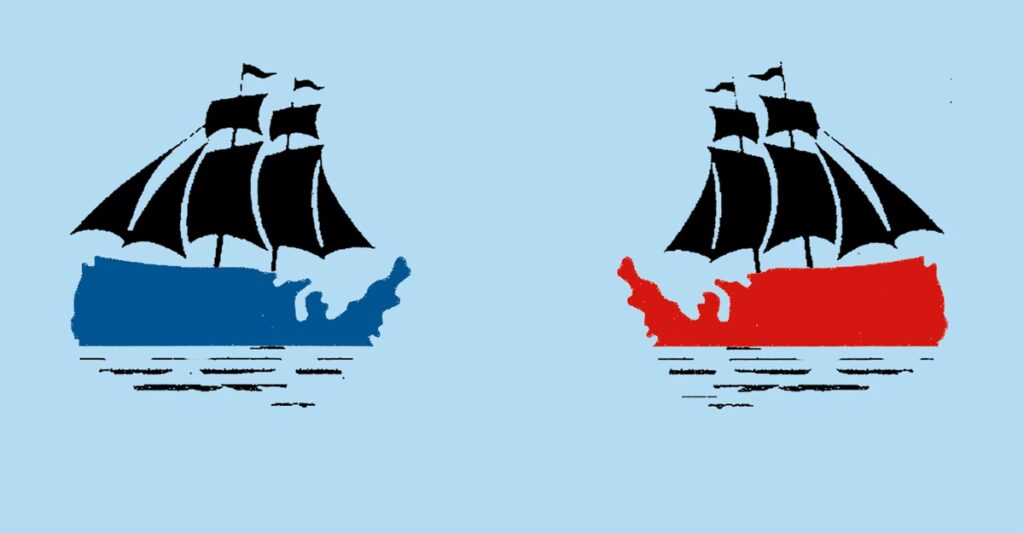
Perhaps Fischer’s pluralism is too expansive. In the new book Two Ships: Jamestown 1619, Plymouth 1620, and the Struggle for the Soul of America, the historian and literary scholar David S. Reynolds argues that America is not one or many or four, but two. We are the residuum of two irreconcilable cultures, red and blue from the get-go, issuing from the Mayflower and a slave ship known as the White Lion. Drawing on an astonishing wealth of references to the metaphor of two ships by figures from the early colonial era through the Civil War, Reynolds lops off the Quakers and the Scotch-Irish in favor of the groups that came first and seemed most antithetically opposed—Puritan and Cavalier. And whereas Fischer described without judgment the family patterns, social customs, and religious lineage of his four groups, Reynolds contrasts his two on ideological and ultimately moral grounds. He presents American history as a perpetual struggle between a Puritan North dedicated to liberty and equality and a Cavalier South predicated on hierarchy and domination.
Two Ships is thus a narrative for our time, when the aspirational vision of oneness has given way to intractable twoness. Each side has now acquired its own historical narrative. On the left, “The 1619 Project,” first published in 2019, recast the national story as the endlessly ramifying consequence of the original sin of slavery. “Some might argue,” in the lead essay’s words, “that this nation was founded not as a democracy but as a slavocracy.” The answering blow from the right, “The 1776 Report,” insisted that America was an exceptional nation dedicated to “natural equality” and shaped by “self-sacrifice, courage, and nobility.” In 1620: A Critical Response to the 1619 Project, the conservative scholar Peter W. Wood made the case that 1620 was in fact America’s founding moment—not the arrival of the slave ship but the signing of the Mayflower Compact. Reynolds’s response is, in effect: No, it was both. Americans were separated at birth, and have remained so ever since.
Reynolds adopts Fischer’s germinal metaphor (though he never acknowledges doing so). “Early differences in religions, laws, and slave systems,” he writes,
planted seeds for societies that eventually developed into the opposing cultural identities of the Cavalier South, with its hierarchical class system and reliance on chattel slavery, and the Puritan North, which moved toward democratic government, free labor, and ultimately widespread opposition to slavery.
The northern seed, in Reynolds’s telling, first sprouted on the other side of the Atlantic. The Pilgrims abhorred the hierarchy of the Church of England and began to practice a democratic politics among themselves in Holland, where they had fled. The language of the Mayflower Compact reflected that commitment: The passengers agreed to “covenant and combine ourselves together into a civil Body Politick” and to enact “just and equal laws” in order to advance “the general Good of the Colony.” Once settled in Plymouth, they established a broad franchise that included even those who chose not to join the church.
As for the South, Virginia’s first comprehensive legal code, passed in 1619, placed the Anglican Church and its hierarchy at the center of colonial life, appointing church wardens to “police the moral behavior of the people in their district,” Reynolds writes. Settlers risked punishment if they failed to attend church. These two radically different understandings of the individual’s place in society were reinforced in ensuing generations, as the Puritans flocked to New England to escape the persecution of King Charles I. Then, after a Puritan-dominated Parliament under the Roundhead leadership of Oliver Cromwell deposed and executed the King, Charles’s followers, known as Cavaliers, began their own migration, to the Jamestown colony. Slavery became integral to Cavalier culture, and far less so in Puritan New England.
Each of these societies deplored and ridiculed the other. Yet Reynolds clearly puts his thumb on the scale: The Puritans were right in their disdain and the Cavaliers were wrong. Though Virginians regarded New Englanders as theocrats who inflicted dire punishments on anyone who fell afoul of their strict code, he stresses that capital punishment, which was mandated for sodomy or adultery in New England, was very rarely imposed. The South cried hypocrisy on slavery, given that the seamen of Providence, Rhode Island, played a central role in the Atlantic slave trade. Reynolds instead emphasizes that Puritans (and Quakers) framed the earliest antislavery arguments in the English-speaking world. Enslaved Black people in much of New England could own land and property or sue for freedom.
As for the Cavaliers—guilty as charged. The Puritans regarded the Cavalier lifestyle, inherited from Charles’s court, as a feckless round of feasting, gambling, and wenching. And so it was, Reynolds writes. In the Cavalier worldview, hierarchy was rooted in nature: The husband controlled the wife and children as the master controlled the slave. Reynolds cites the early-18th-century diary of William Byrd II, who read Homer in the morning and administered whippings to refractory slaves in the afternoon. Virginia may have established a representative body, the House of Burgesses, in 1619, but the mid-century Cavalier elite continued to accept the divine right of kings as the Stuart monarchs had propounded it. Reynolds leaves the strong impression that slavery flourished in the South instead of the North simply because southern religion and ideology depended on mastery rather than because southern topography and climate also favored the plantation system.
[From the July 2026 issue: Yoni Appelbaum on how to tell the American story]
Separated-at-birth is an intriguing theory, and of course very gratifying to those in the Plymouth/Roundhead/blue half of America. But the test of the two-ships metaphor is what light it casts on our national story. A narrative, like Reynolds’s, that squeezes everything into a single frame must be able to account for both the American Revolution and the Civil War, the two formative events of American history. That’s asking a lot, and I don’t think he succeeds. The conceit of two implacably opposed cultures inevitably reveals more about the country’s moment of maximal division than it does about the great coalescence of 1776.
Why, after all, did the feudal lords of the South, loyal to Church and throne, throw off the royal yoke to join the Revolution? Among the colonists’ motives, “The 1619 Project” emphasizes the preservation of slavery, which seemed to be gravely jeopardized after the British governor of Virginia, Lord Dunmore, issued an emancipation proclamation in 1775 for enslaved people who joined the British army. Reynolds, like most historians, rejects that theory; the South, he writes, shared in the general animus against British oppression.
Yet he describes the Revolution as the fulfillment of specifically Puritan ideals of liberty. The Boston revolutionaries venerated Cromwell, tribune of the common man, and, with their deeply ingrained habit of viewing history analogically, cast King George III as a reincarnation of the monstrous Charles. The Glorious Revolution against the divine right of kings thus recurred as the American Revolution against colonial oppression.
What, then, to make of Thomas Jefferson, George Washington, James Madison, and Patrick Henry? If they were Cavaliers, as the southern elite of the day claimed, we must rethink the boundaries of that identity. Instead, Reynolds observes that these sober men bore little resemblance to the roistering patriarchs of the remote plantations. They were, he insists, southern Cromwellians. Even the Declaration of Independence, he writes, “can be seen as an updated version of a seventeenth-century anti-Stuart declaration, revised to incorporate the egalitarian vision of the Lockean Enlightenment.”
That won’t wash. Neither Jefferson nor Madison needed to reach Locke by way of Cromwell. These Virginia aristocrats had been raised on the same Enlightenment thinkers—David Hume and Adam Smith, Montesquieu and Voltaire—as John Adams and Samuel Adams had. They pored over the works of radical Whig pamphleteers such as John Trenchard. They were inspired by Cicero and Cato, the heroes and martyrs of the Roman republic. Jefferson also sought precedent in Cromwell and the Glorious Revolution, but that hardly meant he had to surrender Virginia-gentry ways and become an adoptive Puritan in order to write the Declaration. Mono-causal history winds up paving over the uneven surface of human experience with a layer of ideological asphalt.
The American Revolution is a story of shared heritage and shared ideals uniting disparate people, but the Civil War is a story of irreconcilable beliefs and practices dividing a single nation. If you view slavery and the Civil War, rather than the Revolution and the founding documents, as the central fact of American history—if you imagine an “1861 Report”—the metaphor of two ships and two cultures becomes deeply suggestive. In the period immediately preceding the war, Reynolds shows us, people on both sides almost instinctively reached for this conceit to explain the irrepressible conflict. A southern newspaper asked, “What similarity, pray, was there, or will there ever be, between Plymouth and Jamestown?”
In the years before “Composite Nation,” Douglass returned again and again in his speeches to the very different vision of two ships. So, too, Charles Sumner and prominent abolitionists. In a speech delivered before 8,000 listeners, Sumner divided the two sides between “the Mayflower, filled with men, intelligent, conscientious, prayerful”—authors of a great “written compact”—and the “Slave-Ship, with its fetters, its chains, its bludgeons.” The question facing all Americans was “Which of the two to choose?”
These partisans did not think of North and South as two different economies or clusters of “folkways”; they were two cultures, founded on incompatible views of power, equality, and justice. Reynolds concedes that by the early 19th century, the Cavalier way of life had long since disappeared from the South, and the Puritan (if less so) from the North, yet he argues persuasively that the proud, living memory of what had actually been gave a tremendous sense of reality to the myth. Reynolds uses the modern expression culture war to describe the mutual antagonism; that feels right. The fact that northern bankers financed the slave trade and northern “Copperheads” were prepared to let the South preserve slavery in order to end the Civil War complicates the allegory of two ships, yet the life of the South was organized around slavery, and that of the North, more and more over the years, was organized around opposition to it.
The Civil War did not, of course, end the evil of racial oppression. Reynolds writes that northerners greeted victory in the Civil War as the fulfillment of the two-ship struggle: “The Barbarism of the Plantation kneels to the Christian civilization of the Puritans,” as a Massachusetts politician put it. Yet the South soon got up off its feet and reasserted the plantation ethos, while the North surrendered the cause of racial equality in the name of national reconciliation. Reynolds tracks the willingness of northern partisans—Carl Schurz, Horace Greeley, Lyman Trumbull, and even Sumner himself—to abandon that cause by the dwindling references to Jamestown and Plymouth. Southerners returned the favor by addressing northern crowds at Plymouth to celebrate a new fusion. At a Forefathers’ Day event in Philadelphia, the Atlanta journalist John Temple Graves hailed “the Christmas Wedding of the Puritan and the Southern Cavalier.”
Reynolds argues that the “struggle for the soul of America” of his subtitle never ended. Even as Jim Crow ruled the South, he finds instances of suffragettes claiming inspiration from the Pilgrim women of the Mayflower, and of early civil-rights activists citing the radical Puritans. The very last words of the book assert that the metaphorical battle between Plymouth and Jamestown, Mayflower and White Lion, has “taken a new shape in today’s America.” Reynolds’s Two Ships thus makes not only a claim about who we were but one about who we are and perhaps always will be.
Reynolds never explicitly says that he regards American history as a moral allegory on the order of Paradise Lost. You can understand why. His cultural determinism appears to leave America fated to endlessly repeat an ancient pattern of conflict. And it assumes a fixity over time that belongs more to an isolated archipelago than a dynamic modern nation. Although America may be as divided today as it was during some of the worst moments of our past, the arrival of tens of millions of new people over the course of more than a century, and the mobility of our population, has thoroughly scrambled whatever ancient germinal lines there may once have been. Mapping today’s red-blue conflict on the Jamestown-Plymouth antinomy of four centuries ago can’t help seeming extremely forced.
It also seems presumptuous. Do we really wish to regard those on one side of our current divide as the heirs of all that is best in the American tradition, and those on the other side as the legatees of slavery and domination? Where does that leave us? It’s instructive that Reynolds cites only one major figure in the 19th century who steadfastly rejected the imagery of cultural polarity: Abraham Lincoln. Twoness was, after all, a choice. Lincoln repudiated it because he wished to bind up wounds, not open them afresh. “With malice toward none,” as he famously said in his second inaugural address, “with charity for all.” Perhaps subsequent history shows that his generosity of spirit was misplaced. Yet we rightly revere the leader who reminds us of our common humanity.
This article appears in the August 2026 print edition with the headline “The Slave Ship and the Mayflower.”
The post The Slave Ship and the Mayflower appeared first on The Atlantic.