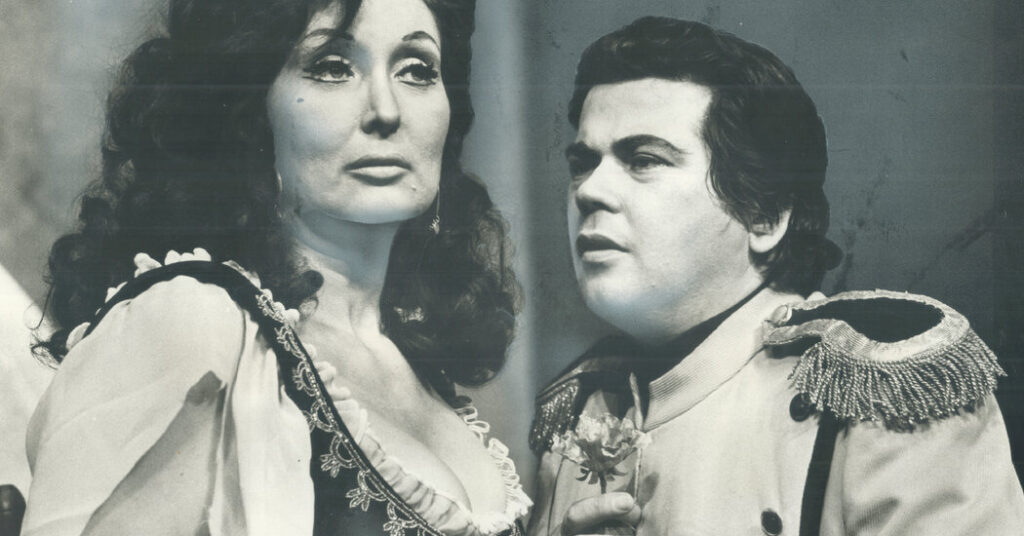
Mignon Dunn, an American mezzo soprano who emerged from rural Arkansas to star in major opera houses around the world, especially in the role of Carmen, which she sang more than 400 times, died on Sunday in Colorado Springs, Colo. She was 98.
The death, at a long-term care facility, was confirmed by her nephew Christopher Carlson.
“I learned how to make conversation and arrange flowers,” Ms. Dunn once said about her childhood growing up in the South. “But I never wanted to be anything but a singer. My whole life I always thought that what I wanted to do was sing at the Metropolitan Opera.”
And that she did, prodigiously so, performing there more than 650 times over 35 years.
Her wide-ranging repertory included dramatic Italian roles such as Santuzza in “Cavalleria Rusticana,” the Princess in “Adriana Lecouvreur” and Amneris in “Aida,” and Wagner and Strauss roles including Klytämnestra in “Elektra.” She also sang Russian, Czech and Spanish parts.
When Ms. Dunn sang Venus in Wagner’s “Tannhäuser” at the Met in 1981 a reviewer noted that “her opulent tones carried splendidly over the heavy orchestral sound.”
But she excelled in vocally lighter roles too.
When she sang the title role of Gluck’s “Orfeo” in 1974 at what was then called Avery Fisher Hall at Lincoln Center, the New York Times music critic John Rockwell wrote that it was “a magisterial performance, full-voiced, vocally and dramatically commanding, and shaped with a true appreciation for Gluck’s noble classicism.”
She did not sing Mozart, however. “I’m just not a Mozart singer,” she once said. “I choke to death.”
Mignon (pronounced “MIN-yawn”) Armistead Dunn was born on June 17, 1928, in Memphis, Tenn. She grew up nearby in Tyronza, a rural area in northeastern Arkansas, on a cotton plantation run by her parents, Christine (Lundee) and Dudley Dunn, who died when Mignon was 7. Christine Dunn ran the farm on her own until a fire burned the farmhouse down in the early 1940s, at which point the family moved to Memphis.
Mignon listened to the Metropolitan Opera’s Saturday matinee radio broadcasts as a child and attended her first opera, “Carmen,” at age 10, after which she decided she wanted to be an opera singer. She made her operatic debut in 1955 at the New Orleans Opera, singing the title role.
A scholarship from the Metropolitan Opera, whose talent scouts heard her sing when she was 17 while attending Rhodes College in Memphis, allowed her to study music privately with Karin Branzell in New York, where she traveled with her mother, since “no well brought-up southern girl of 19 would go alone to New York,” she said.
To supplement her income early in her career, she sang in German restaurants and beer halls in Manhattan’s Yorkville neighborhood and worked as a guide at LaGuardia Airport, though she failed an audition for the Radio City Music Hall chorus.
But a break came when she was hired to sing Carmen at the New York City Opera in 1956, and she made her debut at the Met in 1958 as the nurse in Mussorgsky’s “Boris Godunov.” She sang her first professional Met performance of Carmen in 1969, substituting on short notice for Regina Resnik.
That year, in a Times review of her performance of Azucena in Verdi’s “Trovatore” at the Met, Robert T. Jones said she acted “with venomous intensity,” and that “her voice is bright and capable of ringing power at the top.”
In 1973, after singing Azucena in her first opening night at the Met, a profile of her in The New York Times noted that “she walked away with an armload of critical paeans, and at long last came into her own as an artist to be reckoned with — 15 years and 45 roles after coming to the Metropolitan Opera.”
Ms. Dunn also sang at La Scala, Covent Garden, Paris Opera, the Bolshoi and other major houses. She performed “Carmen” in four languages on different continents.
Along with Mozart, comic roles also generally eluded her. Opera houses simply didn’t think of her.
“I don’t get as many funny parts as I wish I did,” she said. “I am a funny lady and I love to get funny parts, but everybody hires me for these ‘chewing-up-the-scenery’ parts.”
In 1993 she said was looking forward to performing that year in “Falstaff,” her first comic opera, describing herself as “really a hoot.”
Ms. Dunn’s final performance at the Met was in 1994. After retiring from the stage she focused on teaching and became a prominent pedagogue.
She joined the faculty of the Manhattan School of Music in 1988 and also taught at the University of Texas at Austin, the University of Illinois, Northwestern University and Brooklyn College, in addition to adjudicating vocal competitions. She retired from teaching at the Manhattan School of Music in 2023.
An early marriage ended in divorce. In 1972 Ms. Dunn married the Austrian conductor Kurt Klippstatter, director of the Arkansas Symphony Orchestra, who died in 2000. An article in People Magazine in 1979 noted that Ms. Dunn, who loved country music and spoke with a pronounced Southern accent, saw herself as “an operatic Loretta Lynn.” They did not have children, and Ms. Dunn had no immediate survivors.
An exacting vocal technician, she continued to study with Armen Boyajian long after her career was established.
“I take every new role to him. You always need extra ears, and if you don’t work on your voice, it goes,” she said in an interview in 1991. “Singing is not an exact science, it’s a matter of habit — and it’s easy to get screwed up and form a bad habit. You need someone to keep tabs on you.”
She described the often painstaking process to create an operatic role.
“Some things you work like hell, and other things came easy,” she once said. “Mostly you work like hell. Every role I do is worked note by note by note, then three notes together, then four notes together, then a line together, then a sentence together, then a page together.”
Alex Traub contributed reporting.
The post Mignon Dunn, Mezzo Soprano Known for ‘Carmen,’ Dies at 98 appeared first on New York Times.