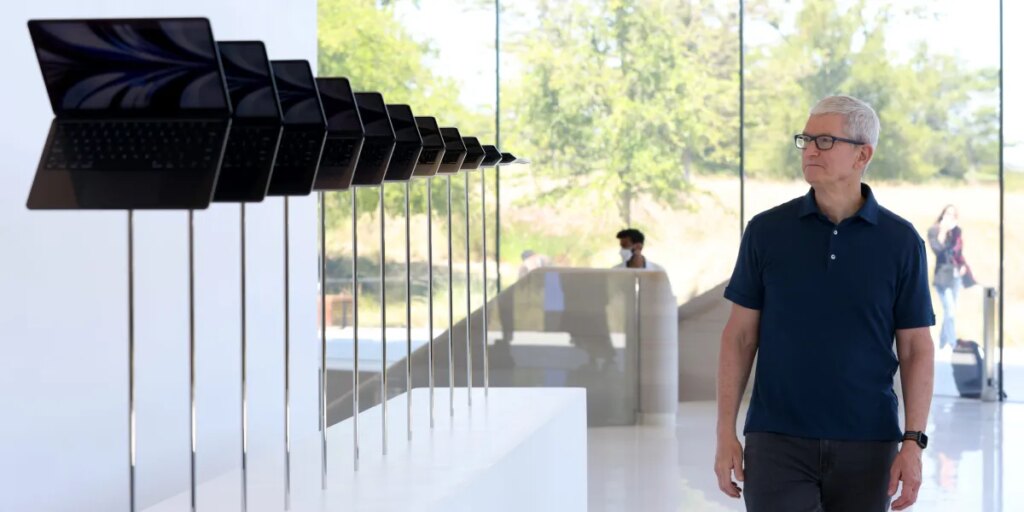
On Monday, an Apple MacBook Pro laptop cost $1,699. On Thursday, it cost $1,999.
Apple didn’t launch a spiffier, more powerful new version of the laptop; the $1,999 machine is exactly the same as the one that sold for $300 less a few days earlier. Similarly, the MacBook Neo—introduced in March as Apple’s budget option—saw its price tag increase from $599 to $699 this past week.
Welcome to “RAM-ageddon,” the theatrically named phenomenon caused by a severe shortage of computer memory chips. Apple is just the latest of a string of PC and gadget makers who have hiked prices in recent months to make up for the rising cost of RAM and NAND memory—critical components inside computers, smartphones, and game consoles, as well as in automobiles and industrial equipment.
On Thursday, the same day Apple raised its prices, Microsoft said it will increase the price of its Xbox game console by $100-$150 depending on the version, and that it would no longer sell Xbox consoles with 2 terabytes of memory, its highest-end configuration. Dell, HP, Lenovo, and Asus have also raised prices or reduced the amount of memory in their products.
But the fact that Apple was forced to raise prices—despite its famous supply chain prowess and its massive purchasing power, not to mention the potential damper on demand—sent a shockwave through the global markets. The Nasdaq slid 1.4% the day Apple unveiled the price increases, as investors worried about the implications of rising memory prices.
“The storm isn’t over yet, this is just the beginning,” Nabila Popal, an analyst at industry research firm IDC, said of the memory crunch.
Feeding the giants
The reason for the price hikes is no secret to anyone who’s been paying attention. It’s all about AI, specifically the unprecedented industry-wide build out of the data centers that power AI services like OpenAI’s ChatGPT, Anthropic’s Claude, and Google’s Gemini.
The computers inside those AI data centers need memory chips too, just like your laptop and smartphone do.
Memory is one of the two most important chips in a computer. The computer’s processor serves as the “brains” of the device, crunching through gobs of data at blazing speeds. The memory is where the data gets placed and served up to the processor, like a dinner platter holding a gluttonous giant’s feast.
The problem is there are not enough of those dinner plates to feed all the giants. The cloud computing companies, which are spending hundreds of billions of dollars this year to build AI data centers, are snapping up massive volumes of the memory supply. Consumer PC and phone makers fight for the scraps.
Adding to the problem is that data centers favor so-called high bandwidth memory (HBM), a specialized type of memory that stacks multiple chips on top of each other in order to achieve higher data throughput but which also reduces the supply of silicon wafers available for traditional computer memory.
“The production of memory chips is becoming a zero-sum game,” Deutsche Bank analysts wrote in a recent report on the memory crisis. “For every wafer devoted to HBM stacks for AI servers, others are unavailable for smartphones, PCs, or vehicles. And because the shortage will reverberate across key economic systems well beyond AI—hurting the average consumer via memory-cost inflation—memory chips have transitioned from a pure commodity to a distinctly macroeconomic variable.”
The cost of protecting profit margins
For hardware makers like Apple and Microsoft, the big questions now are what type of impact will RAM-ageddon have on their businesses, and how much worse could the situation get?
Few expect the crisis to subside anytime soon. A memory chip manufacturing facility, or fab, takes between two to three years to build and bring online. Most of the announced projects will not be ready to deliver supply until 2027 at the earliest, and the overall supply of DRAM is expected to remain “tight” beyond 2028, Deutsche Bank said in its report. Jefferies, another Wall Street firm, recently published a note outlining the views of a memory industry consultant who forecasts prices rising 30%-40% in the fourth quarter, and an additional 40%-45% in 2027.
With memory supply scarce and pricey, consumer electronics companies have spent the past six months pulling various levers to manage the situation, from reconfiguring product SKUs in order to reduce the bill of materials to reluctantly hiking prices.
“Our initiatives are focused on securing supply, shaping demand and product configuration, implementing targeted cost reductions, and taking pricing actions,” HP finance chief Kevin Parkhill told investors during the company’s first-quarter earnings call in February.
The tactics succeeded in protecting the company’s profit margins that quarter. But with memory prices that are “roughly doubling versus the prior quarter,” Parkhill said the company expects operating profit in the PC business to be “below our long-term range for the remainder of the year.”
Passing the increasing memory costs on to end users by raising PC prices is one way to protect profit margins, but the tactic can only go so far. “The challenge for consumer focused vendors is of course at some point you price yourself out of the market,” said Holger Mueller of Constellation Research.
“The question is, how much of a price hike affects sales?” he added, noting how difficult it is to predict.
A $300 price increase on a high-end PC aimed at professionals might not cause too much disruption. But Apple has much much less room to maneuver when it comes to mass market consumer products like the iPhone.
Given the current trajectory of memory prices though, IDC’s Popal expects that Apple will soon be forced to raise iPhone prices.
“Seeing the price hikes today to iPad and Macs going as high as $300 for some models, my personal instinct says the hike to iPhones may be even higher than what we assumed,” she said. By raising prices for Macs first however, Popal reckons Apple could be trying to “mentally prepare” consumers for more expensive iPhones.
“Seeing Mac prices go up by $300 for some models, it will make the $100 (or even $200) hike to the iPhone seem relatively less when it comes,” she predicted.
Additional reporting by Sebastian Herrera
The post Even Apple supply chain maestro Tim Cook couldn’t dodge the memory chip ‘RAM-ageddon’ crisis. Here’s why PC prices are soaring this summer appeared first on Fortune.