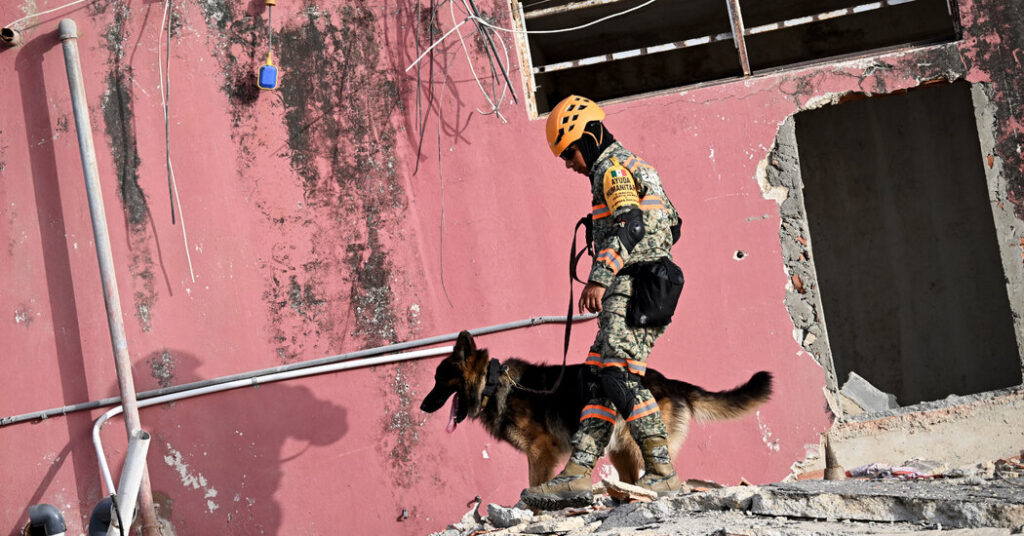
The United Nations’ main humanitarian agency says that 140 dogs from 21 countries have been mobilized to assist in search-and-rescue efforts after the earthquakes in Venezuela, trying to help emergency responders locate people trapped under the rubble.
The specially trained canines can pick up the scent of survivors beneath mounds of collapsed debris, indicating with a bark to their handlers where clearance teams should begin digging.
“The dog is the fastest of all methods,” Ryan Gray, a canine handler at K9 Search and Rescue Northern Ireland, said in an interview on Sunday. Later in the day, he was scheduled to fly with Max, a 10-year-old black Labrador search dog, to Colombia in the hope of entering Venezuela through its partially reopened Simón Bolívar International Airport.
Once deployed to the site of a collapsed building, a dog can indicate a human’s scent within two minutes, he said.
“The dog’s body language will change quite a lot,” Mr. Gray said. “He’ll stare at me for a couple of seconds. Then he’ll bark.”
After an initial alert, a second dog will often be sent to confirm the scent. Then, a team equipped with acoustic listening devices will try to isolate the survivor’s location, before digging teams begin to remove the rubble layer by layer, a delicate process to avoid further injuring anyone who is trapped, Mr. Gray explained.
Linda Hornisberger, president of REDOG, the nonprofit Swiss search and rescue dog association, said on Sunday that her team had deployed eight dogs to Venezuela along with 88 personnel, including handlers, medical teams and specialist engineers.
Since Thursday, the day after two powerful quakes shook northern Venezuela, she said that the dogs had identified the locations of two survivors in La Guaira, the hardest-hit state, but that both had died before they could be reached by rescue teams.
Ms. Hornisberger said that this was not unusual, and underscored the urgency of the ongoing response effort.
Trained dogs are very capable of picking up scents, but there are also limits to their abilities. “If a person is very far down, and they’re trapped in the middle of a huge building, the scent of that person can’t come out,” especially if the rubble is dense, she added.
For this reason, REDOG’s canine team has prioritized searching buildings that have flattened, “like a pancake,” Ms. Hornisberger said. This is where the floors of a building have stayed largely intact as they came down, which offers a better chance that debris will leave gaps of air between the floors to help people survive, she said.
As the search entered a fourth day on Sunday, the window for finding survivors was diminishing. “I’m not saying we’re not going to find people and save lives,” said Ms. Hornisberger, but she added that such cases would be “miracles.”
Mr. Gray struck a more optimistic tone. In Turkey in 2023, he and Max located a survivor more than a week after a devastating earthquake, allowing for that person’s safe rescue, he said.
The post Dozens of Dogs Join Search for Venezuela Quake Survivors appeared first on New York Times.