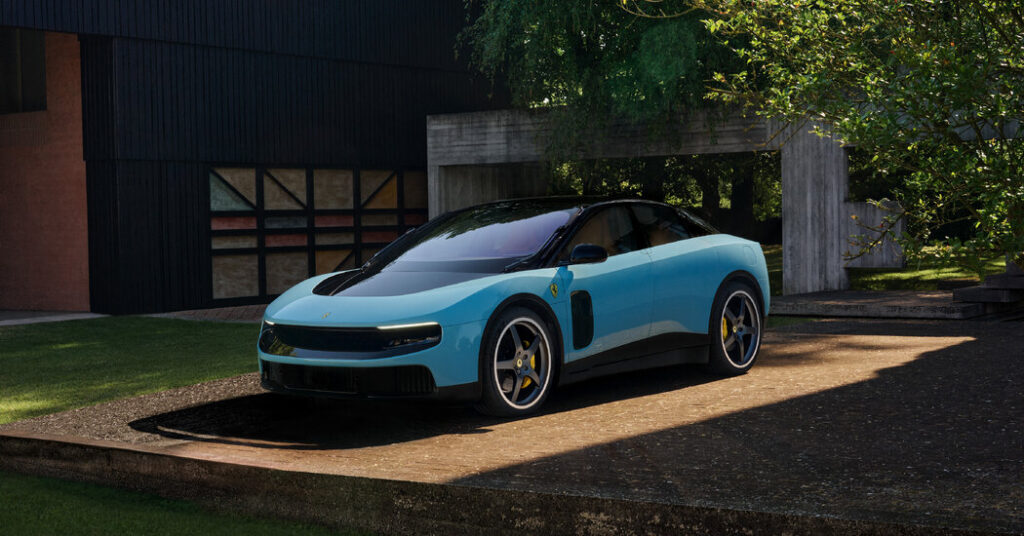
The revered Italian sports car maker Ferrari has debuted its first electric vehicle, the Luce — a $640,000 five-seater with a staggering 1,035 horsepower. The reaction has been swift and savage. The Ferrari faithful, the Ferraristi, are mortified, angry, apoplectic that the brand would appear on a vehicle that doesn’t resemble a muscular sports car. “It looks like a mouse, it looks like a Prius, it looks like a Honda, it looks like a Chinese E.V., it looks like everything BUT a Ferrari,” wrote one Redditor. A former Ferrari chairman decried, “We’re risking the destruction of a legend.”
Innovation is never easy, especially in Italy, where design is close to divine. From Ferrari cars to Armani jackets, from Prada shoes to Cappellini sofas, the look of things occupies a central place in Italian life. Style is a cultural value and a serious economic engine. When this aesthetic is challenged, people take it personally — another field in which Italians excel. And with Ferrari, it’s not just Italians who are furious: Gearheads worldwide have raged against the new E.V. machine.
Their animosity is out of alignment with how innovation works. The Luce — “light” in Italian — is meant to carry Ferrari into the age of electrification. The Luce’s critics should be praising the company for its willingness to rethink what an E.V. is. The transition to E.V.s like the Luce unsettles us precisely because it disrupts the comforting visual language we live in; building the cars of the future demands that we expand our imagination.
The industry’s history has plenty of examples of cars with radical designs panned by the press and public that ultimately reshaped the look of future models. Chrysler’s aerodynamic 1934 Airflow didn’t sell well but still rewrote the rules of engineering design and production. Fiat created the first minivan, the Multipla variant of the Fiat 600, in 1956, but the concept didn’t catch on in the United States until the 1980s. The minivan saved Chrysler and gave Detroit a profit machine.
Perhaps the best parallel for the Luce is Fiat’s VSS. In the 1970s, Gianni Agnelli, Italy’s most powerful industrialist, sought to create a revolutionary vehicle. His company turned not only to conventional car designers but also to two of the era’s most admired architects and engineers: Renzo Piano and Peter Rice, fresh from their work on the Centre Pompidou in Paris, a modernist structure that initially outraged Parisians but is now considered a masterpiece.
The result was the Fiat VSS, unveiled at the 1981 Turin Motor Show — clever, modular and so deliberately unstyled that Fiat, finding no real design breakthrough, quietly shelved the experiment. Yet it was not wasted. Its thinking fed directly into the Fiat Tipo, which a decade later carried off European car of the year.
Mr. Agnelli’s American-born grandson John Elkann, the current executive chair of Ferrari, seems to be repeating that experience. Ferrari chose the design studio of Marc Newson and Jony Ive, of Apple fame, to create yet another breakthrough car. Whatever the flaws of their Luce, they were doing something daring: ditching century-old automobile styling for something fundamentally new.
We need more of that willingness to experiment with car design; electrification and autonomy will ultimately change everything about how a car is shaped. E.V.s have different weight distributions and cabin constraints from gas-powered cars. Without engines under the hood, why not enter through the front, as the success of the Microlino microcar suggests? Tighter steering angles also become possible, enabling cars to spin around because all four wheels steer simultaneously, as in the latest models released by China’s BYD.
Some designers have already abandoned the old form. Amazon’s Zoox robotaxi has no hood or trunk. In China, cars already resemble mutants escaped from the lab. Tesla reshaped the boxy pickup truck introduced by Henry Ford in 1925 — and still America’s best-selling vehicle — into an ungodly wedge of aluminum. Perhaps something better will emerge from it.
The self-driving technology available in most E.V.s turns the car into something summoned on demand. Our work at the Massachusetts Institute of Technology suggests that autonomous driving could allow cities to operate with a small fraction of today’s vehicles while reducing parking demand by as much as 85 percent. And once your hands and eyes are freed from the steering wheel, they can be used for other activities, like eating, working and scrolling through your internet feed. Italians have joked that the nation’s low birthrate may ultimately benefit from the disappearance of stick shifts — long a major obstacle to four-wheeled romance.
Car design is a different beast from every other form of design. Ferrari’s cars, especially, are more movable art than mere transportation. Growing up as an aspiring designer in one of the world’s automotive meccas, I always looked on the process with a mix of awe and terror. Car design answers to aesthetics, yes, but equally to the wind tunnel and to velocity. It eludes most of us, unless your brain is wired like that of a speed-loving futurist.
All design is a quarrel between two impulses: the wild idea and the cold edit. Unleash the wild, and you get baroque chaos. Lean too far toward cold, and you get vanilla or gray. The danger for Ferrari lies between them. Each designer knows how difficult it is to balance both forces, like reconciling the right and left brain hemispheres.
This is also why many great design stories are, in essence, love stories. Charles Eames needed his wife, Ray. Domenico Dolce needed his partner, Stefano Gabbana. Mr. Ive, one suspects, might have needed Steve Jobs — and that intense, intolerable temperament — to push against. This could explain why, since Mr. Jobs’s death, Mr. Ive’s production has been plentiful but not so memorable.
Switzerland’s watch industry, after quartz movements arrived in 1969 from Japan, lived through a design transition like the one occurring in autos. Quartz nearly buried Swiss mechanical watchmaking until Swatch rescued the industry by making quartz watches that were cheap and playful — accessories, as opposed to jewelry. The mechanical watch survived, reborn as a luxury product that sells precisely because it is revered old tech. The internal combustion engine may follow the same path: kept alive for love.
The Luce arrives in precisely this context. Ferrari’s chief executive said that the company has received “strong interest” in the car. But whatever this pricey E.V.’s fate — and misfits often succeed by triggering a collector’s savior complex — it marks an important step in our uncertain journey toward the future of mobility. Let Ferrari thrive despite its Luce moment, a nod to the messy, glorious struggle of human innovation.
Source photograph by Agence France-Presse, via Ferrari Press Office.
Carlo Ratti is a founding partner of the architecture and design firm CRA-Carlo Ratti Associati and the director of the Senseable City Lab at M.I.T.
The Times is committed to publishing a diversity of letters to the editor. We’d like to hear what you think about this or any of our articles. Here are some tips. And here’s our email: [email protected].
Follow the New York Times Opinion section on Facebook, Instagram, TikTok, Bluesky, WhatsApp and Threads.
The post The Haters Are Wrong About the $640,000 Ferrari E.V. appeared first on New York Times.