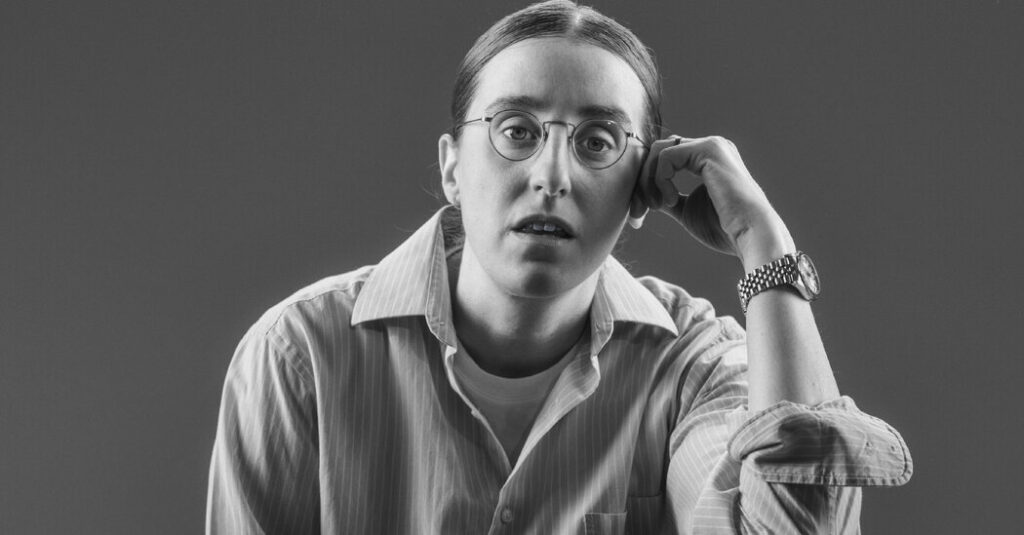
The comedian Robby Hoffman seems to be everywhere these days, including her scene-stealing role in “Hacks” as a former Hasidic Jew from Crown Heights, Brooklyn, who becomes a Hollywood assistant and her part in the HBO comedy “Rooster” as the blunt, protective roommate of a student having an affair with a professor.
Some of these characters’ traits come directly from Hoffman herself — she grew up poor in a Hasidic community in Crown Heights, the seventh of 10 children, and yes, she’s blunt. Like many teenagers, Hoffman spent a lot of time and effort trying to fit in and to hide her socioeconomic background and, as she puts it, her “boyishness” — until she was outed by a classmate as gay and couldn’t pretend anymore.
These life experiences are a source of much of Hoffman’s unfiltered comedy, including her most recent Netflix special, “Wake Up,” and her current tour. They also inform how she looks at the world now, in her 30s, how she handles her growing fame and how she relates to her wife, the reality TV star Gabby Windey. I’d guess that they even influenced how she engaged in this interview.
Subscribe: Apple Podcasts | Spotify | YouTube | Amazon | iHeart
Robby Hoffman! Yeah, can you imagine?
We’re actually in your home. It’s weird because you guys said, “Oh, they have to do it at your house because we want the person to be comfortable.” But you come to the house and you totally rip it apart. You want me to be comfortable, but the couch isn’t where the couch is. The whole house is moved.
Apologies. Do you feel comfortable? No. But I’m not comfortable a lot, so don’t worry. I’m comfortable being uncomfortable.
Are you comfortable making people uncomfortable too? Oh, yeah.
Great. Then we’re in for a fun conversation. So, as you have often talked about, you grew up really poor. What is the weirdest thing now about finding yourself with money and fame? I don’t know if “weird” is the word. It’s tremendous. It’s amazing. Life is weird everywhere. It doesn’t change necessarily based on my socioeconomic status. Now I just see rich people and their weirdness. It’s like you go to a different level of a video game.
How would you compare rich weird with poor weird? Rich weird is way weirder and worse, because there’s a humanity that is missing. My favorite is the people like me who grew up poor and then by the grace of god got some money, and now we can be like, Oh, my god, how weird are these rich people who’ve been like this since birth? Small things like when you go into a rich person’s house and nobody’s allowed to go in the fridge. The poor have much less, but when you go to their house, it’s: “Take, take, take.” Generosity seems like a small thing, but I’ve mostly seen generosity in poor households. It’s not to say it doesn’t exist, but it is notable. Whenever I meet a rich person and they actually were helpful, I mention it. It’s worth mentioning.
Are there things that have stayed with you about having really struggled? My mom came as a political refugee from Cuba with basically a suitcase. And no matter how comfortable she is, she’s a hoarder. She says it’s because she lost everything so young. Is there anything like that for you? Everything. The way that I am is entirely informed by how I grew up. That’s why I like being with Gab. We both grew up in meager beginnings, and we speak the same language. We speak the same language if we’re grocery shopping and raspberries are $7.99 for a little thing and I’m not in the mood to spend that. I don’t care if the money’s in the account. I’m not in a place emotionally to drop $7.99 on a little thing of raspberries. She agrees; we move on. If I’m going to buy something, I make sure it’s something I love, that I’ll have forever.
What’s the last thing you bought that you loved? Probably my backpack. I bought a designer backpack for tour. As a dyke, I don’t buy purses or anything like that, but a backpack is a kin. I’ve had it for almost a year, and I don’t see it slowing down.
You grew up the seventh of 10 kids in an ultra-Orthodox Hasidic family. You’ve described growing up in pretty brutal terms. What are your earliest memories of your life in Crown Heights? Really bad. I don’t speak too much to this, but I can a little bit. Crown Heights is beautiful now, but there were a lot of robberies when we were kids. The summers are very hot in New York. We didn’t have air-conditioning, but my parents had one air-conditioner in the window in their bedroom. My parents had the 10 kids on the floor — some in the bed and others of us on couch pillows, like quasi-made mattresses — and we would sleep on the floor in our underwear.
I was very afraid of my father. My father was abusive to my mother. I try to give grace. Not too much grace, but my parents were very young when they had us. My father was 35 with 10 kids; my mother was 30. So they were under a lot of pressure and stress. I’m not excusing him, but I don’t know that he had the proper resources to deal with anything. And I’m not sure how he was told to manage his family in the religious systems that he was a part of. So that said, he was very abusive.
What does that mean, if you don’t mind my asking? He was physically abusive to my mother for years. I always avoided him. He was not physically abusive to us, and in fact I remember some bad fights he would speak to us after and say, “I would never hit you.” But it’s like, “You hit Ma!” And my mother is the sweetest, wouldn’t hurt a fly. I remember once walking into the kitchen at 5, 6 years old. I wanted orange juice or a snack. And I saw him sitting there, and I’d go: “Ooh! Didn’t see you there.” And I would walk away. That was a tiptoey time, for sure.
When did you realize you were funny? Probably later. But my whole family was funny. My father was very funny, and my mother is hysterical. It was always brutal and funny. We laughed at each other. We laughed at ourselves. We laughed at everyone and anything. Nothing was off-limits.
Was funny a way to deal with the hard things? I’m sure. It’s cultural, and there’s a roughness to comedy. It isn’t polite all the time. It’s not sensitive all the time. It’s just funny. If you grow up that way, politeness and decorum is to the side, because you can’t invest in those things. It’s not always polite, and it’s not always comfortable. I think the idea of comfort generally, even when you asked me if I’m comfortable, is a rich thing. These are concepts. If you ask somebody how they grew up, they won’t tell you rich. They’ll say, “We were comfortable.” I’d never heard the word growing up. Comfortable? What? We’re not comfortable. Nobody is comfortable! There are roaches in the sink. The snow has come through the window, and I’ve got to put cellophane on it. Nobody is comfortable, and we’re very comfortable being uncomfortable. But the rich are not. And they dictate what is comfortable and what isn’t. They are uncomfortable often. They don’t talk about things, like money. Whether I wanted to talk about it or not as a kid, we had one phone and my mother was screaming about money on that phone from morning till night. We heard everything. The rich have their own siloed rooms. It’s not like I could go into the other room and not hear her. It’s basically one room, and the walls are thin as hell. One more thing on comfortable — are you going to kill me?
No, I think it’s really insightful. Thank you. So, poor people know how to chill. The house is a dump. But it’s Friday night, people are back from work, school’s out — you get into a poor person’s house, you got the chips on the table, everybody’s got a Coke or a Sprite, whatever they want. Take, take, take. You’re sitting outside. You’re shooting the [expletive]. It’s a lot more comfortable to hang in a poor house than when I go to the rich houses.
Eventually you leave Crown Heights. You move down to Florida. You’re there for a little bit, and then your grandfather —— Wow. How did you hear the Florida piece? I always skip the Florida piece. We were there for like a year, but you did your research. We’re at The New York Times, baby. OK, go ahead.
So your grandfather then comes and rescues your mother from your abusive father, and you all move to Canada and leave your dad behind. Did you become more secular at that moment? What was it like to move from a religious community to a less religious environment? What was that transition like? So it wasn’t overnight. Transition is the exact word. I was kosher till 19. I’ve got a mezuza here; I’m not an animal! So there are still remnants. I don’t know that I totally transitioned out. When we left, we were still religious. In fact, we moved to a Montreal neighborhood that was the same sect. The biggest difference was not having the father in the home, which meant my mother took on all of the male religious commandments. She did the kiddush, which is the Friday night blessing over the wine, and Saturday she did Havdalah, which is the service at the end of the Sabbath. She did all the male things.
Was it something that you wanted to break from or something that you were battling against? You’re asking about my mother’s battle. My mother is the one who took us out of that insular community. It’s really her story. I was born into it. So I don’t know that it was such a battle. This was life. For my mother, she was starting to open up and say: “Is this what I want for my life? Is this what I want for my kids’ life?” My brothers, for instance, were not learning English. They were learning Yiddish, and they were learning the Torah. My mother is proficient in English. My mother is potentially the most well-read person I’ve ever met in my whole life. So she had a big dissonance between her kids not being able to read the classics later on. Like, “What am I doing to these boys that they’re only learning the Bible and they’re not learning their own language?” So there were things like that that my mother shared later that led her to be like, “I don’t want my kids living like this.” Beyond her own abuse and what she was facing, she was thinking about what kind of people we were going to be.
You end up going to a private Jewish school on scholarship. You said in an interview that you had to find your voice and that you had been sounding “JAPpy” — your word — in order to fit in at high school. I wouldn’t use such language.
I’m quoting. I’m kidding. [Laughs] Shout out to my Japanese fans — nothing to do with you! “Jewish American Princess.” It’s a derogatory term for Jewish girls, which I can use. Go ahead. [Pause] Does anyone give you a hard time in the interview?
Oh, yeah. Name names! I can’t wait for the tea.
I was curious about when you gave up trying to fit in. It was another transition. It’s also a teenage thing. Many teenagers want to fit in. I was already poor. I was going to this nice school, which in the end was a net positive. It was hard socioeconomically to not fit in and feel looked down upon, but it also created a fire in me. But it was a transition. Not only was I hiding where I came from, the classism of it all, but I was also hiding the boyishness. I wanted to be feminine and girly. I was always a loud kid. I was always annoying. I hated these things about me. I still hate being annoying. and I’m working on it. But it wasn’t for girls to be like that. It was unladylike and not hot, not cool.
One of my good friends sat me down, probably in ninth grade, and said that I’m bringing down the group, that I can’t wear a backpack anymore, I’ve got to have a purse. And I was like: “But these books are so heavy! I can’t do one shoulder! I need both shoulders. These math books — are you kidding me?” I remember she was like, “No, you’ve got to get a purse.” I was always checking myself. I was always thinking about how I look, how I sound, how I look, how I sound. And over time, as I came out and as I started doing stand-up, it was all about leaning back in. When you’re onstage, it gives you an excuse to be 1,000 percent you.
You were actually outed when you were 17 in a way that sounds like something out of “Mean Girls.” Bro, this was brutal. I had a girlfriend, and this girl wanted to be out of the closet with me. And I was like: “I’m not being [expletive] gay. Are you out of your mind? There’s no way. I’m doing well in school, getting a great job.” And so she would say, “Fine.” And I just wouldn’t talk to her in public.
You didn’t want to come out at this point because you just didn’t feel like it was anyone’s business? I didn’t know how long this was going to go. As soon as I found out I was gay, I was already living on my own. I was already having to make rent. I was in school full time. I was working basically full time too. I was living a really grown-up life, and I just could not have another thing.
I didn’t go out too much, but I went out, and this is where it gets sloppy. We went to the student bar, and I was with all my friends and she was with hers. At some point, she texted me to meet her in the bathroom. So we went into the stall together. And we’re making out in the stall — we were 17, who cares? — and the door sprung open, and a girl that I had gone to school with, part of the Jewish community, saw me. By the next day, it felt like everybody knew. It felt like the scene from “A Walk to Remember.” I was walking through the cafeteria, and everybody was like, “She’s [expletive] gay.” I’m lucky to be here. It was the worst time in my life. I lost all my friends overnight at 17. And it wasn’t a time where nobody was gay; we were just in a pretty conservative environment.
That’s terrible. It was really bad.
You eventually go to McGill, you study accounting, you started doing stand-up and you were getting your first steady paychecks as an accountant after you graduated. You were going by Rivkah, your given name, at work, and Robby in the comedy clubs. Was that like an alter ego? No. It wasn’t like Beyoncé/Sasha Fierce. It was a practical decision. My name is Rivkah, but I didn’t want the accounting firm to think I wasn’t living for the firm, because it was a very big culture at these professional jobs, that you live and die for this firm. I didn’t want people knowing that I was leaving at 7 p.m. to do stand-up.
I watched a TEDx talk you gave in 2014. I hate that that’s still up there. It makes me cringe, but go ahead.
I found it to be poignant. Good job, younger Rob. I don’t know why I’m salty about it. I look for problems. This is what I do. To complain is to enjoy for me. I can’t even look at something good and say: “You know what? That was a good thing.”
One thing you said in that talk is that “comedy chooses you.” And you also said, “The stage understands me, and it’s where I’d like to live.” To bring it back to comfort, I’m the most uncomfortable one on one or in small talk or at little dinner parties. But onstage, when everything goes black and the lights are on me, I feel like I’m in a womb. I’m free. I always worked small, and then bigger, bigger, bigger, and now I’m working on a massive scale, and I feel at home.
Why do you think that is? I don’t know how to explain it better than that, but I do think that comedy chooses you. You can choose it, and the people who choose it, some of them, you can tell they chose it and it didn’t choose them. [Laughs] As soon as I started stand-up I was like, “I’ve got to do this now. This is really throwing a wrench into my plans. I was going to marry good, get a good job, maybe have a condo, have a husband. Now I’m gay, and I have to really consider pursuing art,” which seemed like the poorest thing you could do, and I’m trying not to be poor anymore. Like, this is no joke. But I felt like it was a calling.
You said earlier that growing up, nothing was too taboo to joke about, and in a recent interview you said that anyone can do anything. Do you mean you don’t have to be part of a group to make fun of it? I think anyone can do anything, but you’re at your own risk. So for instance, Dave Chappelle can joke about trans people. He’s not trans, he’s not on the trans spectrum, but he can do it. But people can clap back. I think you can do whatever the hell you want, but also know that it could be perceived by people however the hell they want.
How do you think about what you would or wouldn’t do? Because you’ve joked about AIDS, pedophilia, late-term abortions. You’ve got to go listen to the jokes! You can’t just list.
You’ve got to go listen to the jokes. It’s hard to talk about comedy out of context! But is there something that you won’t joke about or haven’t found the right way to joke about? I’m sure. I don’t know how to answer that. Jokes come to you. It’s divine. Where does an idea come from? Yes, you’re informed by your life and all of the experiences, and then one day you’re walking and you’re like: “Oh, that would be funny. Can I do that? Can I not? Well, I’ll have to try.”
How do you feel about being controversial? Because you said that people also have a right to clap back. There is this continuum where the more famous you get, the more scrutiny you get, the more backlash you get. I can see that in your career already. You just had the celiacs come after you. The only two communities that have come after me, hysterically enough, have been the pit bull community. After the special in which I talked about some of the topics you listed so elegantly, the pit bulls came out. Of all the things I said in that special — raising the age of abortion to 10 years old — the pit bull people came after me. Turns out they’re as scary as the dog. The only other people to come after me is the celiac community. I mean, you can’t make this stuff up! Celiac is a real disease that affects mostly white women who are privileged to have health care to get the diagnosis. People of color tend to be less aware or not diagnosed with these things as much, because they lack health care, unfortunately, in this country. I was asked a silly question about gluten in a hard-hitting interview with [the podcast] “Call Her Daddy,” and I responded jokingly, as I always do. Nothing more serious than that. But of course, rich white women came after me, as they’re at the helm of both the pit bull and the celiac community.
Rich white women are at the head of the pit bull community? Yeah, they like to rescue dogs. Which is great! I’m just joking, right? Just like I joked about those other things. It’s amazing that more people from other communities haven’t [come after me]. It’s always the people who are like, “I have a problem too!” I will get in trouble for this, but it’s kind of like how I feel about antisemitism. Antisemitism is bad. I don’t want antisemitism. But is it the worst thing? No, to me right now it’s not, especially living in a country where there’s massive anti-Mexican sentiment and Mexican people are currently being rounded up. So, sorry if I’m not screaming as much about antisemitism as you want me to. Right now I have bigger focuses on some of my neighbors that are going through horrendous anti-Mexican sentiment.
I’m not a person that thinks I’m going to live a life free of any problems. You asked me about being offended with my comedy. I don’t think being offended is the worst thing. Being poor is. Some people expect to go through a life of not being offended, I guess? Not me. I was born offended. My whole circumstance was offensive. Again, like I said, if I hit your community, I’m also hitting my community, they’re hitting me, you’re hitting me, it’s all fair game. And I think it’s OK for something to bristle you and to make you think something or feel something or react.
You were in the show “Hacks,” which just ended. What did that experience mean to you? It changed my life. I’m an Emmy-nominated actor now. It’s just everything you would want: a part written for you and gets you an Emmy nom. I have no complaints.
I was really entertained by a recent article. The headline was “How ‘Hacks’ Botched Its Yiddish Line.” It was in response to a cutaway gag on one of the last episodes. You say a line in Yiddish, and the author wrote that the line was grammatically incorrect and then said, very archly, “as any fluent Yiddish speaker will confirm.” I asked my mother how to say “free.” I was using the word “frei,” and my mother said, “bkhnim.” So I ad-libbed the first part of the line, which maybe was grammatically incorrect, who cares. This is what annoys me about Jews. It’s like, they want me to speak about antisemitism. We get Yiddish onto the show, and then this Jewish publication has an issue with the Yiddish. I may have gotten the grammar wrong, but my mother got the word right. “Which any Yiddish speaker would know”? My mother is fluent in Yiddish. I asked her one word on the phone. She doesn’t need to be indicted for this.
It feels like it hurt you. No, it bothered me. Annoyed. It goes to your thing of like, with more fame, you have the scrutiny. My little sister gets excited about all these things, because she’s like, “We’re going up, up, up.” They wouldn’t scrutinize me if I was a nobody. Come on. We have other fish to fry.
One of the reasons I wanted to talk to you is not only because I’ve admired your work, but I’m also really interested in transition periods in people’s lives, and you have become a lot more famous. Is that hard to deal with? I think I’m ready, but it is interesting. I’m new to this, and I don’t want anyone or need anyone coming for me. But I think the big thing for me as I navigate this next level is: Why am I successful? Why are my shows successful? And I think it’s because I don’t need to be part of this big machine dividing us by having us squabble about this and that. It’s enough partaking in petty squabbles. And if you want the us versus them, at my core, it has always been about the rich versus the poor. That’s what we need to focus on. I’ve been screaming about this since growing up the way I grew up.
Part of your fame is also compounded by your relationship with Gabby Windey, whom you married last year. She was on “The Bachelor” and “The Bachelorette” and was also a breakout on “The Traitors,” which I love. Did you think she was traitor material, or did you always see her as a faithful? I thought she was a faithful. She doesn’t need all the stress of lying. We can’t really lie. That’s probably why we get in trouble. I would be out first. I would be too nervous. I would need to go home. I don’t have the temperament for it.
I’ve seen you talk about Gabby with so much love and so much respect. Have you had to figure out what a good relationship looks like because of the chaos of your upbringing? Yeah, of course. I grew up in a single-mom household, poor, but my mother was home, in the kitchen, 24-7. Every day, this woman was cooking and cleaning. To this day, if I’ve got to find my mother, I know exactly where she is. Gab didn’t have that. Gab had a parent who was not there, oftentimes didn’t know where the parent was. Then she went to live with her dad. But I’m just saying she didn’t have that consistency. So Gab used to think that bringing up something with me, I would leave. If she thought I was annoying — which we’ve established; I’ve long been annoying, and I apologize — if something hurt her feelings, or if she didn’t like the way that I did something, she just wouldn’t say, because she wouldn’t want me to go away. But I was like: “I’m not! Try me.” So she had to get comfortable trusting that. And I had to get comfortable that she was tepid about everything.
It’s not our job to heal each other, but through the relationship we are healing each other. It’s not the job, but it’s the cherry. And it’s really nice to design the life you want to live. When I was a kid and I hated my brothers, my mother would say, “You don’t choose your family.” Then I realized there’s a loophole: If I marry Gabby, I choose my family. Choose wisely.
All right. Thank you so much. I’ve really appreciated your time. That’s it?
That’s it! Oh, my god. We’re finally done.
This interview has been edited and condensed from two conversations. Listen to and follow “The Interview” on Apple Podcasts, Spotify, YouTube, iHeartRadio or Amazon Music. Follow us on Instagram and TikTok.
Director of photography (video): Aaron Katter
The post Robby Hoffman Will Always Feel Poor, No Matter How Rich She Gets appeared first on New York Times.