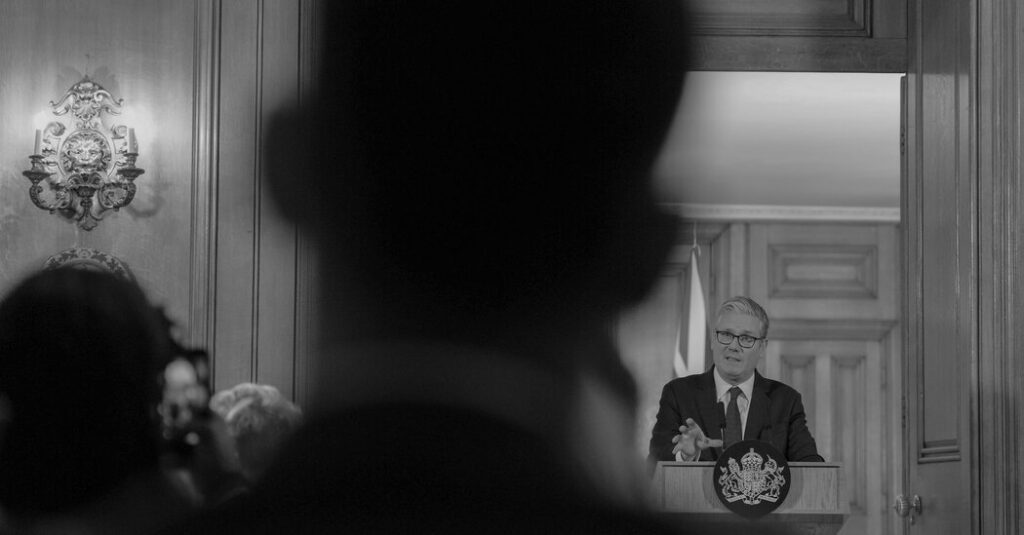
Prime Minister Keir Starmer of Britain still occupies 10 Downing Street, but all power is already flowing toward the man widely expected to replace him, Andy Burnham. In the American system, a president becomes a lame duck the moment a successor is elected. Britain seems to have accidentally replicated this condition.
It isn’t quite correct to say that Mr. Starmer has become a lame duck, however, for the simple reason that Mr. Starmer has been a lame duck from the moment he entered office just under two years ago, despite winning a large parliamentary majority. His ineffectuality was self-inflicted; it was a condition of his victory.
This is the paradox of Mr. Starmer. His great achievement was to restore the Labour Party to government after 14 years in opposition. But this was made possible by a lack of conviction, which made him disastrously irresolute once he got there.
In 2020, the Labour Party held an election for a new leader after Jeremy Corbyn resigned, following a shattering defeat in the general election that allowed Boris Johnson to “get Brexit done” and left Labour with its smallest share of seats since the 1930s.
The party was demoralized. Mr. Starmer, who had served on Mr. Corbyn’s front bench, ran on a platform of “10 pledges” that would appeal to a membership that had heavily backed Mr. Corbyn. He offered socialism with a sheen of professional competence, and he looked the part: a handsome human rights lawyer with reassuringly good hair. His victory was decisive.
The about-face he then executed was jarring even for those who are cynical about political promises. He started to drop the pledges, and moved to expel Mr. Corbyn from the party. He celebrated wealth creation and committed to fiscal probity.
The strategy worked. By reassuring the country that this Labour leader would be boringly centrist, he did what many had deemed impossible. Less than five years after its devastating defeat, Labour won a landslide majority. But Mr. Starmer the centrist seemed no more authentic than Mr. Starmer the socialist. He appeared to have no core political intuitions, and consequently no idea what to do with the job once he had it.
In opposition, Mr. Starmer criticized Mr. Johnson for having “lurched from crisis to crisis and U-turn to U-turn.” But once in office, he executed the same maneuver. He tightened eligibility rules for winter fuel subsidies for seniors and then loosened them. He suspended Labour lawmakers who voted to end a two-child limit on benefits, then scrapped the limit. He watered down inheritance tax plans in the face of protests, and retreated on welfare cuts after opposition from his own party.
In the spring of 2025, he gave a speech on immigration in which he spoke of his fear that Britain risked becoming an “island of strangers.” The phrase was an unfortunate echo of the infamous “Rivers of Blood” speech by the right-wing politician Enoch Powell, for which Mr. Starmer later apologized while appearing to claim that he hadn’t read through the speech properly before he delivered it.
The cumulative effect of these reversals was the impression of a man who neither believed nor disbelieved what he said — who said only whatever he understood to be the politically appropriate thing to say at that moment.
Mr. Starmer seemed happiest when meeting foreign leaders, when representing Britain rather than running it. He played a pivotal role in European support for Ukraine, and he signed trade deals with the United States and India and a post-Brexit reset deal with the European Union. But even on this front there has been a failure of will. One of the most recent blows to his authority was the resignation of the defense secretary John Healey, who despaired at the prime minister’s refusal to end a long-running impasse with the Treasury and fund increases to military spending that would meet the promises made to NATO allies.
Previous prime ministers have had policy preoccupations or obsessions. For Margaret Thatcher, it was trade union reform and economic liberalization; for Tony Blair, public service reform. Even Rishi Sunak, who was prime minister for the last 20 months of the previous Conservative government, had A.I.
British voters are divided in many ways, but there is consensus on Mr. Starmer. Responses to a YouGov poll in May that asked Britons to describe what they thought of him in their own words contained multiple versions of more or less the same thing: “I don’t think he believes in anything.”
One may ask how a man with so little proclivity for governing ends up being prime minister. In Mr. Starmer’s case, it was this very absence of ballast that enabled him to get there. If Mr. Burnham is the next prime minister, he would do well to absorb the lesson of his predecessor’s failures: plan beats no plan.
Ian Leslie is the author, most recently, of “John and Paul: A Love Story in Songs.”
The Times is committed to publishing a diversity of letters to the editor. We’d like to hear what you think about this or any of our articles. Here are some tips. And here’s our email: [email protected].
Follow the New York Times Opinion section on Facebook, Instagram, TikTok, Bluesky, WhatsApp and Threads.
The post Does Keir Starmer Believe in Anything? appeared first on New York Times.