On a cool Monday morning in October 1779, three years after the Declaration of Independence was signed, an armed mob of militiamen set out in search of Philadelphia’s elite.
The war against Britain had dragged on for more than four years, and ordinary Philadelphians were suffering from the skyrocketing costs of bread, flour, salt, sugar and other necessities. Pennsylvania’s leaders had failed to impose price controls. By fall the militias were ready to act.
“We have arms in our hands and know the use of them,” one member said in a statement printed in The Pennsylvania Packet that summer. “We will no longer be trampled upon.”
By 10 a.m. on Oct. 4, a large crowd had gathered at Burns’s Tavern on 10th Street. The people were hungry, angry and out of patience. On their list of targets were some of Philadelphia’s wealthiest residents, including James Wilson, a signer of the Declaration and one of the young nation’s leading lawyers.
Wilson and his family lived in a grand, four-story brick townhouse on the corner of Walnut and Third Streets. It would have stood out for its extravagance at any time, but especially at a moment of citywide desperation.
Wilson’s wealth wasn’t the only source of the radicals’ suspicion of him. In 1776 he had delayed voting in favor of independence, then strongly opposed passage of the state’s constitution, which was by far the most democratic of the founding era. More recently he had defended Loyalists who had been accused of treason after the British occupation of Philadelphia.
In all these instances there were good explanations for Wilson’s behavior, but those were irrelevant as the mob, numbering as many as 200, marched down Arch Street, playing “The Rogue’s March” on drums and fife. Wilson had gotten word that the militia was coming, and he rounded up about 30 men to protect his house.
The mob soon arrived, and when one of the men holed up inside the house, Capt. Robert Campbell, stuck his head out a window and told the crowd to move along, he was struck immediately by a bullet. His wounds were fatal, and the fight erupted.
Inside the house, Wilson and the others were gathered in an upstairs room, according to one account, as “a number of desperate-looking men in their shirt sleeves” moved toward them “armed with bars of iron, and large hammers.” One attacker swung a sledgehammer against the front door, and the men entered, only to be met by gunshots from the top of the stairs. Other men dragged one of Wilson’s defenders down the stairs by his hair and bayoneted him, while Wilson’s crew barricaded the door.
Whether Wilson could have held out much longer is doubtful; the militia had sent for reinforcements, and a cannon was being hauled over from the arsenal. Before it could be loaded, the City Light Horse Cavalry showed up, scattering the crowd. When it was all over, seven people were dead, including a young Black boy who had been standing nearby and was caught in the crossfire. At least 17 were wounded.
The Fort Wilson Riot, as it came to be known, would echo through Philadelphia society and across the states, shaking the young nation’s leaders, many of whom saw in it the shadow of disorder and mob violence that lurks behind democracy. In the hours after the attack, Henry Laurens, a former president of the Continental Congress, wrote to John Adams, “We are at this moment on the brink of a precipice, and what I have long dreaded and often intimated to my friends seems to be breaking forth — a convulsion among the people.”
More than anyone else, Wilson would be forgiven for sharing these fears, and yet only eight years later, he led the fight to devise a constitution that gave much more direct power to regular citizens than any of his peers wanted to, a document he drafted explicitly in the name of “we the people,” and then helped ensure was ratified by special state conventions, not sitting legislatures, to emphasize the idea of popular sovereignty.
In fact, Wilson, who was born into a poor farming family in Scotland before immigrating to America as a young man, had long argued for placing more power in the hands of the people. Throughout his life, he held to that ideal. To him, America’s founding documents were inextricably linked.
The Declaration’s soaring preamble — “We hold these truths to be self-evident, that all men are created equal” — and the Constitution’s opening phrase — “We the People”— are the Genesis of our civic scripture, repeated today with such frequency and familiarity that many Americans forget which one goes with which document. But these words did not resonate in the same way with most of the country’s founders.
George Washington, John Adams, Benjamin Franklin, James Madison, Alexander Hamilton, John Jay — these are the most famous men associated with the American founding, yet, according to research by William Ewald, a law professor at the University of Pennsylvania, none appear to have uttered the Declaration’s preamble aloud in public after 1776. Not “created equal,” not “self-evident,” not “pursuit of happiness,” not “unalienable.”
But one founder did: James Wilson. He quoted from the Declaration constantly, including one day on the floor of the constitutional convention in Philadelphia. In notes Madison recorded that day, Wilson pulled out a copy of the Declaration and read aloud from it, arguing that it proved that the states had declared their independence “not individually but unitedly.”
Wilson’s insistent focus on one, united people was the natural consequence of his commitment to popular sovereignty: the idea that the people are, as he put it, “the legitimate source of all authority.” In other words, the people, not the states, are the ultimate fount of power in government.
This was the essence of the Declaration, as he saw it, and he did what he could to make it the essence of the Constitution, too. When he was assigned to a committee tasked with drafting the Constitution in the middle of the summer of 1787, he opened it with the words, “We the people,” to tie that document to the Declaration and to remove any doubt about who this government was being built for.
So why does almost no one today know Wilson’s name? Only a few years after the Constitution was ratified in 1788, he succumbed to malaria while hiding out in the back room of a tavern in North Carolina. He had been there for the better part of a year, absconding from his Philadelphia townhouse and from the Supreme Court, to which he had been appointed by George Washington. He had already been jailed twice for unpaid debts, a result of his compulsive and reckless speculation in lands; his modern anonymity is a result of his ignominious death.
The irony is that Wilson’s fellow founders were well aware of his prominence. “His mind, while he spoke, was one blaze of light,” Benjamin Rush, Wilson’s friend and a fellow signer of the Declaration, wrote. And what Wilson spoke about more than anything else were the radical egalitarian ideals behind the Declaration.
When I think about James Wilson, as I have fairly constantly over the seven years that I have spent researching and writing his biography, I keep coming back to the Fort Wilson Riot, and his reaction to it. It’s easy to imagine him returning to his ransacked study after that brutal attack, betrayed and furious, and resolving to give up on his commitment to “the people” and the idea of popular sovereignty. He might have joined with Adams, whose own analysis of history convinced him that “tumults arise in all governments, but they are certainly most remediless and certainly most fatal in a simple democracy.”
Instead, within hours of escaping the violence, Wilson was looking to get home, despite warnings from his friend the financier Robert Morris. “As the ferment is particularly high against you, it may be best to keep out of the way for a day or two,” Morris wrote. Wilson responded that he wanted to return as soon as possible: “My absence, I’m afraid, only makes matters worse.”
Wilson’s choice is a central part of what fascinates me about his life. I wanted to understand how a man could be so committed to the principle of popular self-rule that he doubled down on it even after an armed mob broke down his front door and tried to kill him.
At first, I thought my inquiries would be limited to libraries and historical archives, but in the middle of working on my book proposal, Jan. 6 happened. Thousands of angry marchers, some of them armed, stormed the U.S. Capitol in protest of Donald Trump’s defeat in the 2020 election.
Suddenly I felt the question I was asking about Wilson was being turned back on me, on all of us: The People’s House was under attack, and we were all targets. As I watched the mob break through Capitol windows, pepper-spray police officers and defile the seat of our government, I wondered about my own commitment to popular sovereignty. Was it really preferable to the alternatives? Was I just a fair-weather democrat?
The answer, I came to believe, could be found in Wilson’s defiant response to the attack on his own home. Democracy, after all, is a constant practice, not a state of being. At the time of the American Revolution, most humans had lived in a state of perpetual war for thousands of years. The democratic vision embraced by Wilson and (to a lesser extent) his fellow founders rejected “the iron laws of the world,” as Stephen Miller, Mr. Trump’s right-hand man, put it this year: the resolution of all conflict through strength, force and power.
In place of this “might makes right” view of humanity, democracy offered a set of principles about how to get along — a society based on the rule of law, one in which everyone has an equal say and disputes are resolved through reason and deliberation, not weapons. It was a radical idea at the time, and it remains a radical idea today. Viewed from the perspective of human history, the democratic faith in the ability of regular people to live together and govern themselves in peace is nothing short of miraculous.
What Wilson illustrated in his post-attack commitment to popular sovereignty is that it is most necessary to keep this faith not during times of calm and contentment, but when the tenuous bonds that hold us together threaten to break. To be meaningful, democratic principles have to be something we can count on when the house is stormed.
This isn’t to say that democracy as a practice always leads to perfectly democratic outcomes. Obviously it does not. Here in the United States, those currently in charge of the federal government are seeking to destroy the very things that make us a democracy. They may yet prevail.
But the true value of democracy is not in one specific election or policy; it is in the fact that we, the people, always retain the opportunity — and the power — to fix our mistakes. Bad decisions are less permanent because of democracy. One might say the solution to a bad guy with a vote is a good guy with a vote.
In the face of those who are both armed and intent on undermining these principles, holding onto them can feel naïve or even dangerous. But James Wilson managed to do it; the question for us today is, can we?
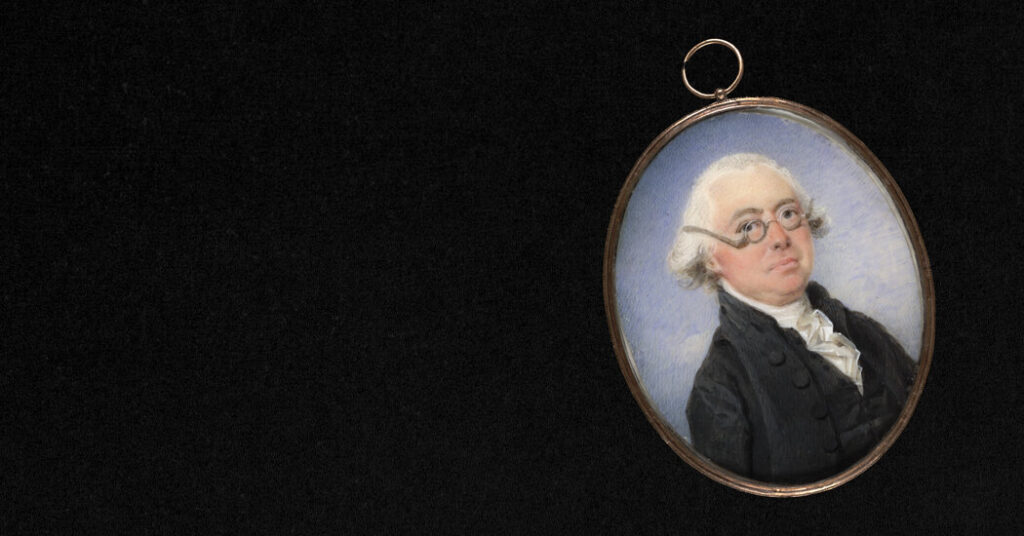
Source photograph via the Smithsonian American Art Museum.
Jesse Wegman, a contributing Opinion writer, is a former member of The New York Times’s editorial board, a senior fellow at the Kohlberg Center at the Brennan Center for Justice and the author of “The Lost Founder: James Wilson and the Forgotten Fight for a People’s Constitution.”
The Times is committed to publishing a diversity of letters to the editor. We’d like to hear what you think about this or any of our articles. Here are some tips. And here’s our email: [email protected].
Follow the New York Times Opinion section on Facebook, Instagram, TikTok, Bluesky, WhatsApp and Threads.
The post The Founder We Need Is the One We Don’t Remember appeared first on New York Times.