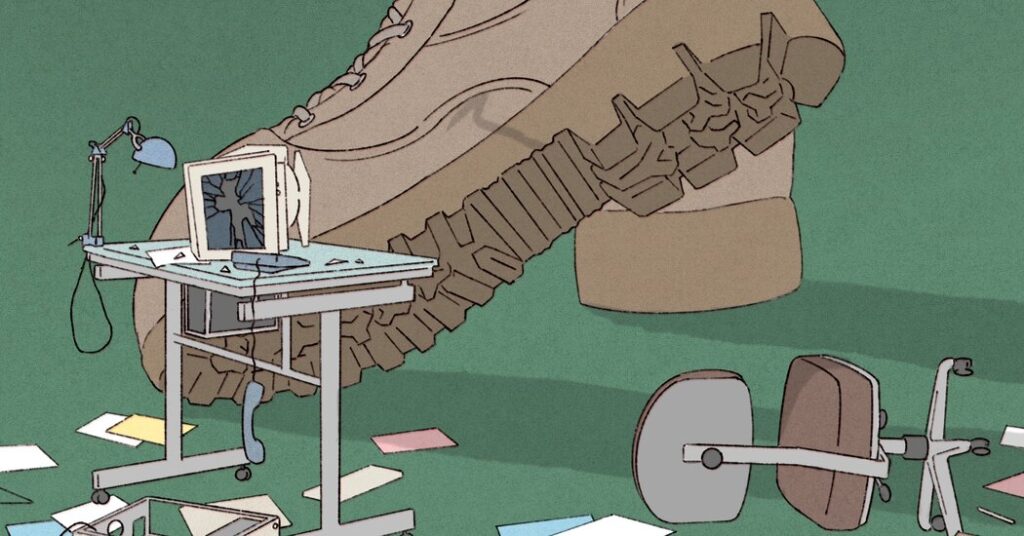
The Trump administration has argued that mass immigration enforcement will free millions of jobs for Americans by reducing competition from foreigners.
The opposite is true. Despite the administration’s claims, a recent study, which I helped write, shows that the crackdown on immigrants has not unlocked jobs for Americans. During the first nine months of 2025, Immigration and Customs Enforcement operations led directly to at least 668,000 lost jobs across 86 U.S. metropolitan areas.
The damage is easy to miss in national statistics. Since 2025, the national unemployment rate has hovered between 4.0 and 4.5 percent. But the national rate, with its large margin of error, isn’t a good measure of local employment shocks. It’s more likely that the notable effects show up in local jobs data. And they do.
ICE was active in both small and large cities. Laredo and El Paso in Texas and Richmond, Va., saw substantial increases in enforcement. And while the conventional narrative is that ICE targeted blue sanctuary cities, 56 of the 86 metro areas where ICE was most active were in red states, primarily Texas, Florida and Georgia. Which means that they bore the brunt of the job losses.
Looking at the 51 cities where we were able to track data for at least six months in 2025 after the surges began, we saw that the situation worsened over time. In places where ICE enforcement surged between January and March — including Dallas, Detroit, Miami, Oklahoma City and Philadelphia — employment losses were twice as high after six months.
The key finding: Immigrant and native workers are not simply substitutes for each other. They are complements. When you remove one, you often undermine the other.
In much of the economy, immigrants aren’t competing for jobs held by American-born workers; they make other jobs possible. Immigrants tend to take on more physically demanding tasks, which allows American-born workers to shift into communication-intensive, supervisory and coordination roles. Immigrants also help drive American innovation and patents, and they are about 80 percent more likely than American-born workers to start a business, which could then hire Americans.
To understand why so many jobs have been lost, it is crucial to understand what this administration has called its “shock and awe” enforcement strategy. The goal is to spread fear far beyond those who are arrested and to induce immigrants to self-deport.
To accomplish this, ICE has gone all in: It has arrested people at their workplaces. It has flooded immigrant neighborhoods with agents. It has held children as leverage to detain their parents. It has housed detainees in unpleasant and sometimes inhumane conditions. It has transferred some arrestees to a notorious prison in El Salvador and sent others thousands of miles from their country of origin to places such as South Sudan.
It’s unclear how many self-deportations this strategy yielded. With little or no evidence, the administration says the number is north of two million, while other researchers say the figure is probably closer to 200,000. But what is undeniable is that the surges have caused widespread alarm among immigrants and those close to them.
This fear led to most of the job losses. Many immigrants in surge cities stopped going to work, even if they had legal status. Businesses had a hard time replacing these workers, as well as the ones arrested by ICE. As a result, many small businesses scaled back or shut down, creating a domino effect that cost even more jobs. Fear has caused people — both immigrants and nonimmigrants — to stay home and to spend significantly less money in their communities.
Los Angeles shows us what this looks like. After a major ICE operation was announced in May of last year, spending in immigrant-heavy neighborhoods fell by 20 to 25 percent over the next two months, costing the region an estimated $625 million in lost sales. This strategy suppressed demand for everything from restaurants to dentists, which led to further job losses. Holing up and hiding out, not surprisingly, aren’t good for the economy. The damage spread farther than you might expect. Even sectors that have few immigrant workers, such as arts and entertainment, saw significant job losses.
Some industries, such as construction, have been especially hit hard. Construction workers experienced job losses more than three times as great as the surge cities’ average. This fits with how the industry operates. Work is often specialized and sequential. If you don’t have enough workers to build the walls, you can’t build the roof; if you can’t finish the roof, you can’t sell the building.
A developer we spoke with in the Rio Grande Valley who survived the 2008 housing market collapse and the 2020 Covid supply chain shock told us he stopped building and started selling building lots instead. Retaining his crew proved too difficult. If an employee disappeared, he said, finding a replacement took weeks. Another builder who once had about 100 employees recently finished his last home and is liquidating the company’s remaining properties.
The Trump administration has framed its immigration policy as a win for American workers. It isn’t. There are far better approaches that won’t cost American jobs. These approaches have broad public support and have been championed by both Republican and Democratic administrations from Ronald Reagan’s to Barack Obama’s. We need enforcement that targets genuine public safety threats, paired with durable legal status for those already here. Creating orderly channels for immigration instead of the current chaos would help the American economy and American workers.
Marcela Escobari is a senior fellow and a research vice president in the global economy and development program at the Brookings Institution.
The Times is committed to publishing a diversity of letters to the editor. We’d like to hear what you think about this or any of our articles. Here are some tips. And here’s our email: [email protected].
Follow the New York Times Opinion section on Facebook, Instagram, TikTok, Bluesky, WhatsApp and Threads.
The post ICE Is Killing Jobs for Americans, Not Creating Them appeared first on New York Times.