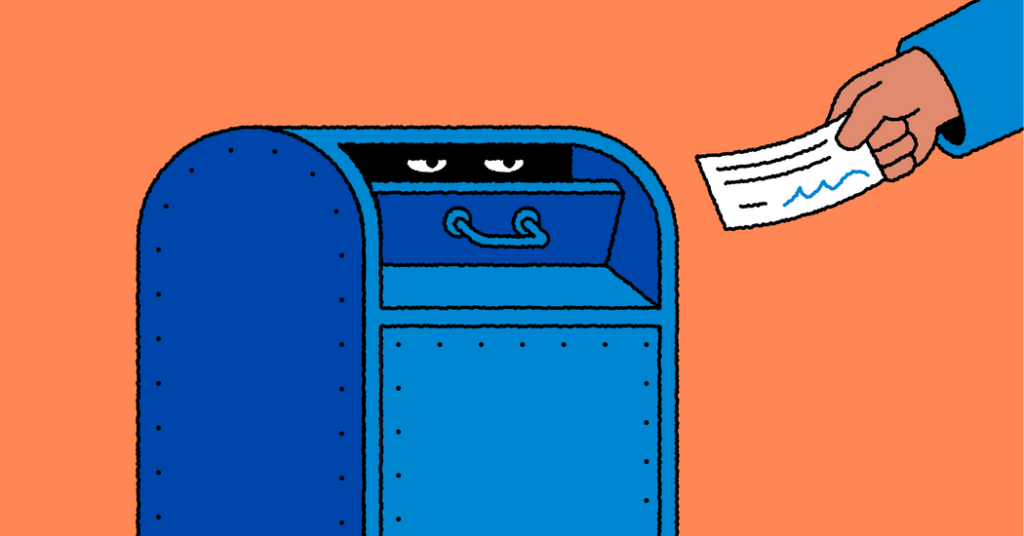
A practice that was common not so long ago has become increasingly risky — sending checks in the mail. But if you must send money this way, scour your account statements promptly.
Skipping that advice can leave you vulnerable to check fraud, and may also make it more difficult to recover the money if you lose it.
Joan K. Atchinson, 63, a retiree who lives in Washington, D.C., is dealing with that right now.
Ms. Atchinson said in a phone interview that she was trying to recover several thousand dollars stolen when someone intercepted a check she mailed last year. The check was altered to be payable to someone else before it was cashed. After months of trying, she said, she still has not recovered payment from either of the two banks involved — Charles Schwab, where she has an account that she used to write the check, and Chase, where the falsified check was cashed. “I’ve kind of lost hope.”
How does this kind of check fraud work?
Checks sent through the Postal Service have become targets for criminals in recent years. While fewer people write checks, the checks haven’t disappeared. Two-thirds of adults say they rarely or never use paper checks, but more than a fifth either have experienced check fraud or know someone who has, according to a poll in 2025 by the Independent Community Bankers of America, a trade group.
In some cases, thieves may pilfer one or more checks from local mailboxes. Adam Rust, director of financial services for the Consumer Federation of America, said thieves sometimes “fish” for checks at free-standing drop boxes, using long tools with sticky pads on the ends to grab letters. In other cases, more sophisticated criminals may steal large batches of checks, copy them and then sell them on the internet.
Often, the purloined checks are chemically altered in what’s known as “check washing” to remove the name of the recipient. The thief replaces it with a fraudulent name, and often increases the amount of the check, before cashing or depositing it.
Ms. Atchinson appears to have been a victim of such a fraud.
She said she wrote a check in April 2025 for $3,719 from her account at Charles Schwab to pay 2024 income taxes she and her husband, Brian, owed to Maryland, where they lived previously.
Ms. Atchinson said that she didn’t recall where she had mailed the check, but that she had probably dropped it in the mail slot in the lobby of their condominium building. She recalled noticing that the payment had been deducted from her account, but said she hadn’t thought to view the electronic check image online.
Then, in February, she said, 10 months after the check was sent, the couple received a balance-due notice from the state. (It’s unclear why the tax notification took so long.) Ms. Atchinson said she had logged on to the Schwab account to obtain an image of the check, intending to use it as proof that she had paid the tax. That was when she saw, to her dismay, that the check had been changed and made payable, in unfamiliar handwriting, to a name she didn’t recognize.
The back of the check indicated that it had been deposited electronically at Chase. (Criminals tend to prefer remote options, like mobile deposit or automatic teller machines, to avoid interaction with bank personnel, the authorities say.)
Her discovery prompted her to call and email both banks multiple times and to file complaints with law enforcement agencies, she said, but she is uncertain if she will be reimbursed.
The banks involved have had some back and forth since May.
Meghan Durant, a spokeswoman for Chase, said in an email, “Unfortunately, we did not receive communication from Ms. Atchinson’s bank until over a year after the check was deposited, and there are no funds available to recover.” Chase said it had not received a “formal” claim from Schwab indicating that Chase was responsible for paying the funds. It added that it took such matters “seriously” and that the account had been closed.
Tatiana Stead, a spokeswoman for Schwab, said the bank had submitted Ms. Atchinson’s affidavit to Chase and received a response on May 15 “advising that there were no funds available to recover.”
Ms. Atchinson said that she had contacted Schwab immediately when she had become aware of the fraud, noting that she had been a customer for “decades,” but that it hadn’t referred her case to a fraud specialist until May.
Ms. Stead sent an email to The New York Times on Wednesday saying, in part, “We sympathize with Ms. Atchinson.” But it added, “Timely reporting can significantly improve the ability to investigate potential fraud.”
Ms. Stead said on Thursday that a “final determination letter” was mailed to Ms. Atchinson earlier in the week outlining Schwab’s decision. Ms. Atchinson said she had not yet received the letter.
Schwab’s “security guarantee,” outlined on its website, says that “Schwab will cover losses in any of your Schwab accounts due to unauthorized activity.” But fine print at the bottom of the page notes that reimbursement “requires your timely reporting of unauthorized activity to Schwab,” and that Schwab “will not be liable for additional or increased losses resulting from a failure to report unauthorized activity in a timely manner.” It notes that more details are available in account agreements.
What should I do if I suspect check fraud?
Notify your bank as soon as possible, said Scott Anchin, vice president of strategic initiatives and policy at the independent bankers association.
Banks generally allow at least 30 days and sometimes up to 90 days from the time your statement is made available to you to report suspected check fraud, he said. Check your account agreement.
(The agreement available online for a Schwab One account, which appears to be the kind of account Ms. Atchinson used, notes an even tighter window for reporting check fraud: 10 days. Ms. Stead, however, said the bank’s cutoff is 30 days.)
If you get statements online, the clock starts when the statement posts, even if you haven’t opened it yet. Review statements promptly, Mr. Anchin said, including the check images, because an altered recipient isn’t always obvious from a one-line entry on a statement. Banks typically make check images available online or by request.
Will I get my money back?
Sorting out which bank is liable can be “quite time consuming,” Mr. Anchin said. It may depend on details of the incident, like what sort of alterations were made to the check. “There’s a lot that goes on behind the scenes,” he said, but typically, “the customer’s bank wants to make them whole.”
How can I avoid check fraud?
Try to break the check-mailing habit. “No one should ever mail a check,” Mr. Rust said.
If you must write a check, he said, try to deliver it in person or take it inside a post office to mail rather than relying on your own mailbox or public drop boxes.
The American Bankers Association recommends using permanent “gel” ink pens when you do write checks to reduce the risk of tampering. Promptly review your bank statements — including online check images — for anything that looks suspicious. And if you don’t already, consider using your bank’s online bill payment service.
All states now offer some type of electronic payment option for paying taxes, so look into using your state’s system if you owe money at tax time.
Are efforts underway to eliminate paper checks?
The federal government has been moving away from paper checks for things like benefit payments and income tax refunds, saying digital payment methods are more secure. But any effort to do away with all paper checks is likely to be contentious.
The Federal Reserve system, which acts as a central clearinghouse and electronically processes millions of checks daily, recently sought public input on potential changes to its check services.
More than 300 people and groups responded, many of them representatives of banks serving rural and agricultural communities where paper checks remain important. The chief executive of PriorityOne Bank, for instance, a community bank based in Magee, Miss., said in a comment letter that the bank served many low- and moderate-income rural communities with limited internet access. So online payments aren’t a reliable option, particularly for older residents who aren’t comfortable with digital banking.
The post Don’t Send Checks Through the Mail. Just Don’t. appeared first on New York Times.