This is an edition of The Atlantic Daily, a newsletter that guides you through the biggest stories of the day, helps you discover new ideas, and recommends the best in culture. Sign up for it here.
Last July, a group of activists staged what they called a “noise demonstration” at ICE’s Prairieland Detention Facility, near Dallas. They shot off fireworks, damaged a surveillance camera, and vandalized government vehicles. When police responded to the disturbance, a demonstrator fired several shots, hitting one officer in the neck; he survived.
The activists could reasonably be described as “antifa.” According to The Washington Post, alleged ringleader Benjamin Song “trained students for close quarters combat and large-scale gunfights,” and people involved wore the “black bloc” clothing that self-described antifa activists often pick in order to keep a low profile. But the name is contentious: President Trump has labeled antifa a “domestic terrorism group” even though no such legal designation exists. Treating antifa as a “group” that can be labeled doesn’t make a lot of sense either, because antifa is not a single centralized organization or even a clear ideology, but rather a style or affect adopted by various people with a range of political affiliations and views. Indeed, Song denied being a member of antifa, saying that it was not a real group, but he described himself as holding anti-fascist views.
Nine people were tried in connection with the incident, and prosecutors leaned into the antifa framing during the trial. All nine activists were convicted: Song of attempted murder for the shooting of the officer, and the others for charges including rioting, providing material support to terrorists, conspiracy to use and carry an explosive, and conspiracy to corruptly conceal a document or record. On Tuesday, eight were sentenced and received extremely harsh sentences: 100 years in prison for Song, and 30 to 70 years for the others. (Attorneys for the defendants have said that they are appealing the convictions, alleging issues with evidence and jury deliberations.)
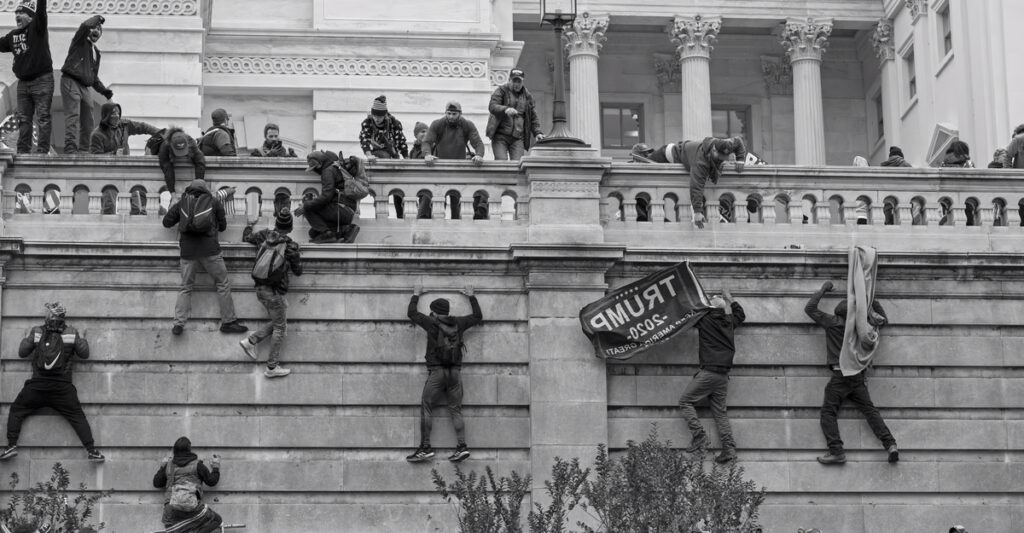
The trial and sentences raise uncomfortable questions about protesting, political violence, speech, and equality under the law—especially when compared with the punishments meted out for those who fomented and participated in the riot at the U.S. Capitol on January 6, 2021, and the subsequent clemency granted to them.
Some of the Prairieland charges are ones that any administration in American history would have brought, and rightly so. Anyone who vandalizes government property, fires guns around an ICE facility, or attacks a police officer can and should be charged with crimes. Whether one believes that the activists’ motivations were righteous is more or less irrelevant. Dissent is not without risks; that’s the point. If you believe strongly in a cause, such as opposing ICE, and you decide that you are willing to engage in political violence, you should also understand that you could be arrested and convicted. The Prairieland group’s actions are distinct from, for example, the people arrested in Washington, D.C.; Minneapolis; and elsewhere who were protesting peacefully (or wielding only sandwiches).
Yet some of the charges are more troubling and suggest a real attempt to crack down on legal dissent. Daniel Sanchez-Estrada, for instance, was charged with corruptly concealing a document or record and with conspiracy to conceal documents, and received a 30-year sentence even though he wasn’t present at the demonstration. His wife, who was arrested and later convicted, had asked him to move boxes full of zines and other materials that prosecutors described as “anti-government,” arguing that he moved it to try to cover up her connection to the charges. Federal prosecutors’ attempts to criminalize materials critical of the government because of an alleged nexus to terror is troubling no matter how one feels about the content or cause.
These misgivings only grow given the stiffness of the sentences. Paul Butler, a Georgetown law professor, told the Post that the sentences were “stunningly severe,” but you don’t need a faculty position to know that. One reason is that the two judges who issued the sentences ruled that the defendants must serve them consecutively rather than concurrently, as is typical.
The penalties look even more draconian when compared with those for people who stormed the Capitol on January 6. One of the judges in the Prairieland case, Reed O’Connor, said in court that the sentences fit the crime: “The defendants’ violence and terrorism is an assault on democracy. The defendants’ planning, staging and execution of the attack led to the attempted murder of an officer.” The characterization of “assault on democracy” is even more true of January 6, when rioters—many of them armed—attacked and injured officers, but also sacked the very seat of the government in the hope of disrupting the constitutional process of certifying a presidential election.
Yet the longest sentences issued in connection with the riot were 22 years (for the Proud Boys leader Enrique Tarrio), 18 years (for Stewart Rhodes, the Oath Keepers founder), and 17 years (for Joe Biggs, another Proud Boy). In all three cases, judges gave sentences shorter than what prosecutors sought. Moreover, none of the rioters are in prison now. Upon taking office, Trump pardoned Tarrio and commuted Rhodes’s and Biggs’s sentences. That was part of a sweeping grant of clemency for the nearly 1,600 people involved in the insurrection—including those who’d participated in violence against police officers.
Now some people who took part in the riot have been hired for sensitive Pentagon positions, as my colleague Will Gottsegen recently reported, and senior advisory roles at the Justice Department. Several are running for office. (Quite a few others have already reentered the criminal-justice systemfor different reasons.) The administration fired career prosecutors for the sin of having prosecuted overt crimes against the federal government on January 6, and it has explored ways to hand millions of dollars over to participants—most recently in the president’s $1.8 billion fund, though that at least seems to be frozen up by politics for now.
Violence directed against anyone demands justice, but it demands justice that is equal and proportionate. The sentences in Texas make it extremely difficult for anyone to pretend that that’s what exists in the United States right now.
Related:
- The J6 rioter now working at the Pentagon
- The Trump administration’s favorite tool for criminalizing dissent
Here are three new stories from The Atlantic:
- Trump is making the 250th small, Tom Nichols argues.
- The 10,000-year flood
- Saahil Desai: “My new life with the Palantir chore coat”
Today’s News
- The Supreme Court ruled that the Trump administration can remove the temporary legal protections for Haitian and Syrian immigrants who are legally in the United States, which could clear the way for them to be deported.
- At least 188 people were killed and more than 1,500 people injured by two 7.2 and 7.5 earthquakes that hit La Guaira, Venezuela.
- A federal judge halted President Trump’s executive order that tried to create a federal-voter list and limit who can receive a mail-in ballot.
Dispatches
- Time-Travel Thursdays: Isabel Ruehl on why authoritarians are great at propaganda—until they’re not.
Explore all of our newsletters here.
Evening Read
Perhaps France Should Reconsider AC
By Joshua Partlow
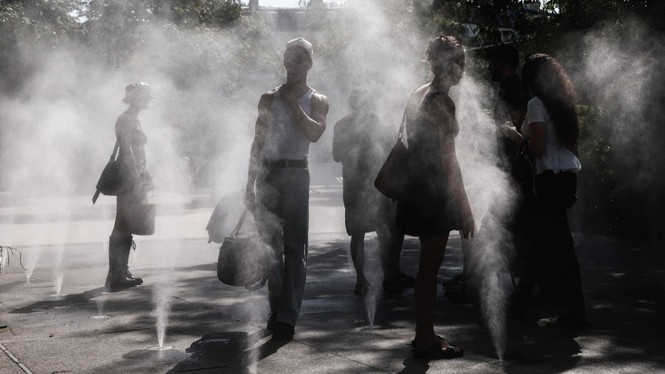
A summer escape to Paris, at least in the American mind, evokes a certain set of images: quiet strolls along the canals, long hours in bookstores and museums, a pleasant park bench, a glass of wine. Those pleasures are now contending with one of the most brutal and dangerous heat waves that Europe has faced in decades, a muggy, enervating stretch of weather that has forced millions of people across Europe, many of them in homes without air-conditioning and with few options for refuge, to endure triple-digit temperatures …
The heat has disrupted train travel, spiked utility prices, and led to power blackouts for thousands in Brittany and in Italian cities such as Turin and Milan. French television showed throngs of people swimming in Paris’s Canal Saint-Martin, once notorious for its pollution. Tuesday was the hottest day recorded in France in nearly 80 years. Yesterday was even hotter.
More From The Atlantic
- Trump has a Bill Pulte problem.
- The whiplash of Trump’s Iran capitulation
- Alan Greenspan was “not quite God.”
- AI can’t fix the student-motivation problem.
Culture Break

Watch. In its final season, The Bear (streaming on Hulu) reveals what it has always been driving toward, Sophie Gilbert writes.
Come in peace. Shirley Li explains the truth about Steven Spielberg’s alien obsession.
Stephanie Bai contributed to this newsletter.
When you buy a book using a link in this newsletter, we receive a commission. Thank you for supporting The Atlantic.
The post What the Prairieland Prosecutions Reveal About Trump’s America appeared first on The Atlantic.