There’s a line from a speech that I keep thinking about.
I wrote about it last month. Shane Massey, the Republican majority leader in the South Carolina Senate, spoke against a Trump-inspired plan to redistrict the state.
“I will tell my Republican friends: Republicans are stronger when the Democrat Party is vibrant and viable,” Massey said. “We are. Competition makes you better, y’all.”
I’m reminded of a conversation I had many years ago with a friend who was then a senior executive at McDonald’s (my favorite restaurant). When we spoke it was obvious that McDonald’s had decisively won the burger wars, and that its chief competitors, Burger King and Wendy’s, were no longer threats to dislodge Ronald McDonald from the Throne of Fries.
I asked him if there was a sense of satisfaction at the company, and his response surprised me. “I have mixed feelings,” he said. “We were a great company when the competition was intense.”
The innovation and energy required to stave off a challenger was invigorating and perhaps most crucially, it staved off stagnation.
So why isn’t this happening in American politics? Our nation has two parties of near-identical size and power, at least in theory. Control of the national government routinely flips back and forth, and even when one side wins full control its margins of victory are extremely narrow.
And yet, instead of creating innovation and energy, our political competition seems to be yielding stagnation and corruption. I don’t believe that stagnation and corruption exist equally on both sides of the aisle, but it’s hard to find anyone who believes the Democratic Party is healthy and vibrant, especially after two losses to Donald Trump.
Even if the two parties aren’t equally corrupt, they do share a different common characteristic: They’re equally repulsive to the public.
A Gallup poll in January found that 45 percent of Americans identify as independents, a record since Gallup began regular polling in 1988. Equal percentages of adults, 27 percent, identify as Republicans or as Democrats.
This doesn’t mean that neither side can win. When the public is disgusted with the current leadership, it has but one other alternative. Many voters are voting against incumbents more than they’re endorsing their challengers.
If the competition between McDonald’s and Burger King gave us tastier fries, somehow the competition between Republicans and Democrats is giving us rotten politics.
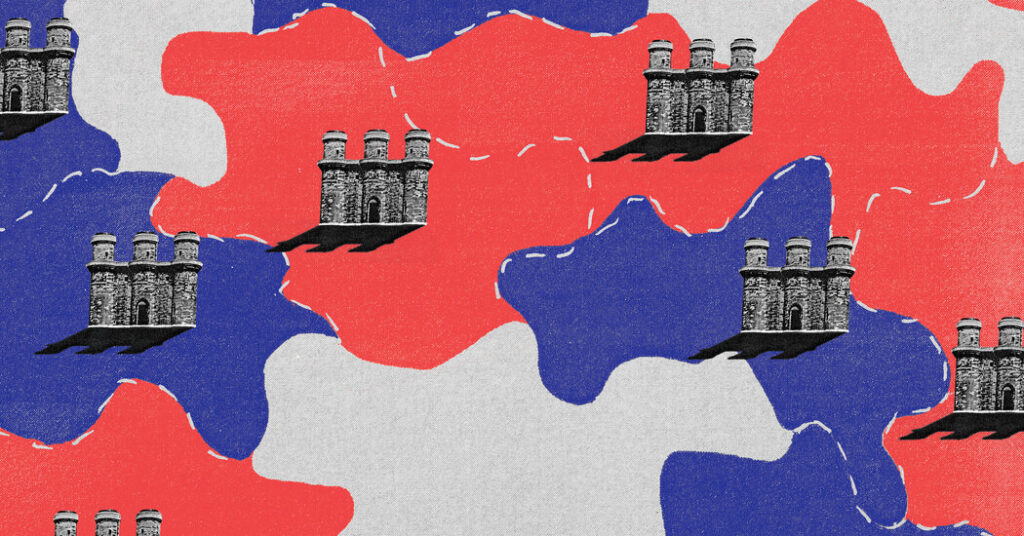
But what if we don’t actually have a competitive two-party system? What if our nation actually has two one-party systems, instead? And if the United States has two one-party systems, then that means that each way they turn voters are confronted with the arrogance, stagnation and corruption that almost always disfigures single-party rule.
The best illustration of this reality is found in state government “trifectas.” That’s the term for a state where one party controls the governor’s mansion and both houses of the state legislature. As of this month, there are 23 Republican trifectas and 16 Democratic ones. That leaves 11 states with divided governments.
Republicans may govern more states, but Democratic states tend to be more populous. As a result, a roughly equal percentage of Americans live under total red or blue rule. As of January, 39.1 percent of Americans lived in blue trifecta states, and 41.5 percent lived in red trifecta states, which means that less than 20 percent of the population lives in a divided state.
Combine trifecta state control with aggressive partisan gerrymanders, and you have exactly the situation in Congress that my colleague Tom Edsall described this week: “An overwhelming majority of House members run in districts that are safe in the general election, where the only threat to an incumbent is from a more ideologically extreme challenger in the primary.”
Another way of putting it is that the other side is so weak in so many states and congressional districts that politicians can build entire careers without having to appeal to voters on the other side of the aisle.
For example, even in a year of remarkable public discontent, in which the House may well change hands, the vast majority of members of Congress are completely safe. The Cook Political Report lists 186 districts as solid Republican and 182 districts as solid Democrat. There are only 18 tossup races. If you add in the 20 races that merely lean in one direction or the other, that gives you a grand total of 38 competitive races in a 435-member House of Representatives.
As a result, one-party politicians are often born in the parties’ bases and inept at reaching anyone even a few inches to their ideological right or left. In fact, the very effort to reach out to the opposition is usually interpreted as weakness, a misguided compromise against an uncompromising foe.
The art of compromise vanishes before our eyes. After all, generations of politicians now come from the roughly 80 percent of the country where compromise is almost always unnecessary. Compromises are internal only, as the party negotiates with itself. The opposition might as well not exist.
The partisan majority in a single-party state will often radicalize. As I’ve explained before, the law of group polarization suggests that when like-minded people deliberate, they tend to become more extreme. Red bubbles get redder, Blue bubbles get bluer.
It’s not just that the two sides separate ideologically. They also develop very different political cultures — to the extent that each side is completely convinced that the other side is just, well, weird. Our nation is full of radicalized people who don’t fully understand that they’re radical because everyone they know agrees with everything they say.
I’ve heard Republicans and Democrats use exactly the same “Star Wars” reference to describe the other side. They’ll say the other side’s convention, for example, is like the Mos Eisley Cantina, the bar in “Star Wars” filled with bizarre creatures from across the galaxy.
Compounding the problem, the sheer size of the red and blue trifectas mean that they define the nature of the respective parties, not swing-state politicians — even though swing-state politicians are indispensable to party control. The single-party partisans tell us what it means to be a “real” Republican or a “real” Democrat and often despise the rare politicians from their own party who can win on hostile ground. They’re the squishes, after all.
Politics is always vulnerable to corruption, but single-party rule can be a virtual petri dish for favoritism and graft. We all know that institutions tend to be terrible at policing themselves, and when one party possesses complete control, it is rarely as vigilant at punishing its own as it is at pummeling the other side.
Even swing states aren’t immune from the maladies of one-party rule. The states themselves are often carved up into one-party enclaves.
President Trump is perhaps the ultimate example of what one-party rule in a two-party nation can produce. While he governs for himself (as many one-party politicians do), he’s also vicious and vengeful to the other side, and so long as he keeps attacking the hated Democratic foe, his party will gladly cover for his corruption and graft.
But if the Democrats challenge Trump with the products of their own one-party rule, with a candidate who can’t even begin to speak the language of the swing voter, much less the language of the disaffected Republican, then we’re setting ourselves up for yet another lurch back to the competing extreme.
There is no easy way for Americans to change this dynamic. But perhaps — just perhaps — we can start by turning to those politicians who’ve proven that they’re culturally and politically bilingual. They can win on hostile (or purple) ground. One can think of Andy Beshear, the governor of Kentucky, or Josh Shapiro, the governor of Pennsylvania. On the Republican side, I can still remember when Charlie Baker, as governor of Massachusetts, was by some counts the most popular governor in America. In 2022, he recorded a stunning 74 percent approval rating.
All of these politicians, though, suffer from the same vulnerability. The partisan base can believe they’re weak, that they’re not real Democrats or Republicans, mere DINOs or RINOs. But a party shouldn’t be defined by its most zealous ideologues. Why would a progressive in Brooklyn be a more authentic representative of the Democratic Party than a moderate in Tennessee? The same analysis applies to Republicans. You are not more Republican the more guns you own or the more often you go to church — that makes you a type of Republican, but not the ideal form.
There are many, many Republicans, for example, who will rejoice if Susan Collins loses in Maine. She voted to convict Trump, and which real Republican would do that? There should be no such thing as the model ideological candidate.
To quote the Apostle Paul in 1 Corinthians, one body has many parts, and “the eye cannot say to the hand, ‘I don’t need you!’ And the head cannot say to the feet, ‘I don’t need you!’” The parties need ideological diversity. Groupthink is dangerous, no matter where it is found.
I’d like to end a rather bleak newsletter with a dash of optimism. As the Gallup poll indicates, present trends cannot continue forever. If the number of independents continues to grow, and the share of partisans continues to shrink, the present system will grow more unstable. A diminishing percentage of Americans will not be able to hold the same amount of power.
One-party rule can look imposing, but it is often fragile. It wasn’t that long ago, for example, when there was a different kind of one-party rule in the South, and then it shifted from Democratic to Republican. It wasn’t that long ago that California was a swing state, or that Iowa was briefly part of the Democratic Party’s blue wall.
It might take time — far too much time — but when the single party fails, eventually the dormant second party revives, the logjam breaks and the system resets. But until then our one-party politics is undermining our two-party system, and our competition is reduced to determining which broken party will prevail.
Some other things I did
My Sunday column was about a series of malicious prosecutions in Illinois. Prosecutors in Trump’s Department of Justice have tampered with the grand jury, brought meritless claims against innocent protesters and slandered them in public statements, and now those prosecutions are falling apart:
Something very bad went down in Illinois.
Why, you might wonder, would I write about a criminal case in Chicagoland when the world is convulsed by so many seismic events? Last week alone, Trump capitulated to Iran, the United States cut some of its defense commitments to Europe, and Ukraine hit Moscow with what appears to be its largest drone attack of the war.
We’re living in a moment when every week seems to bring a new development of global importance.
But the Chicago case is indicative of the fight for justice in the Trump administration. For every high-profile case that goes to the Supreme Court, there are dozens of other, smaller cases in federal courts across the country in which the Trump administration lies, bends the rules, slanders innocent citizens and otherwise abuses the legal system to persecute its political opponents.
Thanks for reading. You will soon start to get my columns emailed to you too.
If you’re enjoying what you’re reading, please consider recommending it to others. They can sign up here.
Have feedback? Send me a note at [email protected].
You can also follow me on Threads (@davidfrenchjag).
The post Two-Party System, One-Party Rule appeared first on New York Times.