This article contains spoilers for the film Disclosure Day.
As much as Steven Spielberg likes aliens, he seems to prefer holding them at arm’s length. The creatures in Close Encounters of the Third Kind contact humans using music and lights, but the director offers only glimpses of them, mostly in silhouette. E.T. the Extra-Terrestrial spends plenty of screen time depicting the titular character as a fish out of water; meanwhile, viewers never get to see the inside of E.T.’s spaceship. And in his adaptation of H. G. Wells’s classic sci-fi novel The War of the Worlds, the extraplanetary invaders stay largely hidden, preferring to observe humanity from behind their weaponry.
Aliens are just as camera-shy in Disclosure Day, Spielberg’s newest ostensible examination of them. The movie hinges on a whistleblower releasing evidence of the government’s encounters with UFOs, yet it’s remarkably short on extraterrestrial spectacle. The gray aliens who arrived on Earth decades ago exist on the story’s fringes, masking themselves as wild animals and showing up in the flesh only in the film’s final minutes; they’re otherwise seen in grainy clips of scientists and military officials inspecting and interrogating them. Throughout, they’re spoken of with awe and depicted as both fearsome and vulnerable, all-knowing yet unknowable. Disclosure Day is Spielberg’s first summer blockbuster in nearly 20 years, but its enigmatic aliens turn the movie into a strange puzzle—the latest in a long line of attempts by the filmmaker to use them as tools for understanding humans.
Spielberg’s instinct to show only glimpses of aliens hasn’t always been intentional. Sometimes, he’s obscured the extraterrestrials due to the limitations of movie magic. Like the shark in Jaws, the aliens of Close Encounters couldn’t quite achieve what the script called for: The wire work involved in making them fly around their mothership proved too frustrating to pull off. Yet the director seems to rely on extraplanetary visitors as catalysts for particularly heady stories, positioning them as intellectual superiors and at times moral compasses. Whereas Spielberg’s other blockbusters involving impressive creatures—the dinosaurs of Jurassic Park, the great white of Jaws—contend with the question of how to control them, his alien stories consider what humanity can learn from them.
[Read: The religion that’s very ready for aliens]
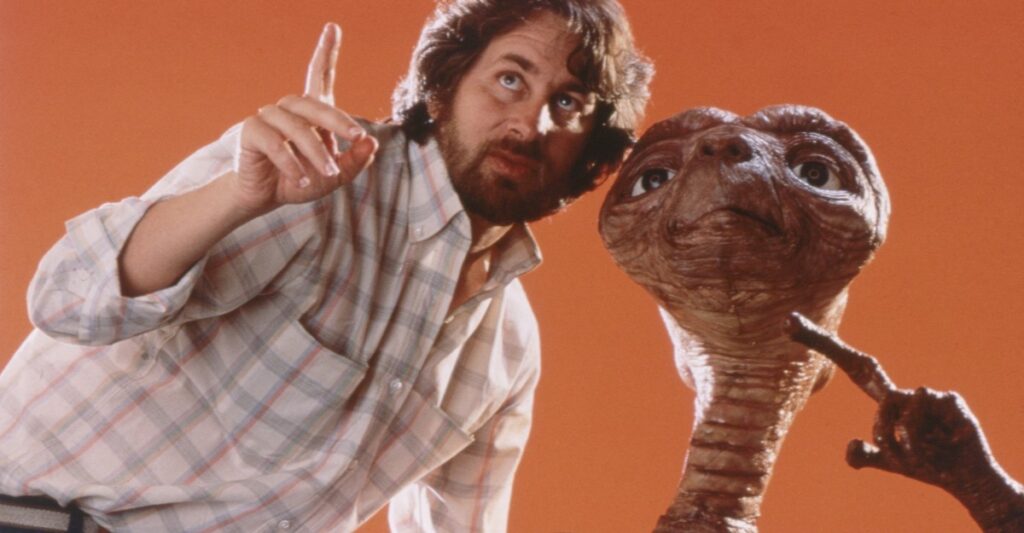
Again and again, characters become psychically connected to these extraordinarily intelligent tourists: In Close Encounters, the aliens are half the size of an average person, but they are sophisticated enough to grant the disaffected Roy (played by Richard Dreyfuss) repeated visions that take him away from his family and everything he’s known. In E.T., Elliott (Henry Thomas), a child coming to terms with his parents’ divorce, perceives his wrinkly friend’s every feeling. And in War of the Worlds, the self-centered Ray (Tom Cruise) seems to grasp how the technologically advanced invaders terrorizing Earth think, which enables him to protect his family from their attacks. In these films, aliens are Spielberg’s means for interrogating the limits of human intelligence, a distant north star that allows him to transform straightforward stories into thought experiments. By spotlighting perhaps the greatest unsolved mystery facing humankind, Spielberg gets to mix genres—paranormal horror, conspiracy thriller, family drama—however he wants.
Perhaps that’s why he treats aliens with the kind of care befitting a museum artifact or a cherished altar. Consider the ones in the much-maligned Indiana Jones and the Kingdom of the Crystal Skull; Spielberg explained in a behind-the-scenes featurette about the making of the movie that he perked up at the idea of including “interdimensional” beings only once George Lucas, his collaborator on the film, suggested portraying them as members of a revered ancient civilization. (If anything, Spielberg looked genuinely pained at how Lucas initially wanted to incorporate aliens just for the sake of visual spectacle.) By imagining aliens as gods of intelligence, the director shows the possibilities of having knowledge beyond human comprehension. The results can be wonderful—E.T. builds a profound kinship with Elliott; a wordless correspondence seems to transcend space and time at the end of Close Encounters—or terrible, as when the invaders in War of the Worlds underestimate how deadly microbes can be to their armored bodies. Extraterrestrials are too often portrayed in popular culture as either the unsettling obsession of tinfoil-hatted theorists certain of government cover-ups or as cartoonish humanoids in flying saucers. Spielberg, by contrast, takes them completely seriously—and encourages his audience to do the same.
War of the Worlds may best demonstrate how easily even the most stereotypical aliens, for Spielberg, double as metaphors. Wells conceived of the Martians as a thinly veiled representation of imperialism; Spielberg (working off a script co-written by the Disclosure Day screenwriter David Koepp) relates them to the protagonist’s reluctance about being a dad. Tom Cruise’s single-father character, Ray, knows his children so poorly that he doesn’t even remember—or perhaps never knew—that his daughter, Rachel (Dakota Fanning), has a peanut allergy. Ray eventually stops trying to run from the Martians and instead faces them head-on, risking his life for the family he’s now grown closer to. That’s how Spielberg’s alien stories tend to operate: What many of his characters find more astonishing than the presence of aliens are the emotions that they, as humans, have been holding at bay.
[Read: Just show us the spaceships already]
Spielberg has had his aliens play many different parts: his characters’ all-consuming fixation, their closest friend, their worst nightmare. In Disclosure Day, perhaps the director’s most earnest and motivational movie yet to incorporate them, the interplanetary visitors are teachers; they push Earthlings to consider how easily empathy, memory, and faith—tenets of the human experience—can be overlooked in the face of overwhelming realities such as, say, world wars. Yet the film isn’t meant to be a reflection of our present; it’s a distillation of Spielberg’s decades-long thesis about aliens. Whether such creatures exist seems to be beside the point for the director. The mere idea of them, his movies suggest, can remind humans to strive for more—for our minds to be brighter, for our imaginations to run wilder—than simply being alive.
The post The Truth About Steven Spielberg’s Alien Obsession appeared first on The Atlantic.