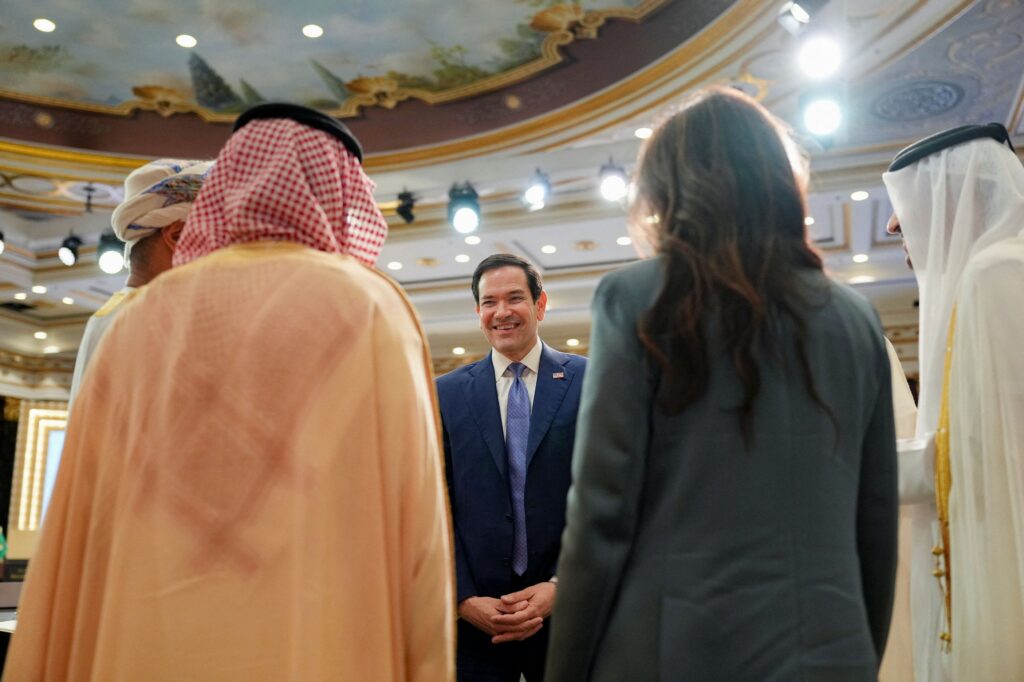
MANAMA, Bahrain — It took a three-month war and a 14-point peace plan to shatter the Persian Gulf’s image as a beacon of stability and influence in a troubled Middle East. But on a whirlwind two-day trip to assuage U.S. allies, Secretary of State Marco Rubio did his best to put it back together again.
The top U.S. diplomat traveled to the United Arab Emirates, Kuwait and Bahrain this week, delivering a message of reassurance to U.S. allies that had been targeted by Tehran‘s drones and missiles but were largely left out of ongoing U.S.-Iran peace talks.
Rubio assured the foreign ministers of six Arab Gulf states Thursday that there would be “no part of this deal that’s undertaken that in any way undermines the security, stability or prosperity of any of our partners in the Gulf region.”
“Thank you for this alliance, not just in the defense realm, but also in the economic realm,” he said in opening remarks at a ministerial meeting of the Gulf Cooperation Council.
America’s Arab Gulf allies have been battered and bruised after Iran lashed out at them with retaliatory strikes following the U.S. and Israeli bombardment that began in late February, with at least 20 civilians killed across the three countries and hundreds injured. At the same time, Iran’s closure of the Strait of Hormuz also highlighted the vulnerability of their energy export-heavy economies.
As oil and gas exports slowed to a trickle in March and April, most Gulf states welcomed a ceasefire with Iran, but only Qatar — which is acting as a mediator — is directly involved in the peace talks. Some in the region worry the negotiations will fail to address their biggest concerns, including Iran’s missile and drone threat and support for militant proxies such as the Houthis.
“The status quo situation is worse than it was before the war started,” said Dania Thafer, executive director of Gulf International Forum, a Washington think thank. “These countries had never been attacked regularly and to that degree. All the red lines were crossed.”
Andrew Leber, a nonresident scholar at the Middle East program of the Carnegie Endowment for International Peace, described “a general resignation toward the terms of the deal” in the Gulf, with both Saudi Arabia and the UAE “viewing this as the best they can hope for from a president who is no longer focused on the war.”
Trump “doesn’t seem capable of striking a better deal,” Leber said, but was now focused on “selling” the deal he had.
If that deal goes as planned, Iran’s new leaders — widely considered more hard-line than those before the war — could receive hundreds of billions of dollars in reconstruction funds. They are already receiving money in the form of sanctions relief on oil sales.
Gulf states are concerned that Tehran now has “access to a lot of money to do all the bad things that Iran does without any checks … except kind of a vague threat from Trump to return to the military campaign,” said Michael Ratney, a former U.S. ambassador to Saudi Arabia.
Rubio, long an Iran hawk, has been quiet on the memorandum of understanding reached between Tehran and the Trump administration signed earlier this month, leaving much of the public defense of the deal to its chief negotiator, Vice President JD Vance.
Dismissing the suggestion that there was a divide with Vance on the issue, Rubio said Thursday that they were both part of a team working together to support the president. “I’m here today because [Vance and other U.S. officials] were overseas last week. We all have a role to play in this regard,” he told reporters.
The secretary was the most senior U.S. official to visit the Gulf region since the war started on Feb. 28. In some ways, his visit showed a return to prewar norms.
In his first stop in Abu Dhabi on Wednesday, Rubio emphasized the friendly personal ties that exist between the Trump administration and the Gulf’s ruling families, bringing Michael Boulos, Trump’s son-in-law, to a working lunch with UAE president Mohamed bin Zayed.
Asked why Boulos, who does not hold an official position, was invited to a high-level diplomatic meeting, Rubio said that the young businessman was a “good friend” who happened to be in town and that he did not participate in any policy discussions at the Emirati lunch.
The same day, Rubio attended a flag-raising ceremony at the U.S. Embassy in Kuwait City and the State Department announced that the embassy, which still shows signs of damage from Iranian drone attacks, would resume operations.
In Bahrain, Rubio met with King Hamad bin Isa Al-Khalifa, with the two discussing a regional security pact and other issues such as artificial intelligence and critical minerals, according to a U.S. readout of the meeting.
Rubio said that his meetings with officials at the Gulf Cooperation Council, which included a pull-aside with Saudi Foreign Minister Faisal bin Farhan al-Saud, had been positive and that there had been unanimity on key issues, including rejecting Tehran’s proposals for tolls or fees on ships passing through the Strait of Hormuz.
“Fees and tolls are the same thing to me,” Rubio told reporters, adding that Oman, which also claims territorial waters in the strait, had agreed with the other five council members on the issue.
The Arab Gulf states are seeking compensation for damage incurred in Iranian attacks, Rubio said. The secretary said that it was not yet clear whether they could be compensated with frozen Iranian assets.
At the same time, however, some countries are seeking some degree of rapprochement with Iran. Qatari Prime Minister Mohammed bin Abdulrahman Al Thani told the Financial Times this week there were efforts among Gulf countries to work with Tehran to create a “regional security framework.”
Even in the UAE, which was one of the most aggressive in responding to Iranian attacks, there was a begrudging acceptance that it would have to be “pragmatic” by working with Tehran’s new leaders, somehow. “We all understand — there was no knockout,” said Abdulkhaleq Abdulla, a political science professor and analyst based in Dubai.
Ironically, some analysts said, the tentative deal could see Iran even more intertwined with the Gulf states it recently targeted.
“Iran has more leverage now,” said Thafer of the Gulf International Forum. “If the goal of the war was a more isolated Iran, the result may be the opposite.”
The post Rubio’s new job? Selling Trump’s Iran deal to a worried Gulf. appeared first on Washington Post.