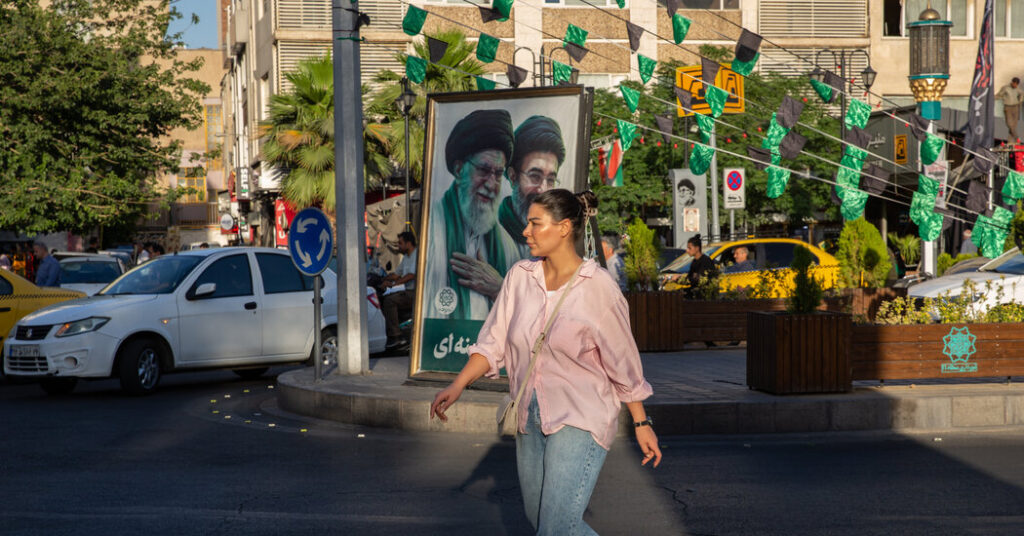
I’ve been intrigued to see how the war in Iran has changed the way the country’s Islamic government portrays women. State television features women’s military parades with pink guns and pink jeeps. Most notably, it features women who say they support the regime but are not wearing hijabs.
In the face of attacks by outside powers, the Islamic republic is crafting a new kind of identity, one that is less about religion and more about nationalism. And that shift is emblematic of something bigger happening in the Middle East: Political Islam is waning.
I spoke to my colleague Ben Hubbard about what is emerging in its place — and how Islamic the Islamic republic really is anymore.
Has political Islam’s moment passed?
So, Ben. Let’s start with the basics. Your story is about the decline of political Islam. What is political Islam?
That’s almost the hardest part. It’s a lot of things to a lot of people. Islam is a religion with two billion followers worldwide. Even the scholars who study political Islam don’t agree on one definition. For my purposes, I decided to focus on governments or movements taking inspiration from Islam in the service of statecraft — so groups, parties or rulers who cite Islam as part of their governing philosophy.
And I focused on the Middle East because so much of the conversation since 9/11 has been about political Islam there: parties like the Muslim Brotherhood, terror groups like ISIS and countries like Saudi Arabia, Syria and, of course, Iran.
Say more about Iran. How does it fit in here?
Iran is in some ways the most successful example of political Islam. It has accomplished what many of these other groups set out to do. It was an Islamic revolution where Islamists took charge of the country and laid out a program for how they were going to use Islam to run the place. This included foreign policy, domestic policy, the economy and even land reform. It’s arguably the most elaborate modern experiment of how to put these ideas into practice.
For many years people were talking about the rise of political Islam. You looked at its decline. What did you find?
I’ve noticed a shift in how people in the Middle East talk about Islam in relation to politics. They’re stepping away from linking the two. That doesn’t mean they’re giving up their religion; they’ve just given up on it as an answer to their country’s political problems.
“Islam is the solution,” which was the slogan the Muslim Brotherhood ran on in Egypt, has been losing its hold. In Tunisia, Islamists won elections but then lost the trust of secular voters, who elected a populist strongman.
Or take Iran: Since Israel’s 12-day war last summer, the Iranian government has been playing patriotic ballads and hanging posters of Persian folk heroes, not just figures associated with the Islamic Revolution.
But like Iran, some countries remain officially Islamic. So what does this shift look like?
Yes. Look at Saudi Arabia. Strict application of Shariah was the rule. Women couldn’t drive. There were no movie theaters. So-called religious police barred unrelated women and men from socializing. Then along came Mohammed bin Salman, the crown prince and de facto ruler. He wants to remake the kingdom and that includes recasting its relationship with Islam. This is in part to meet the expectations of young Saudis who don’t want the kingdom’s old strictures. So he has allowed women to drive, opened movie theaters and brought music festivals to Saudi Arabia.
Or take Syria. Early in the civil war, Ahmed al-Sharaa, who then led a branch of Al Qaeda, went on TV and vowed to build an Islamic state. But since his group overthrew the Assad regime and he became president, he has avoided overt Islamism. He has not tried to implement Shariah and has worked to build relations with Western leaders. He wears suits and shows up in public with his wife, which his former comrades in Al Qaeda would never do.
Many of these leaders seem to have concluded that there’s not much to gain, internally or externally, from being an outspoken Islamist. It makes many people nervous — terrorism tarnished the brand, as Faisal Devji, a historian at Oxford, told me — and there doesn’t seem to be a lot of interest from citizens these days either.
Is anything taking its place as a political force?
I’d describe it as a deepening sense of national identity. In both Saudi Arabia and Syria, the leaders want their people to be proudly Saudi or Syrian. Those people may also be proud to be Muslim, but that’s less essential to their politics.
We see this in Iran, too. To rally people during the recent war, the government has been appealing to a Persian identity that attracts a broader swath of Iranians than the ideals of the Islamic republic do.
Has the war accelerated this shift? What has it changed inside Iran?
Two things, and they pull in opposite directions. The war has accelerated Iran’s drift toward becoming a military dictatorship with an Islamic gloss. The country is run by the Islamic Revolutionary Guards Corps more than the clerics.
I spoke to Mohsen Kadivar, an Iranian cleric who is critical of the Islamic republic and is now at Duke University. He told me that the Islamic Revolution had failed to use religion to bring freedom and justice to Iran. But it had upheld another Islamist goal: opposing foreign domination of Muslim lands. By that measure, Iran’s fight against the U.S. and Israel still resonates.
So the Islamic republic isn’t all that Islamic anymore?
Its commitment to strict Islamism has faded. But the war has fortified what remains: a political Islam committed to anti-Zionism and resisting American influence in the Middle East. On that front, this war has empowered the hard-liners in Iran.
MORE TOP NEWS
Venezuelans search for the missing
Venezuelans around the world posted photographs of missing relatives on social media in the desperate hope that someone has seen them after two devastating earthquakes that struck on Wednesday.
The toll stands at 188 people killed and more than 1,500 people injured in the quakes, the worst to hit the country in many decades. Those numbers are expected to climb. Photos show the devastation in the northern state of La Guaira, where dozens of large buildings collapsed.
The disaster created an unexpected hurdle in the U.S. campaign to bring the oil-rich country under its influence. Secretary of State Marco Rubio said the U.S. government would provide aid and rescue workers. We have live updates.
OTHER NEWS
-
Spain and Italy reported deaths from heat exposure, and Britain recorded its hottest day ever. Belgians found creative ways to escape the heat. Temperatures are expected to start easing today.
-
Iran struck a container ship in the Strait of Hormuz, according to U.S. and Iranian officials, halting efforts to restore shipping and move hundreds of ships from the Persian Gulf.
-
A Chinese open-source A.I. model closed the gap with OpenAI and Anthropic, offering similar abilities at a much lower price.
-
The Supreme Court allowed President Trump’s crackdown on immigration to move forward.
WHAT ELSE IS HAPPENING
-
A rare public appearance by Dolly Parton put fans at ease after concerns about her health.
-
There are signs Canada wants to enter the Eurovision Song Contest.
TOP OF THE WORLD
The most clicked link in your newsletter yesterday was about why Europe is the fastest-warming continent.
WORLD CUP
48 countries, 96 jerseys
There’s a catalog of football shirts to admire during the tournament. Vote for your favorite designs.
The latest: The U.S. will take on Turkey. Or is it Türkiye? Here’s what to know about the matchup. Germany took the field against Ecuador, and Japan will play Sweden. Follow your team’s path to the finals.
NUMBER OF THE DAY
30 million pounds
That’s the amount King Charles III has paid in income taxes since ascending to the throne. It’s the first time any British monarch has released a personal tax bill, part of a push for greater transparency after the scandal over former Prince Andrew’s friendship with the convicted sex offender Jeffrey Epstein.
AROUND THE WORLD
Dancing cheek to cheek in Turkey
There are tango schools just about everywhere in Istanbul, and more dance events there than in almost any other city outside of Argentina. Tango clubs are popular at Turkish universities. Turkish cobblers and tailors cater to the demand for specialized shoes and gowns.
The story of tango in Turkey is a deep one, and it’s entwined with the country’s history. The founder and first president of modern Turkey, Mustafa Kemal Ataturk, took up ballroom dancing and developed a taste for tango as part of his quest to promote Western sophistication. Read more about how Istanbul became a tango capital.
RECIPE
This recipe celebrates the classic Breton kouign-amann, with a yeast-risen pastry that yields soft layers, deep buttery flavor and a caramelized top. There’s no shortcut and no substitute for the repetition needed to perfect this pastry. But much of it can be prepared ahead of time.
WHERE IS THIS?
Where are these cannonballs?
BEFORE YOU GO …
It’s midyear check-in time at The New York Times and many other businesses — that time of year when we discuss how our goals for the year are going.
I used to roll my eyes at this exercise, but I’ve come around. It forces you to stop and think about what you’re doing and why. It’s an opportunity to advocate for what’s important to you. And for managers, it’s a chance to help your team be the best and happiest it can be.
I remember my first management training. We were instructed on how to provide effective feedback. Someone shared advice that has stuck with me: For every piece of negative feedback you give, give five positive ones.
Maintaining that kind of ratio takes real effort. The idea is that humans process negative and positive feedback very differently. Negative feedback triggers stress hormones that linger. Positive feedback empowers us, but the effect is more short-lived — which is why you need more of it.
The magic feedback ratio also applies, by the way, to how we talk to our partners and children. I think it also applies to newsletter readers delivering feedback to newsletter hosts. (Keep it coming!)
Almost as happy-making as positive feedback: great music. Here’s “Take Me I’m Yours” by Mary Clark. Bring on the endorphins.
Have a happy weekend! — Katrin
TIME TO PLAY
Here are today’s Spelling Bee, Mini Crossword, Wordle and Sudoku. Find all our games here.
We welcome your feedback. Send us your suggestions at [email protected].
The post Less Islamism, More Nationalism appeared first on New York Times.