In the late 1970s, the comic artist Art Spiegelman and his wife, the editor Françoise Mouly, began dreaming up a new magazine, one they hoped would elevate cartooning into the realm of high art.
A colleague suggested that they talk to Jerry Moriarty, a painter who lived in Manhattan, a little uptown from their SoHo loft.
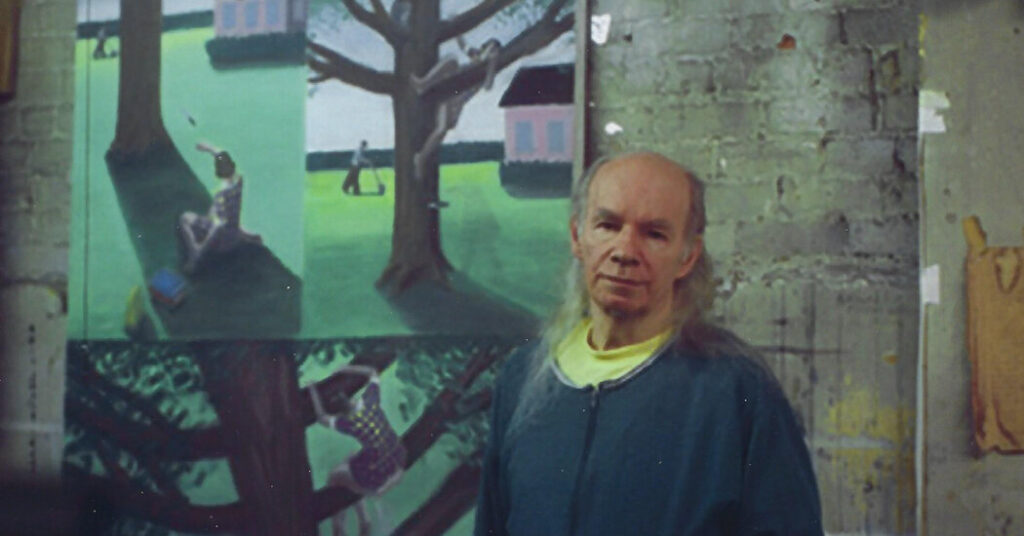
Arriving at Mr. Moriarty’s studio, Mr. Spiegelman was stunned by what he encountered: comics that were painted.
“It was totally mind-blowing,” Mr. Spiegelman, whose graphic memoir “Maus” won a Pulitzer Prize in 1992, said in an interview. “It was exactly what we were groping for, which was a place that wasn’t underground comics anymore, nor was it art underground.”
Raw, their magazine, debuted in 1980 with “Jack Survives,” the first in a series of painted comics by Mr. Moriarty about a stoic Everyman who muddles through the indignities of life in a hat and tie, refusing to capitulate.
“It’s as if Edward Hopper had taken up songwriting,” the comic artist Chris Ware wrote in The Believer magazine in 2009. “For lack of a better word, it’s poetry — I believe the first that comics has ever seen — and poetry as fresh and affecting now as when first drawn.”
Mr. Moriarty died on March 25 at his home in Binghamton, N.Y., where his nephew Kevin Moriarty had been caring for him in his final years. He was 88. His death, which was not widely reported, was confirmed by his brother Fred Moriarty, who survives him.
A self-described loner, Mr. Moriarty refused to sell his paintings, and supported himself by teaching at the School of Visual Arts in Manhattan. In many ways, he had the sort of average life embodied by his Everyman character, Jack, who resembled Mr. Moriarty’s father in appearance (and only in appearance).
“Jack is an average man wanting to be average,” he wrote in “The Complete Jack Survives,” a 2009 collection of his Jack comics. “I am an average man who doesn’t want to be average, and art allows me to express that frustration.”
Jack’s spare dialogue — often spoken aloud to himself — reminded Mr. Moriarty’s admirers of Samuel Beckett’s minimalist, existentialist plays.
In another panel, Jack is in his office. He opens his lunch and discovers that his wife has packed him a cat-shaped cookie.
“I can’t eat a cat cookie,” he says out loud, seemingly to nobody, before taking a bite. “You have to start with the head or it looks at you to the end.”
To describe his craft, Mr. Moriarty created a portmanteau: paintoonist, a fusion of painter and cartoonist. The word hasn’t yet appeared in the Oxford English Dictionary, but it certainly defined him.
“There’s a kind of stillness in his work,” Hillary Chute, a professor at Northeastern University and a scholar of graphic narratives, said in an interview. “So you enter it as a story, and it has psychological depth, but also the kinds of composition that you would see in paintings.”
Jerome Brien Moriarty was born on Jan. 15, 1938, in Binghamton, the third of four children. His father, John Moriarty, was an expert in Morse code who telegraphed play-by-play accounts of sporting events for The Associated Press. His mother, Esther (Turner) Moriarty, sold magazine subscriptions and worked as a sales clerk at a department store.
Growing up, Jerry loved cowboy movies and radio shows. He also read and collected comics.
“At age 8, I crossed the ‘fantasy barrier’ and became an ‘art kid’ because I could copy Superman or Bugs Bunny better than my classmates,” he wrote in the catalog for “Uninked: Paintings, Sculpture and Graphic Works by Five Cartoonists,” a 2007 exhibition at the Phoenix Art Museum.
His father bought him a drafting table and encouraged him to pursue a career in art, setting up a studio in the cellar.
“It was dank, low and funky, but I loved the cellar because no one came down there unless they had to,” Mr. Moriarty said in The Believer. “Sometimes my dad came down after supper and watched me paint, still in his shirt and tie from work.”
After graduating from high school, he moved to Brooklyn to study at the Pratt Institute, earning a Bachelor of Fine Arts degree in 1960.
He remained in New York City, working as a freelance illustrator and contributing drawings to Esquire, GQ, Seventeen, The New Yorker and pinup magazines. In 1963, he began teaching at the School of Visual Arts, painting in his studio at night.
Jack came along in the late 1970s after a student gave Mr. Moriarty a copy of the war comic “Frontline Combat,” which he had read as a teenager.
“I took it home and I fell on the floor,” he said in a 2009 interview with The Daily Cross Hatch, an online comics journal. “Not only was it better than I remembered, it was inspiring. I thought, ‘How many other things since that period have I not seen?’ So I started going to comic cons, and that’s where the collector in me started to awaken.”
To Mr. Moriarty, Jack wasn’t just a character on canvas; he was a way to reconnect with his father, who had died when he was 14.
“‘Jack Survives’ is a whimsical, one-sided conversation with my father where I am 99 percent of it,” he told The Believer. “Dad is in Jack as a quiet presence who survives Jack’s frustrations far better than I do.”
Mr. Moriarty moved on from Jack in the late 1980s and continued to paint, though in an entirely new way — in panel form, much like a comic book artist. In one painting, Mr. Moriarty peers down from the ceiling at his father, who is reading the newspaper. In another, he is an old man painting in his cellar.
“There was no conscious attempt to be poetic or subtle,” he said. “I am not a fan of bigness or theatricality. I prefer string quartets to symphonies, jazz trios to big bands.”
He also savored solitude.
“Loner and loneliness are not the same,” he said. “Everybody has been lonely, but not everybody is a loner. Jack is alone, but he is not a loner. I am a loner, and I fully understand why that makes me strange to society. I am not lonely. Being alone is total freedom for me.”
He usually started painting after midnight, finished by 3 a.m., ate dinner, watched movies, went to bed at 7 a.m., woke up at 2 p.m., had breakfast and watched “Jeopardy!” He had no use for the hoity-toity art world.
“It was about as pure an experience of being an artist as I’ve ever witnessed,” Mr. Spiegelman said. “It was, in some ways, without ambition and without a thought about posterity.”
The post Jerry Moriarty, Painter Whose Brushstrokes Elevated Comics, Is Dead at 88 appeared first on New York Times.