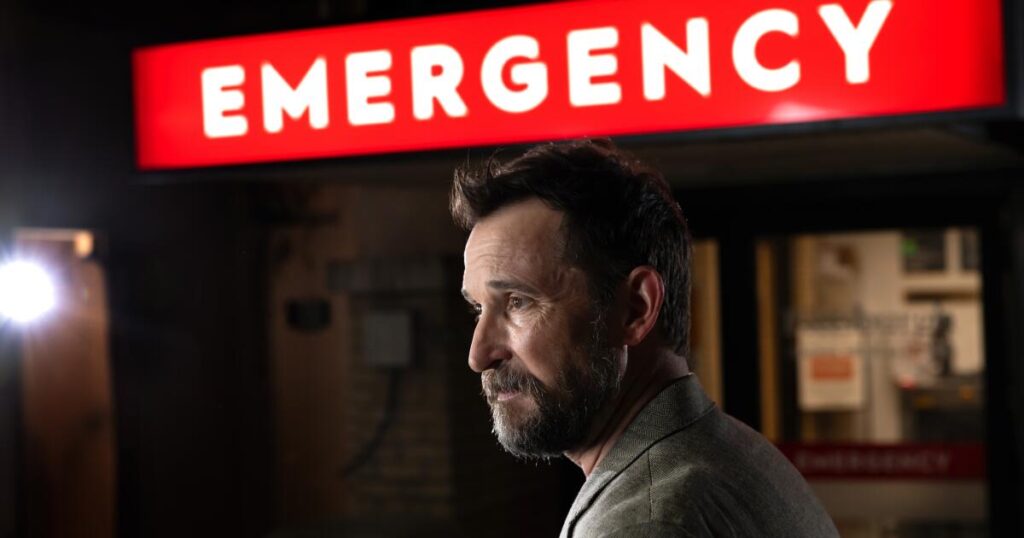
Hollywood is in the midst of a 9-1-1 emergency.
The industry has been pounded by years of jobs losses, business closings and the flight of production to cheaper locales, leaving once bustling soundstages around Los Angeles half empty.
But one high-profile TV hospital drama is offering hope for a cure.
HBO Max’s “The Pitt,” which resumedproduction this month for its third season, has swelled into a massive hit. It’s been embraced by fans, critics and medical professionals for its realistic portrayal of the high-stress life inside an urban trauma center.
The Emmy Award-winning drama has also become an urgently needed Hollywood success story at a time when much of the local film and TV industry has left California for other states and countries.
Though Pittsburgh is the show’s fictional setting, “The Pitt” is filmed almost entirely on the Warner Bros. lot in Burbank. The show has provided jobs for an estimated 1,000 people, including hundreds of background performers.
Nearly 200 local businesses, including caterers and special effects houses, have been lifted by the enterprise. Season One alone contributed $125 million to California’s gross domestic product, according to an estimate by Oxford Economics.
As the series star Noah Wyle puts it, the production has become “The Little Engine that Could.”
“We’re old men who didn’t want to go away from our homes any longer,” Wyle, who also serves as an executive producer and writer on the show, said half-joking. “We’ve all been plying our trades out of state, chasing tax credits and being away from our families for a really long time.”
A different kind of medical drama
Wyle was introduced to millions of TV viewers three decades ago as a boyish medical student on “ER.”
The L.A. native, who played Dr. John Carter, was the newbie in the NBC ensemble drama that debuted in 1994 — the same year as “Friends,” another Warner Bros. hit.
It was the height of “Must See TV,” and Los Angeles was the place to be.
“Every soundstage had a different show,” Wyle, now 55, reminisced during a recent interview on the Warner Bros. lot. Back then, the major networks each ordered nearly two dozen shows, with most producing at least 22 episodes a season.
Broadcast schedules brought stability and a distinct cadence.
“It was very much like a factory turn-out — although a very good factory product,” Wyle said.
That was before Canada, and eventually Britain, began luring American productions with big tax breaks. Louisiana, Georgia, New York and other states followed suit with their own sweeteners, pulling even more production out of LA.
“I had not worked in L.A. since ‘ER,’” Wyle said of the show that ended in 2009. “It had been 16 years since I had slept in my own bed and worked in this city — a long time to be away from your kids when they’re in school and your parents when they’re aging.”
California adopted its own film tax program in 2009, but its initial rollout did little to slow the exodus of productions.
The local industry got a boost a decade later when major studios spent wildly to make shows to launch streaming services to compete with Netflix. But then came the COVID-19 pandemic, followed by the actors and writers strikes in 2023.
A bounce back after the strikes failed to materialize.
Faced with hefty streaming losses, media companies slashed their programming budgets. Spending on scripted TV series plummeted 23% to $27.7 billion between 2022 and 2025, according to ProdPro.
The reset occurred just as cable programmer Discovery spent $43-billion to buy the larger WarnerMedia, leaving the merged entity — Warner Bros. Discovery — drowning in debt.
Warner Chief Executive David Zaslav, who’d spent his early career at NBC, desperately needed lower-cost shows with high production values to entice the streaming crowd. He took his problem to writer-producer John Wells, the prolific showrunner behind such NBC greats as “ER” and “The West Wing,” as well as Showtime’s “Shameless.”
How could Warner’s nascent HBO Max streaming service hold onto fickle subscribers? Netflix’s practice of dropping shows in short bursts of eight to 10 episodes wasn’t working for HBO Max.
“It’s too easy for people to jump in, see the show they want, cancel their subscription and wait until next time,” Wells said during a recent interview at his Hollywood offices, recalling his conversations with Zaslav.
Wells was willing to produce a series for less than half the budget of a prestige streaming drama, which typically costs about $15 million an episode to make.
“I’m not a big believer in ‘things get better when you throw more money at it,’” Wells said. “A lot of creativity happens when you’re figuring out how to do something.”
Warner Bros. executives were hungry for a hospital drama, a TV staple. Wells initially wasn’t too eager after spending decades producing medical-themed shows: “China Beach,” “Third Watch,” and of course, “ER.”
Wyle said he’d long recoiled at the thought of draping another stethoscope around his neck after more than a decade on “ER.”
R. Scott Gemmill, a top writer-producer on “ER” for eight seasons, also was wary.
“I just couldn’t imagine doing another version that was as good or as interesting as being on ‘ER,’” Gemmill said.
They came around. Wyle had friends and personal ties to the medical profession — his mother had worked as a hospital nurse at Kaiser Permanente on Sunset Boulevard — and he’d become fascinated with the upheaval in the hospital industry since COVID-19.
Gemmill, the showrunner, found a way to differentiate the show.
“What is emergency medicine like now on the other side of COVID?” said Channing Dungey, chairman of the Warner Bros. Television Group. “The world has changed a lot since the days of ‘ER’ … It’s a totally different environment now with some very interesting stories to tell.”
Still, hard financial choices would be required to bring the show in on a budget of about $6.6 million an episode for its first season.
They needed an expansive space to simulate a Pittsburgh trauma hospital, one that would support a nearly 600-member cast and crew as well dozens of story lines that could unfold over multiple seasons.
“I said it can be in Los Angeles or it can be in New York,” Wells said. “Those are the only places with a deep enough cast pool.”
It helped that Wyle and Gemmill, a veteran of Paramount’s military dramas “JAG” and “NCIS: Los Angeles” were keen to stay in L.A.
“Shooting here has so many benefits: all the crafts people that live and work here, and all of the talent,” Gemmill said. “There is something very special about this place.”
But years of runaway production have taken a toll.
“People are gone,” Wells said. “They’ve left the business. … You’ve got to support your family and if you’re not working for 13-,14- or 16- months, it’s hard. … We’ve lost a base of expertise.”
Warner Bros. agreed to shoot “The Pitt” on its storied lot, which is home to several other TV series, including “The Voice” and “Abbott Elementary,” and is now 91% occupied.
As word spread, “a whole lot of people wanted to be involved,” Wells said.
Wells and Gemmill had pitched a 12-episode season to follow an ER physician, played by Wyle, during each successive hour of his 12-hour shift. They wanted the series to feel like it was unfolding in real time, and under realistic conditions, such as the pressures of treating mass casualties and frustrated patients who have been waiting for hours to see a doctor.
Warner Bros. insisted on additional episodes. Both sides agreed on a 15-episode season with new installments dropping each week on HBO Max.
“You can get almost four months of stories out of those 15 episodes,” Dungey said.
The studio agreed to Wells’ proposal to forego shooting a pilot episode, which can cost more than $10 million.
The studio and producers also decided to construct the series around just one star: Wyle, who plays the weary Dr. Michael “Robby” Robinavitch, the emergency medicine chief.
Hiring less prominent actors to round out the cast was key to keeping actor salaries within the show’s budget.
The large cast — including hundreds of background actors, many who appear in consecutive episodes — made L.A. the best choice, Wells said, saving the cost of renting hotel rooms in Albuquerque or Vancouver for months.
In April, 2024, the state approved a tax credit of up to $12.2 million for “The Pitt.”
Warner Bros. committed that the first season would span 135 production days and employ 188 crew members and 495 performers.
Building an ER
The century-old, 110-acre Warner Bros. studio lot boasts 30 soundstages, including a 21,600-square-foot cavern — Stage 22 — near the back of the complex.
There, in early 2024, a hospital emergency wing — “the pit” of fictional Pittsburgh Trauma Medical Center — took shape. The last feature film that had been shot in Stage 22 was Clint Eastwood’s 2011 “J. Edgar.”
The studio spent more than $5 million to replicate a full-sized, modern-day ER, using money that would have gone into a pilot.
To imagine the world they wanted to create, Wells and fellow executive producer Michael Hissrich turned to Nina Ruscio, a meticulous production designer they’d worked with before. Ruscio was on another show when they called her in December 2023, but she agreed to design the ground plan during her holiday break.
She dug in, studying blueprints and the work of noted hospital designer Jon Huddy and even making surreptitious visits to actual hospitals. She combed the internet for a look inside Pittsburgh’s Allegheny General Hospital before discovering an image of the hospital’s corridor, revealing the striking maroon and green marble flooring that she was able to match.
She conceptualized a maze of curved-corner corridors with decorative pillars to project a sense of history. The unit has 25 beds, triage rooms, 200 computer screens, authentic medical equipment and a cheerful pediatric room that she and Wyle collaborated on.
“It was very important not to fall into the trap of a lot of hospital shows,” Ruscio said, giving a tour of her invention. “Things are over-designed; they’re frequently blue and the lighting is exquisite.”
“For the story that we were trying to tell, which was the realism, almost documentary-style, this blanched palate felt right,” she said.
LED light strips, which can be adjusted for intensity and in 50 shades of white, were installed into the set’s ceiling. Those 689 fixtures provide the lighting for filming, eliminating a time-intensive process of gaffers setting up bulky floor and rafter lights and blocking shots with stand-ins.
The set is “a masterpiece,” Hissrich said.
The trend for many big-budget streaming shows has been to shoot on location, allowing for cinematic cut-away shots, as well as hefty tax rebates that lower production costs and allow producers to add movie-like special effects.
“There was an assumption that the audience needed bigger in scale, bigger in action,” Wells said.
Instead, “The Pitt” stays on the lot, all but eliminating transportation, security, film permits and other on-location costs. Cast and crew members take just one trip to Pittsburgh a year for scenic shots.
Ruscio designed a sloping outdoor arrival bay for ambulances, on the edge of Stage 22 — virtually identical to one in Pittsburgh. By Season 2, the show had fully expanded to a second Warner stage.
Much of “The Pitt’s” authenticity comes from its stunning special effects. “Blood mats” were molded — red rubbery silicone splats — which can be temporarily stuck to the floors and walls with no cleaning required.
Lifelike heads and torsos are made for the TV doctors to operate on. One $60,000 torso bears an incision across its midsection, revealing a chest cavity with realistic looking organs. There’s also a life-sized head of teenage boy with reddish freckles — and a bulging eyeball — from Season 1 when a character was rushed to the ER after getting hit in the face with a baseball bat.
A physican, Dr. Joe Sachs, has been part of the writing staff from the beginning to ensure the show is accurate. A second doctor was added to the writing room last year, and a third joined this year. Medical consultants, two other doctors and nurses work with the cast to ensure accuracy with the medical procedures.
Crew members wear scrubs on set so the camera can sweep 360 degrees and everybody in view looks like they belong in a hospital.
Shooting in sequence
Other decisions were made for “more efficient shooting days,” Gemmill said, including his mandate to shoot script pages in linear order, which is highly unusual. Directors typically film scenes out of sequence.
“Getting through nine pages [of the script] in under 12 hours is very important,” Gemmill said. “It allows people to have a good quality of life. People look forward to coming to work, because they know it’s not going to be a slog.”
Few expected “The Pitt” to become a major hit, let alone a rallying cry for filming in LA.
The production resulted in nearly $87 million in spending in California, including $62.2 million in wages and salaries for the show’s 590 employees, according to the Oxford Economics report commissioned by the Motion Picture Assn.
Another $24.8 million was spent for goods and services, primarily provided by 200 local businesses in the Los Angeles region, the report found.
Wiley has become a leading advocate for filming in L.A. He extolled the need to reinvigorate the local film industry, and the benefits of “The Pitt,” at a recent hearing in Burbank, part of an effort to nudge Congress to pass a national film tax credit.
Shooting in LA may not have been possible without California’s film tax incentive. The second and third seasons also qualified for the credit. This year’s allocation — up to $24.1 million — doubles the grant of the show’s first season.
“The Pitt” is, in many ways, a throwback to how TV used to be made.
“What have we known how to do for a long time?” Wells said. “That is to produce in a certain way to try and engage an audience with a group of characters they want to spend time with.”
Some of the biggest hits for streaming services were made for broadcast TV, including “Grey’s Anatomy,” “Friends,” “Scrubs,” “The Office,” “Gilmore Girls” and “The West Wing.”
“Audiences get connected to characters,” Wells said. “They come back, they want to see what happens with those characters because they care about them. That’s how television, and entertainment as a whole, has worked forever.”
Like classic TV dramas, “The Pitt” relies on compelling characters and gripping storylines.
“We joke that this is ‘premium broadcast’,” Dungey said of “The Pitt.” “It does have that same feeling of a broadcast show from the heyday — but we’re doing it at premium-streaming quality standards.”
Warner Bros. has commissioned two pilots with formats modeled after “The Pitt,” with plans to produce 15-episode seasons that return once a year. Dungey said one of the projects, should it move forward, will be filmed in L.A.
Can the “The Pitt” model, a vestige of broadcast TV’s glory days, be replicated?
“Absolutely,” Wells said. “We replicated it on four networks with 105 shows [a year] for 50 years.”
The post As L.A. battles production exodus and job losses, ‘The Pitt’ offers hope for a cure appeared first on Los Angeles Times.