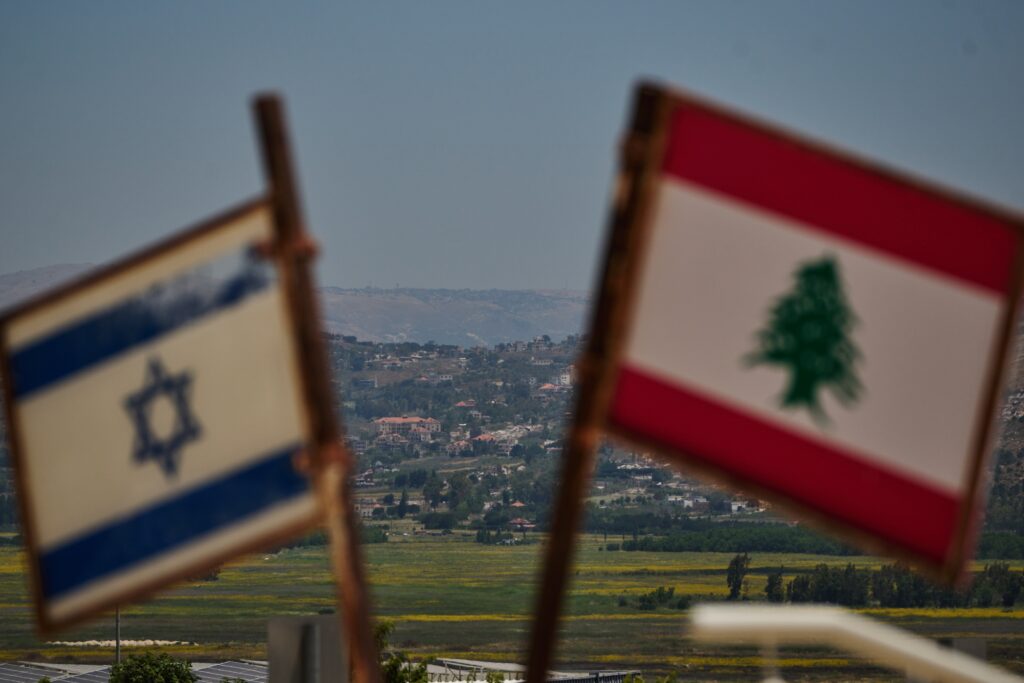
In 1983, I wrote an article for Foreign Affairs magazine with the comically naive title, “How to Rebuild Lebanon.” The task seemed obvious: The United States needed to help this fragile little country reclaim its sovereignty and become a nation again, rather than a punching bag for the region’s warring powers.
That’s still the right mission four decades later, but we know now that it’s a nightmarishly difficult one. Israel demands a perpetual right to attack Iran’s proxy Hezbollah, which can still lob enough rockets to be a convincing menace. The Lebanese government wants to control Hezbollah, but its army is too weak. And America stands on the sidelines trying ineffectually to stop the mayhem.
The Trump administration has now waded into what Lebanese journalist Michael Young called “a graveyard for people with grand projects.” Vice President JD Vance, given the thankless job of overseeing negotiations, declared last week: “This is about regional peace. We expect Hezbollah will not fire rockets at the Israelis and we also expect Israelis to not go wild on Lebanon.”
Amen to that. I am an eternal enthusiast for helping Lebanon. But this time, the U.S. needs to enter the Lebanese octagon as a more determined and realistic referee. We have been making the same mistakes since the early 1980s. We ignore the admonition of Lebanese historian Kamal Salibi: “A small country is rarely involved in an international conflict to its advantage.”
The right starting point this time is to insist on Lebanese sovereignty. That will upset some Israelis, who see Lebanon as a kind of northern annex, to be bombed and invaded at will. But Israel has repeatedly tried pummeling its adversaries in Lebanon into submission, and it hasn’t worked. Lebanon isn’t Gaza. You can’t keep “mowing the lawn” in another country.
I’ve watched Israel make some astonishing mistakes in Lebanon over the past 45 years. It’s a story of continual overreach, usually followed by U.S. attempts to clean up the debris. Peace would prevail for a time, but violence returned. The problem, as the brilliant scholar Fouad Ajami once wrote of his native Lebanon: “It was a garden without fences. … It was too open. It lay at the mercy of outsiders.”
In the early 1980s, the threat to Israel from Lebanon wasn’t Hezbollah (it didn’t exist yet) but the Palestine Liberation Organization. Lebanon had essentially sold its sovereignty to the PLO in the 1969 Cairo Agreement, and after the Palestinians were expelled from Jordan in 1970, they used Lebanon as a platform to attack Israel. The Israelis fought back hard, mostly in the shadows. But in 1982, Ariel Sharon, then defense minister, convinced Prime Minister Menachem Begin to invade all the way to Beirut.
The Israeli invasion stalled in the summer of 1982, as the PLO held its ground despite getting pounded from air, land and sea. (Israel’s inability to impose a military solution was a foretaste of what would come in Gaza after Oct. 7, 2023, and this year in Iran.) Begin came to believe that invading was a mistake. When I came to Jerusalem to interview him in August 1983, his aides said he couldn’t take his mind off the daily death toll in Lebanon. Yehiel Kadishai, Begin’s personal secretary, told me: “The truth is that he is sad.”
The masterful U.S. diplomat Philip Habib brokered the terms for the PLO’s departure from Beirut in 1982, but peace didn’t last. A 2002 biography of Habib was titled “Cursed is the Peacemaker.”
The aftermath of the 1982 war was an illustration of the Middle East’s law of unintended consequences. The departure of the Sunni-led PLO opened the way for the brutal Shiite militia, Hezbollah. Its operatives bombed the U.S. Embassy and Marine barracks, kidnapped American journalists, murdered a CIA station chief and a beloved university president — and began a war against Israel that has lasted more than four decades.
What’s different this time that might warrant yet another American commitment? I see one fundamental change: In Joseph Aoun, Lebanon finally has a president who seems serious about reestablishing sovereignty in his country, and an army that, over time, may be able to back him up. But this recovery will be possible only if two conditions are met: Israel and Iran are out of Lebanon, and the United States is in.
Neither Israel nor Iran should have veto power over Lebanon’s security. Yet the Trump administration seems to be acceding to both. Israel is part of a U.S.-led ceasefire “mechanism” established last year. And, strangely, Iran (but not Israel) is part of a “deconfliction cell” for Lebanon announced last week by mediators Qatar and Pakistan.
Aoun reminded the world Monday: “We welcome any assistance to end the war, but we distinguish between assistance and interference in internal affairs because we are a sovereign country and no one negotiates on our behalf.” As for Iranian deconfliction, he said this month, “It’s not your country, it’s our country. … It’s not your job to interfere into our country.”
Israelis have protested that Trump is ignoring its security in trying to solve the Lebanon problem. But Danny Citrinowicz, a top Israeli military analyst, argues: “We have no one to blame but ourselves. Instead of extending a hand to Lebanese President Joseph Aoun out of an understanding that there is no military solution to the situation in Lebanon, and that Israel will not disarm Hezbollah of its weapons through force alone, we chose to wait … we preferred to rely on military might rather than translating military achievements into a diplomatic move.”
Does the Trump administration have the stomach (or the smarts) to support Lebanese independence? I gagged when President Donald Trump proposed this month that Syria “take care” of Hezbollah. He evidently didn’t realize that a similar American request for Syrian peacekeepers after the 1975-76 Lebanese civil war led to 25 years of brutal occupation.
Everything in the Middle East has already happened. I had that sense as Trump endorsed his Iran-Lebanon peace deal in the Palace of Versailles. There were faint echoes, surely, of the 1919 Treaty of Versailles that ended World War I and dissolved the Ottoman Empire — on terms that led to a century of conflict. That was, as David Fromkin titled his 1989 history, “A Peace to End All Peace.”
We’ve tried this before and failed. As America’s brief military mission to support Lebanon after the 1982 Israeli invasion was collapsing two years later, Syria’s foreign minister scoffed that the United States was “short of breath.” He was right.
That’s America’s worst quality in the Middle East. It makes promises it can’t keep. Let’s not do that again. Helping the shattered nation of Lebanon recover from war is a noble mission, but it’s not for the fainthearted. If Trump can’t see it through to the finish, he shouldn’t start.
The post A better future for Lebanon means getting both Israel and Iran out appeared first on Washington Post.