The divide between Iran and America is, the Opinion columnist Thomas L. Friedman argues, ultimately about the difference between “Kushnerism” (named for the president’s son-in-law Jared Kushner) and “Khomeiniism” (named for the founder of the Islamic Republic of Iran). In conversation with the Opinion editor Dan Wakin, Friedman explains what he means and discusses what he sees as President Trump’s recent string of failures.
Below is a transcript of an episode of “The Opinions.” We recommend listening to it in its original form for the full effect. You can do so using the player above or on the NYTimes app, Apple, Spotify, Amazon Music, YouTube, iHeartRadio or wherever you get your podcasts.
The transcript has been edited for length and clarity.
Dan Wakin: I’m Dan Wakin, an international editor for New York Times Opinion. When President Trump signed an initial peace agreement with Iran last week, in some ways, it didn’t seem like much of a deal at all. The biggest problem remained unresolved: what to do about Iran’s nuclear program.
Vice President JD Vance was just in Switzerland to meet with the Iranians, trying to come to a lasting agreement. They’ve given themselves 60 days to get it done. It’s worth noting that the Obama nuclear deal took over a year and a half to negotiate. To discuss the latest, I’m here with my colleague, Opinion columnist Tom Friedman.
Hello, Tom. Thanks for joining me.
Thomas L. Friedman: Dan, great to be with you.
Wakin: Before we get into this week’s news, I want to go back to something you wrote in a column soon after the war started. You wrote, “We must remember that the timing of the end of this war will be determined as much by the oil markets and the financial markets as by the military state of play inside Iran.”
So, here we are with Trump nervous about high gas prices in the midterms. We have the same Iranian regime basically in place, but now with a younger leader. And Iran is well aware of the power they hold over the Strait of Hormuz. Given all that, what kind of negotiating position is the U.S. in, and what are your hopes for the outcome of this negotiation?
Friedman: Well, I would say that Trump ended this war with a TACO trade — the famous TACO trade described by Wall Street analysts: Trump Always Chickens Out.
In the end, Trump basically calculated that he had to end this war now in order to get oil prices down in time for the midterm elections.
So, what I predicted early on, that oil prices would determine this war as much as events on the battlefield, really played out. He basically sold out the State of Israel and the Arab Gulf states for the swing states of Michigan, Pennsylvania and Georgia.
Trump understood if gasoline prices and food prices kept soaring, as they’ve been since the start of this war, there would be a very high likelihood that he would lose those states.
If he loses the House, and if he loses the Senate — less likely, but a possibility — Trump would then be exposed to impeachment over the way he has enriched himself since he’s become president.
I think there’s a link between all of these things, and the reason we know this, Dan, is because Trump told us so. He said he was not going to be Herbert Hoover and preside over a recession.
Wakin: I want to talk a bit about how the negotiations have been going. I know there are conflicting reports depending on who you listen to, whether it’s U.S. officials or Iranian officials. But as of Tuesday morning, what do we know for certain has happened so far?
Friedman: There’s been a memorandum of understanding signed by the parties to forge a cease-fire in the war that would allow for the opening of the Strait of Hormuz and for Iran to sell oil for dollars and begin to repair its economy.
This is a prelude for wider talks on removing Iran’s nuclear near-bomb-grade-ready fissile material.
That is the general headline, I would say. But we know the details are all to be determined.
Now, Dan, one of the rules I developed as a reporter in the Middle East is that in the Middle East, what people say to you in private is irrelevant. All that matters is what they’ll say in public in their own language.
The Middle East is a funny place. It’s kind of the opposite of Washington. In the Middle East, people lie to you in private and tell the truth in public in their own language. In Washington, people tell the truth in private and lie in public.
We already saw a demonstration of this rule just in the last 48 hours. Vice President Vance came out and said: Hey, the Iranians have promised to let in nuclear observers from the International Atomic Energy Commission. And the Iranians said: No, we’ve offered no such thing. So, I think this is going to be an ongoing problem for the administration. Whether the Iranians did say it in private in English, they’re clearly contradicting it in public in their language.
And there is a bit of divine justice here. I’m thinking about Vance. This is a man who sold his soul, his every principle, to be vice president to Donald Trump, and it’s like the Greek gods have punished him by making him responsible for ending a war that he opposed, started by Donald Trump. That said, Iran needs to be careful not to overplay its hand.
Wakin: Donald Trump, a president who has said, If things don’t go well, it’s going to be JD’s fault and not mine.
Friedman: Absolutely. So, you’re really only going to be able to see what is true and what is Memorex, what is not true, on the basis of what you see happening on the ground. I tend to discount all of these public statements.
At the end of the day, there are some very large, powerful forces at play, Dan. One is the one we alluded to earlier: Donald Trump needs this war to be over politically.
The prime minister of Israel, Bibi Netanyahu’s interests are just the opposite. His interest is that the war goes on for his politics. He needs to show that he is a war prime minister because the end of war brings for him a whole Israeli investigation and election over how he has conducted all of Israel’s policies since the Hamas invasion.
And Iran is divided, I believe, between Revolutionary Guards, who’d like to see the war go on because they benefit and they gain power the more there’s tension with the Americans, and the new politicians who’ve emerged in Iran after the previous generation was decapitated, who may actually have an interest in peace coming about. This second group may be stronger than we originally thought.
These are the hard realities I’m looking at, and how they manifest themselves on a daily basis. I think you’re going to see a lot of contradictory behavior. It’s going to take us a while to see what is the real signal in the noise.
Wakin: Speaking of hard realities, one of them is that the U.S. has promised to unfreeze Iranian assets. That means a flow of dollars to the I.R.G.C., as well as a flow of oil income now allowed under the M.O.U. to the I.R.G.C. What are the implications of that?
Friedman: Well, I want to take you to 30,000 feet if I could, Dan, to really understand the clash that’s at stake here that we’re watching. I describe it as a clash between Kushnerism and Khomeiniism.
So, what is Kushnerism? Let’s go back to the Hamas-Israel war and the cease-fire agreement. After that agreement in Davos this year, Jared Kushner, the President’s son-in-law, made a presentation to the Board of Peace that Trump had created to oversee that cease-fire. It was a presentation of what he called New Gaza, a city built for coastal tourism with 180 towers, areas for residential buildings, industrial complexes and data centers.
Kushner’s view of the world is, basically, people just want condos and hotels and beachfront property, and girls just want to have fun. He really doesn’t have any deep understanding of the passions and grievances that have motivated people in this region, for centuries.
Opposed to him is Khomeiniism. Ayatollah Khomeini, Iran’s religious leader who succeeded and toppled the shah. Very early on after the revolution, he said: We didn’t make this revolution to lower the price of melons. In other words: We really believe what we say. We’re trying to create an Islamic republic based on Shariah law, where women will be covered and be under the rule and thumb of men, and we want to spread this ideology around the region.
And what you’re seeing here is really a clash of which of these two ideologies is going to predominate.
Trump keeps saying, in effect, Look, I wiped out the old leadership, so the new leaders will buy into Kushnerism. But we haven’t seen that with the new leaders yet at all.
Now, let me say that I’m actually glad there’s a Kushner out there, basically saying to the two sides: I don’t know anything about your history. And you know what? I don’t care to know anything about your history, because it’s just a bunch of grievance-driven people who have been turning this region into the Stone Age, and I’m going to paint a different vision.
I’m actually good with that. Whether it’s realistic or not, you need someone out there doing it. But whether he has any buyers for what he is selling is something that’s going to take time to see, and that’s how I’m looking at the future.
Who’s going to win this story: Jared Kushner, who knows none of the history and doesn’t care about it because he thinks the future can bury the past, or the followers of Khomeini, who know only the history and insist that the past must always bury the future?
Wakin: Would you extend Kushnerism to President Trump himself?
Friedman: Oh, I think Trump is a variant of Kushner. I see Trump as a different kind of character in this play. Trump One was, we know, surrounded by buffers, and Trump Two is surrounded by amplifiers. What we’ve been seeing in Trump Two is that everything he does is a no-bid contract.
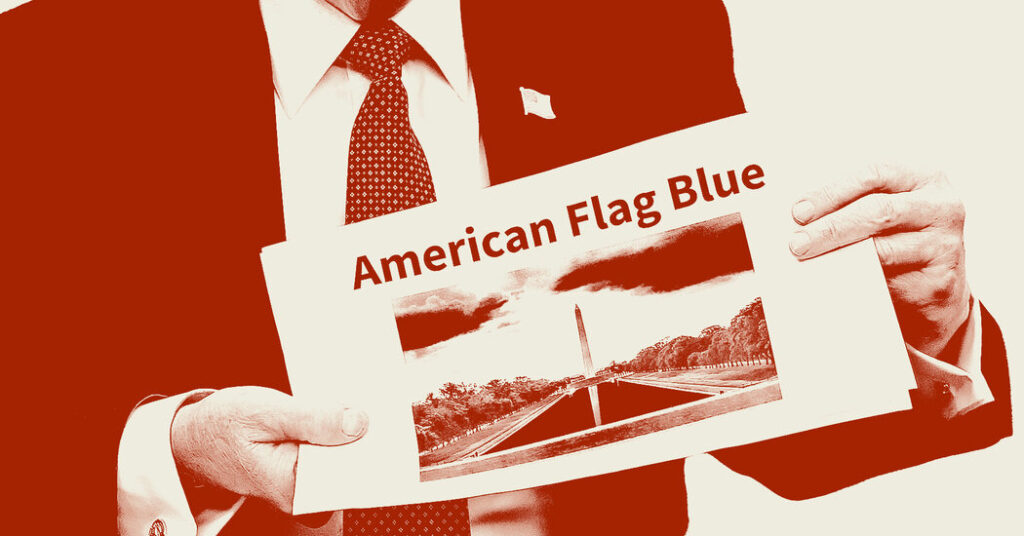
To me, Dan, there is a parallel between Trump’s failure to clean up the Persian Gulf and his failure to clean up the Reflecting Pool at the Lincoln Memorial. Both, to me, are failures of a commander in chief, because both were done, in their own way, through no-bid contracts — and no-bid contracts, which don’t allow any other bidders than the one the president anoints, always get you in trouble.
In the case of the Reflecting Pool, we know that the National Park Service bypassed competitive bidding and gave the $1.7 million contract to a firm called Greenwater Services, which happened to be run — shock, are you sitting down, Dan? — by a Trump campaign donor. But not any Trump campaign donor, one who had been convicted twice — once for bribery and once for some other campaign donation shenanigans.
What happened? Instead of turning the Reflecting Pool blue the way Trump wanted for the Fourth of July, it’s turned into an algae of green blooms that have basically wrecked the whole scene.
Now, why do I compare that no-bid contract with the U.S.-Israeli war against Iran?
Because in a way, Trump approached it, too, in a no-bid fashion. Let’s go back to the reporting of our colleagues Maggie Haberman and Jonathan Swan from the key decision making meeting in the Situation Room at the White House.
Trump invited in Bibi Netanyahu, the prime minister of Israel. He was in the Situation Room. It was a no-bid moment where Netanyahu then brings onto the screen the head of the Mossad, and the Mossad tells Trump that through aerial bombing, they can decapitate the regime and trigger a popular uprising in Iran.
And, of course, none of that happened.
Trump didn’t even have in the room his energy secretary or his Treasury secretary. And his own experts, the director of the C.I.A., called the Israeli idea farcical, and his secretary of state, Marco Rubio, reportedly called it bullshit.
But Trump went with his gut, with his no-bid contract with Bibi Netanyahu, and the result has been the Strait of Hormuz has been turned from blue into green, red and white — the colors of the Iranian flag.
No-bid contracts get you in trouble, whether they’re in the Mall or in the Gulf.
Wakin: Tom, tell me about how you think the situation in Lebanon fits into this whole story.
Friedman: Well, one thing that really worries me about this agreement is how the Iranians have maneuvered Trump into linking the opening of the Strait of Hormuz with the fate of Iran’s proxy militia, Hezbollah, in Lebanon.
Basically, Iran says that if Israel continues to try to destroy Hezbollah, we will choke off Hormuz going forward. That is a terrible linkage because Hezbollah is simply an extension of the Iranian Revolutionary Guards.
One has to ask, “Hey, Iran, what the hell are you doing in Lebanon? What right do you have to protect a nonstate, illegal, armed militia in Lebanon?”
The fact that Trump has allowed that kind of linkage — where the Iranians can say at any time they want going forward, “Hey, if Israel doesn’t stop beating up Hezbollah, then we’re going to choke off Hormuz again” — I find that very troubling, most of all for the Lebanese people who so want to be done with this, who are ready to make peace with Israel.
You also have to ask, “What’s going on inside Israel now?”
Driving in this morning, Dan, I’ll speak very personally, I was listening on the radio about the primaries going on in New York and elsewhere, in which there’s a competition now for who can bash Israel the most.
When you think of where Israel was 15 years ago in America and where it is across these 15, 16 years that Netanyahu has been in power, it’s one of the greatest disasters for the Jewish people.
Netanyahu’s policy right now is that we’re going to kill our way to peace. We’re going to not stop in Lebanon until we’ve killed all of Hezbollah’s fighters. We’re going to take over the demilitarized zone in Syria. We’re going to remain in permanent war against Hamas.
And people in my right-wing government, says Netanyahu, are basically engaged in a project of quiet ethnic cleansing in the West Bank to drive as many Palestinians as they can into Jordan to turn Jordan into a Palestinian state.
Think for a second, Dan, what Israel is sacrificing. If it actually had a different policy, one of at least trying to forge a two-state solution with the Palestinian Authority, albeit a reformed one, we wouldn’t be having the primary we’re having in New York today, where it’s a competition of who can bash Israel the loudest.
Israel could have normalization with Saudi Arabia. Israel could now have peace with Lebanon. It could have peace with Syria. American Jews and Jews all over the world have to stop and think what this Israeli government is trading away by not having an approach for peace with the Palestinians — how they are imperiling the future of Israel and the future of Jewry all over the world.
Wakin: Let’s turn to what President Trump has called his central goal, which is eliminating Iran’s nuclear capability. What do you think the chances are that a deal to do that will emerge that would be any better for the U.S. than the deal struck by the Obama administration known as the J.C.P.O.A.?
Friedman: Well, let’s go back since I covered that administration. Actually, the morning the agreement was signed, I got a call very early from the White House, 3 a.m. , that President Obama wanted to see me in the Oval Office that day. And I came in, and I had the first interview with him about the J.C.P.O.A.
I will tell you, I’d just broken my shoulder and I was on strong medication. I was really in pain. But my head was clear enough to understand this, Dan. Iran is a wicked problem. In fact, Iran is like the definition of a wicked problem, and a wicked problem is a problem that defies any kind of easy solution.
So, what was President Obama’s approach? He said this is a wicked problem, so I’m going to cut through the wicked thicket and try to identify what is the key U.S. interest.
The key U.S. interest is that Iran not be able to amass enough fissile material to ever build a nuclear bomb that could threaten the region, trigger nuclear proliferation in the Middle East and one day even threaten American interests. So, I’m going to strike a deal with them that’ll be grounded in the most stringent inspections that will keep them away from a bomb for at least 15 years, if not more. And who knows, in those 15 years, Iran might change.
That was the simplicity of Obama’s approach.
Now, Trump tore up that agreement. I’m sure he never read it, but he tore it up out of his, I think, hatred and jealousy of Obama and said: I’ll deliver you a better alternative. Of course, he didn’t, and in the intervening period, Iran amassed enough fissile material for nine or 10 bombs that it could assemble actually very quickly, and that’s what brought us to this place.
Now, Trump’s approach was, Oh, this is easy. This isn’t a wicked problem. It’s just a question of will, of toughness, and you need a genius like me. So, what did he do? He basically relied on Netanyahu and Netanyahu’s Mossad director’s analysis, which is that if we topple the regime, we’ll quickly trigger a popular uprising.
Dan, I’ve been covering the Middle East my whole adult life, almost 50 years. I’ve actually learned something observing the Mossad. If you want someone assassinated in Beirut or Tehran, Dan, call the Mossad. If you want to understand political and social trends in Beirut or Tehran, do not call the Mossad, OK?
Because the same reason they’re good on the first, they’re bad on the second. What is that? They’ve penetrated these regimes by relying on people who are turning against their own country, who are spying for you. In other words, they’re people who hate the regime, and because they hate the regime, what do they do? They exaggerate the weakness of the regime.
So, there’s a lot of complicated, contradictory tugs and pulls at work here. You have to be just humble — on one side by avoiding saying everything Trump is doing is wrong.
Look, there’s a big part of me that would like to see this work. I would love to see this Iranian regime changed or reformed because nothing, I think, would improve the Middle East more — both the lives of Iranians and the opportunities for Lebanese, Israelis, Syrians, Iraqis and Yemenis — than if this regime were removed or reformed radically.
So, as much as I detest Trump and what he’s doing to American democracy, I’m not sitting here saying I hope he fails, because if he succeeds, that would be a great thing. It really could be good.
I think, as an analyst, you have to hold out the possibility that you could be surprised by what happens here. So, I’ve got that on one side of my head, and on the other side, I’m watching a president who may have big ideas, but I don’t trust that he has an administration behind him that can implement anything, that can follow up anything.
One day it’s the vice president leading negotiations, not the secretary of state or the national security adviser — who’s the same person in Rubio. There’s no government bureaucracy behind him. They’ve destroyed all that. He doesn’t believe in any of that.
We operate on his gut. He’s tweeting left, right and center contradictory things. No one in this administration trusts each other because they’re all worried that he will shoot them or tweet them in the back.
So, I’m saying you’ve taken on this big project, but who here has the competence, the patience, the focus to actually do what Obama did, which is negotiate a detailed agreement and then deliver on it?
Frankly, Dan, I’d have a lot of sympathy for Trump in this situation — because the end project is one I’d love to see work for the future of the region, which is a different Iranian regime — if Trump had shown one ounce of humility and dignity to cut Obama some slack for the difficulty of what he was trying to pull off … I end where I began. This was a no-bid war.
Trump never really enlisted his own intelligence community. He relied on a no-bid contract from Bibi Netanyahu and the Mossad, and now he’s gotten himself in trouble, and he’s turned over delivering on this no-bid contract to his vice president, who opposed the war to begin with.
Wakin: What do you think the significance is of Vance leading the negotiations and not the secretary of state, Marco Rubio?
Friedman: Very good question. Let’s go back to 1973, that October war. Back then, you had Henry Kissinger, who was running everything for Richard Nixon — a president deeply sophisticated about foreign policy.
If you remember the story of the ’73 war and the negotiations that followed, Kissinger had one hand on the dial of weapon supplies to Israel, which he was actually dialing up and down to make sure Israel won the war but didn’t humiliate the Egyptians because he was already thinking about the negotiations afterwards and what would be required to create a disengagement agreement between Israel and Syria, Israel and Egypt.
So, the same single character, someone deeply steeped in the history of foreign policy, was controlling the dials of the military and the dials of diplomacy at the same time.
What do you have here? You have a president — again, relying on the intelligence and predictions of a foreign power — overriding his own military who told him Iran could take over the Strait of Hormuz, could actually attack our Arab allies, but Trump thought that the regime would collapse before they could ever do that.
Now he’s trying to end the war by turning over the diplomacy to his vice president who opposed it, who has no real experience in that part of the world in the diplomatic sense and doesn’t have the vast team you need to do this.
Meanwhile, Marco Rubio, the secretary of state, as far as I can tell, is in a witness protection program somewhere, trying to stay as far away from this thing as he possibly can.
And what’s happening today when I got up in the morning? The man Trump named to take over the Directorate of National Intelligence from Tulsi Gabbard, Bill Pulte — who comes from the housing industry and whose experience in foreign policy, I believe, is the breakfast menu at the International House of Pancakes — is over at the Directorate of National Intelligence, as we speak, firing intelligence analysts.
This whole crew is just so not serious about such a serious situation, and it forces me, at least as an analyst, to hope somehow against all hope that they find their way through this and that in the end, Kushnerism does actually defeat Khomeiniism, because it will be better for the world and better for everyone.
But at the same time, I’m saying to myself, “If you bring clowns, you get a circus.” I just don’t see this team pulling this off, but I really deeply hope I am surprised.
Wakin: This reminds me of a lovely literary moment in your last column in which you quote “The Great Gatsby.” It’s the line about Tom and Daisy Buchanan, and the quote is, “They were careless people, Tom and Daisy — they smashed up things and creatures and then retreated back into their money or their vast carelessness.” And then the passage ends, they “let other people clean up the mess they had made.”
You compare the situation in Iran and in this war with that passage. My question is, who’s going to clean up this mess? How will it get cleaned up?
Friedman: That’s what I’m worried about, because not only have they broken something, but they’ve broken something in a vast area that now has so many different shards, so many different empowered actors — Israel, Hezbollah, the Lebanese government, the Iraqi militias, the militias in Yemen, the Iranian Revolutionary Guards inside Iran, the politicians who’ve succeeded them.
There are so many moving parts here. If Henry Kissinger were alive today, he would be deeply challenged trying to navigate a way out of this, and we do not have Henry Kissinger today.
Wakin: And we have no one to clean up the mess.
Friedman: What worries me is that Trump, who has no patience, who’s bored, just wants to declare victory and move on.
Remember during the war when Trump tweeted, Open up the strait, you crazy bastards? I just read that and thought, “It’s the Middle East, Jake.”
It’s Chinatown, baby. You walked into Chinatown, and you broke up the whole neighborhood, and now you’re screaming at people, “Open up the streets, you crazy bastards”? It’s Chinatown, Jake. Good luck.
Wakin: Tom, this has been a real pleasure. Thanks so much.
Friedman: Always, Dan. Thank you.
Thoughts? Email us at [email protected].
This episode of “The Opinions” was produced by Jillian Weinberger. It was edited by Kaari Pitkin. Mixing by Carole Sabouraud. The postproduction manager is Mike Puretz. Original music by Pat McCusker. Fact-checking by Kate Sinclair and Mary Marge Locker. Audience strategy by Shannon Busta and Kristina Samulewski. The director of Opinion Video is Jonah M. Kessel. The deputy director of Opinion Shows is Alison Bruzek. The director of Opinion Shows is Annie-Rose Strasser.
The Times is committed to publishing a diversity of letters to the editor. We’d like to hear what you think about this or any of our articles. Here are some tips. And here’s our email: [email protected].
Follow the New York Times Opinion section on Facebook, Instagram, TikTok, Bluesky, WhatsApp and Threads.
The post Thomas L. Friedman on the Clash at the Core of the Iran Deal appeared first on New York Times.