Since April, an outbreak of Ebola in the Democratic Republic of Congo has ballooned to 1,114 confirmed cases and 279 deaths, already the third-largest such epidemic since the disease was identified 50 years ago.
Despite its worrying size, this outbreak is threaded with mystery — particularly regarding its origins.
The cause is a little-known pathogen called Bundibugyo virus, one of three viral species known to cause Ebola disease. Scientists favor the idea that the virus normally dwells in animals, jumping the species barrier every now and then to cause an outbreak among people.
But after years of searching, researchers have yet to pin down information about where the virus lurks when it’s not tormenting humans. “We don’t have anything at all about Bundibugyo,” said Mekala Sundaram, an ecologist at the University of Georgia.
That ignorance leaves humanity vulnerable. Bundibugyo virus could very well cause more outbreaks in the future; preventing them depends in part on knowing where the pathogen hides. The same is true for other viruses that cause Ebola disease — and still other related viruses that have yet to make that first jump to people.
Ebola disease first came to light in 1976 with two deadly outbreaks, one in what was then Zaire, now the Democratic Republic of Congo, and the other in what is now South Sudan. The symptoms were largely the same in both places: fevers, vomiting, bleeding and, for most victims, death.
Scientists discovered similar, snake-shaped viruses in the blood of victims in both outbreaks. They belonged to the same family of viruses, called filoviruses. On closer examination, the two viruses turned out to belong to separate species. Today they’re known as Ebola virus and Sudan virus.
(Confusingly, scientists refer to the species that first appeared in Zaire as Ebola virus, although its relatives, Sudan virus and Bundibugyo virus, also cause Ebola disease.)
If the 1976 outbreaks were not linked, investigators reasoned, then the viruses probably jumped from some unknown animal into their first human victims. International teams commenced a search for these so-called reservoirs — the animal species that normally harbored the viruses.
They examined insect-eating bats that roosted in a cotton cloth factory where the first recorded victim of Sudan virus had worked. They looked at rats, bedbugs, mosquitoes and a host of other species. But in the end, scientists found no sign of the two viruses in any animal in the vicinity of either outbreak.
In the decades that followed, researchers turned up hints , but nothing that definitively pointed to an animal reservoir.
In 1996, for example, scientists in South Africa and the United States injected Ebola virus into 19 species, including spiders and tortoises. The virus failed to infect most of the animals. But in three species of bats, it multiplied to high levels without making the animals sick.
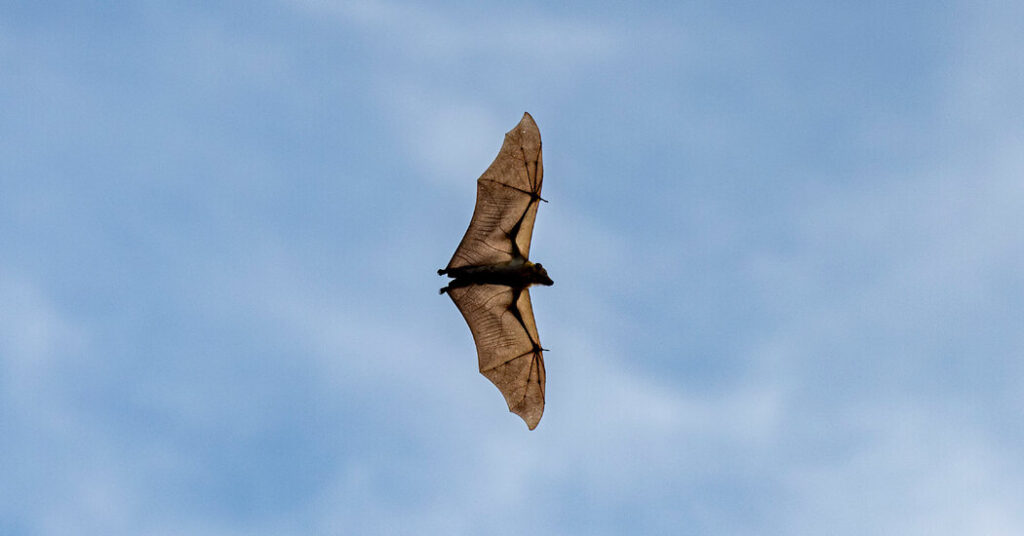
Scientists have also found signs of Ebola virus in bats in the wild. A low percentage of fruit bats across Africa carry antibodies to the virus. In a few cases, researchers have even discovered genetic fragments of the virus in their blood.
But “this is not the same as proving a reservoir,” said Sadic Waswa Babyesiza, an ecologist at Makerere University in Uganda.
The standard ways to locate an animal reservoir might fail when it comes to Ebola virus, Dr. Sundaram said. It can lurk inside people for years, scientists have learned, hiding in such places as the eyes and semen.
People with persistent infections may sometimes ignite new outbreaks years later. No one knows if fruit bats also get persistent infections, but if they do, looking for virus in their blood will be futile.
“Traditional tests will miss the virus hiding in these little pockets,” Dr. Sundaram said.
She speculated that persistently infected fruit bats may pass the virus to others when they gather in huge swarms to feed. Infected bats may shed the virus in saliva and feces, and fruit trees might become hot spots where the virus spreads to other species, including humans.
Most of this research has been done on Ebola virus, the species that first appeared in Zaire and that has caused the most deaths over the past 50 years. Solid evidence for reservoirs for other viruses causing Ebola disease is practically nonexistent.
Scientists have searched tens of thousands of animals from hundreds of species without finding any clear signs of Sudan virus or Bundibugyo virus. And they caution against assuming that fruit bats are hosts.
A related species discovered in 2018, Bombali virus, has turned up not in fruit bats, but in insect-eating bats. (There’s no evidence that this virus has spilled over into humans — yet.)
Even if fruit bats or insect-eating bats are reservoirs for these viruses, scientists are also considering the possibility that they are just part of a larger ecological network of animals that pass the pathogens between one another, a network that is mostly unknown.
“Unfortunately, all these things are still in the mist,” said Fabian Leendertz, the director of the Helmholtz Institute for One Health in Greifswald, Germany. Part of the problem, he added, is that scientists usually look for viral reservoirs in fits and starts, scrambling after each outbreak to inspect animals.
He and his colleagues are embarking on a different strategy, setting up long-term surveillance stations in Africa where they can collect samples from both people and animals on a regular basis.
Why the constant surveillance? “I think these spillovers happen more often than we think,” Dr. Leendertz said.
The post The Ebola Outbreak’s Central Mystery: Where Did This Virus Come From? appeared first on New York Times.