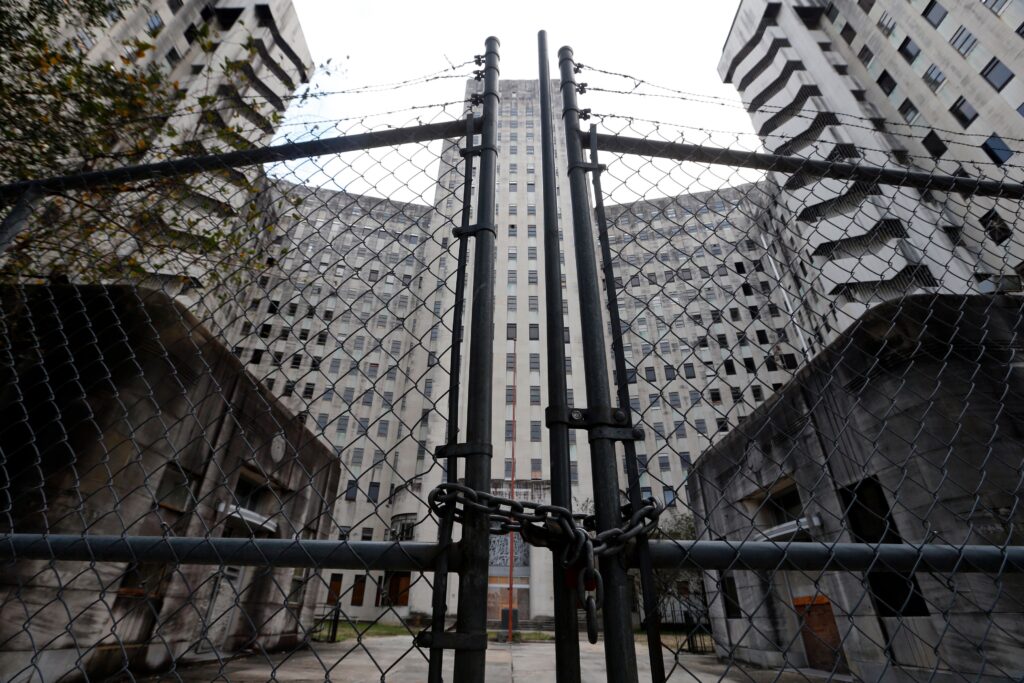
NEW ORLEANS — Vines have grown through the fence and barbed wire surrounding a tall art deco building in this city’s downtown, and cigarette holders and empty food tins litter the tall weeds. Many windows are shattered or boarded over with decaying plywood. The front doors to what was once Charity Hospital are padlocked shut, with a few weathered planks hammered across for good measure.
It’s a desolate reminder of the devastation Hurricane Katrina unleashed on this city nearly 21 years ago, and the institutional failures that followed.
Now, Tulane University wants to transform the building into a symbol of hope.
On Tuesday, Tulane leaders announced they would lead a sweeping redevelopment of Charity, investing $500 million to restore the massive structure and turn it into a hub for research, education, spin-offs and start-ups.
The university signed a purchase and sale agreement for the project with the original developer. Pending final agreements, with support from the state, city, a state-enabled economic development district, a family foundation and other private philanthropy, construction on the 1 million-square-foot project could start this fall.
Project organizers see their effort as a catalyst that will spark impactful science, knit together Tulane’s growing downtown campus, diversify the city’s tourist-heavy economy, and fill a hole in the heart of New Orleans near City Hall, the Superdomeand the French Quarter.
The plan has forged an alliance among political leaders of different parties in Louisiana, a rarity in a deeply divided nation, and symbolizes a powerful commitment to the power of research at a time when federal research funding is dwindling nationally.
“This is very important to the country,” Tulane President Michael A. Fitts said in an interview. “I think people will recognize that over the long run. We’re not making a one-year bet or a two-year bet; we’re making a 20-year bet on this.”
Charity was founded in the early 1700s to care for the poor, with this structure built in 1939. Its slogan is, “Where the Unusual Occurs and Miracles Happen.”
The hospital mostly survived the initial brunt of Hurricane Katrina in August 2005. Then the levees broke. By the morning of Aug. 30, everything was flooded.
Charity no longer had running water or functioning toilets. The temperature rose as high as 120 degrees in some crowded rooms. People cut down light poles from a parking garage to serve as a makeshift helipad, and slowly, small helicopters began to arrive, taking one or two patients at a time, and bringing water and MREs.
Early the following day, emergency power went out. Without elevators, staff members struggled to get patients on flat stretchers down dark staircases with sharp turns. People ventilated patients by hand. L. Lee Hamm, now dean of Tulane’s medical school, and other doctors paddled a canoe to check on Charity, passing people pushing their children and belongings through waist-high waters. They found ER patients lying on stretchers and mattresses in a conference room.
Some died waiting for help.
After Katrina — which killed more than 1,300 people on the Gulf Coast and displaced thousands — Charity was shuttered. A new hospital opened nearby. And over the years, plans to revive the giant, iconic building, which locals referred to as Big Charity, never took.
“We’re still living in Katrina in the Gulf South,” said Douglas Brinkley, a history professor at Rice University who was a professor at Tulane when the storm hit and wrote a book about it. “It’s decades till a region can heal from a major disaster like this.”
Charity is just a five-minute walk from the Ritz-Carlton and the edge of the French Quarter, with its lacy cast-iron balconies, antique shops and bars crowded with tourists ordering drinks named after natural disasters. On a recent afternoon, a restaurant had thrown open tall windows and shutters so people enjoying a drawn-out lunch could listen to a jazz band’s blistering horns in the square outside. People stopped to dance, twirling and dipping on the flagstones.
But the buildings closest to Charity — including Tulane’s medical school, school of public health and other parts of its downtown campus — seem to be in another world.
Students and staff use tunnel-like bridges between buildings, often choosing to avoid streets defined by vacant structures and people sleeping or wandering barefoot on the buckled sidewalks.
On the grounds of Charity on a recent morning, Patrick Norton, Tulane’s chief operating officer and treasurer, stared at an animal slinking through the weeds. Just a feral cat, he and other school officials concluded with relief.
Over the years, people have ventured into the old hospital, photographing its morgue, surgical theater, ghostly abandoned beds and equipment, now emptied.
But the bones are good, Fitts said. The project calls for cleaning and repairing the black-streaked limestone panels outside, replacing the windows, restoring the terrazzo floors, the glazed-tile walls, glass blocks and a frieze over the front door by a noted artist.
Tulane’s school of public health and part of its medical school will move into Charity, to maximize synergy, and the university will use those buildings for other things including research and, likely, clinical trials. The Tulane University Innovation Institute will help guide promising science into start-up companies, with a venture fund to invest in them.
The project will also include some underground stormwater abatement work, said Norton and Jeffrey L. Benjamin, the vice president of facilities and campus development, carrying Tulane-green umbrellas as a tropical storm barreled toward the Gulf Coast last week.
Tulane will occupy more than two-thirds of the Charity building, but the project is also expected to include hundreds of apartments, a food hall and a first floor open to the public with a history of the hospital on display. Former waiting rooms could become cafes or shops. In time, officials say, the neighborhood could become a destination, rather than an area to avoid.
“It truly is the connecting piece,” said Dook Chase, whose grandmother successfully reopened their storied family restaurantafter Katrina, knowing how powerful a symbol it would be. He has launched his own Creole restaurant in a vacant former hotel that Tulanerestored for housing near the old hospital.
Tulane officials said they expect the revitalization of Charity to make a $1.2 billion impact on the state’s economy. In three years, they hope to have some 700 researchers there making new discoveries that will power new companies and cures. It’s a stark contrast to the scaling back of research at some U.S. universities, where federal funding cuts and uncertainty have led to reduced hiring and fewer graduate students admitted.
“Tulane is doubling- or tripling-down on being a research university,” said Andy Kopplin, president and CEO of the Greater New Orleans Foundation, who is helping lead the effort to boost bio-innovation in the city’s downtown.
He called the Charity project a linchpin for a district that also includes Louisiana State University’s medical and public health schools, a nonprofit bio-innovation center and Xavier University’s planned medical school.
Cameron Henry, the Republican president of the Louisiana state senate, praised the partnership between Tulane, philanthropic groups and public agencies. University research brings in federal dollars and can put schools on the map, but it also can solve medical or other problems that will benefit the state and the country, he said. “So we want a greater presence of that.”
As university president since 2014, Fitts has leaned into community. Uptown, at Tulane’s leafy, close-knit undergraduate campus, he added high-end dorms and required students to live on campus for at least their first three years. During the coronavirus pandemic, the school stayed open when many others went virtual.
“We think there’s huge value in being together at Tulane,” Fitts said. “You see this in research, in labs, in start-ups, people being in community and bouncing ideas off each other.”
J. Quincy Brown, a biomedical engineering professor from rural Louisiana, has his lab on Tulane’s uptown campus, but hopes to move to the new Charity complex when it is complete.
On a recent day, he held up a glass plate with human tissue on it, like the slides pathologists study through microscopes to detect cancer. On a computer screen, an image of slices of a tumor showed the cancerous areas blinking red.
“We’re trying to develop new microscopes and algorithms to basically move the practice of pathology closer to the patient in space and in time,” he said, allowing doctors to determine if they have gotten a good biopsy sample, or removed all of the cancerous parts of a tumor, while the patient is still in the room.
Brown has already helped create a device generated from ideas in his lab. He thinks the planned emphasis on start-ups at Charity will help keep companies in Louisiana.
There was a brain drain after Katrina, he said, with people leaving the battered city. Charity sends a different signal.
“Rebirth, resiliency,” Brown said. “These are words that people use for New Orleans all the time, but it’s absolutely true.”
The post New Orleans hospital destroyed by Katrina to be reborn as a science hub appeared first on Washington Post.