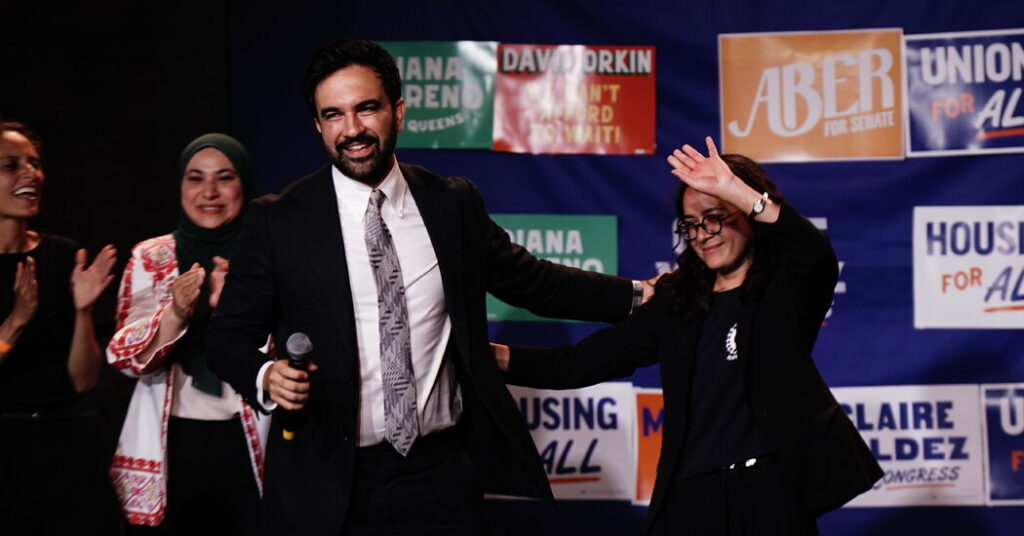
Mayor Zohran Mamdani made a big bet and emerged victorious on Tuesday, becoming an undeniable power broker in New York politics just one year after his Democratic primary victory stunned the political establishment.
His handpicked congressional candidate in a seat spanning Brooklyn and Queens, a one-term state assemblywoman, trounced her opponent, who had the backing of the outgoing congresswoman, Nydia Velázquez. His endorsed contender in a district straddling Upper Manhattan and parts of the Bronx narrowly edged out Representative Adriano Espaillat. And his preferred pick in a seat covering parts of Brooklyn and Manhattan, Brad Lander, routed Representative Dan Goldman in a race called minutes after polls closed.
Mr. Mamdani’s endorsement also helped five candidates, including democratic socialists, win state legislative seats.
The result demonstrated the strength of the mayor’s support, his political acumen and voters’ hunger for insurgency over incumbency.
Along the way, Mr. Mamdani defeated candidates backed by Gov. Kathy Hochul and Representative Hakeem Jeffries in a relatively low turnout primary.
The mayor described the victories as proof that his political movement was not an anomaly. He also argued it offered a path forward in the face of the affordability challenges that he and his allies ran on fixing.
“The old politics that got us into this crisis is not the politics that’s going to get us out of this crisis,” Mr. Mamdani said to cheering crowds at an election night party.
Here are seven takeaways from an eventful primary night in New York:
The Mamdani name was magic across the city.
Mr. Mamdani is in his strongest position yet, as his three endorsed congressional candidates took out two incumbents and a retiring member of Congress’s preferred successor.
The results underscored the reach of his support beyond neighborhoods that represent the heart of his base.
Mr. Mamdani thrust himself into three competitive House primaries, recruiting one democratic socialist and backing another. He held fund-raisers, starred in ads and spent the last few weeks hitting the campaign trail for his slate.
The night seemed to shatter local conventions, with several candidates who lack longtime political connections defeating incumbents and others endorsed by establishment players.
The moves showed Mr. Mamdani’s appetite for a gamble — and the gamble paid off.
In backing the victorious democratic socialists, the one-term state Assemblywoman Claire Valdez and the activist and doctoral student Darializa Avila Chevalier, Mr. Mamdani, also a democratic socialist, put his faith in relatively untested contenders going up against better-known politicians. He was betting voters were so fed up with the political system that they would be willing to give relative newcomers a chance.
The results also showed voters’ tolerance for far-left views. Ms. Avila Chevalier won despite scrutiny of her past provocative social media posts, in which she criticized Kamala Harris, Joseph R. Biden Jr., interracial relationships and the American flag.
A Kennedy scion fell short.
It was a bleak night for Camelot.
Jack Schlossberg, the grandson of former President John F. Kennedy, was bolstered by his family’s political legacy and support from a smattering of Democratic heavyweights in his campaign to succeed Representative Jerrold R. Nadler in the crowded primary race for the 12th Congressional District, one of the nation’s wealthiest and most influential. But his dysfunctional campaign style and irreverent social media habits severely hampered his bid for the high-profile seat. He finished a distant third.
Mr. Schlossberg’s inability to translate the Kennedy name into political success marked a resounding rejection of the influencer candidate. It came in one of the few competitive races in which voters supported a candidate with decades of experience in electoral politics: Micah Lasher, a state assemblyman and longtime Nadler protégé who emphasized his longtime ties in Democratic politics, won the primary.
It is unclear whether Mr. Schlossberg will seek political office again. He ended his campaign with a nod to his grandfather during his concession speech, imploring his supporters to ask “what we can do to help our city.”
Pro-Israel candidates are increasingly vulnerable.
With Democratic support for Israel cratering, the American Israel Public Affairs Committee laid low in a spate of congressional primaries in New York this cycle.
But AIPAC nevertheless played a leading role in the discourse of the campaigns, as the successful candidates sought to tie their opponents to the influential lobby.
In Brooklyn, Mr. Lander, the former citywide official, hammered his opponent, Mr. Goldman, for receiving support from pro-Israel donors and AIPAC. The congressman supports Israel’s right to exist, while criticizing its current leadership, and does not refer to the war in Gaza as a genocide, as Mr. Lander does.
In a bitter race in Upper Manhattan, Ms. Avila Chevalier called out her opponent, Mr. Espaillat, for receiving hundreds of thousands of dollars in AIPAC donations over his decade in Congress and for not using the term genocide. Like Mr. Goldman, Mr. Espaillat has criticized Israel while defending its right to exist.
And the campaign of Ms. Valdez, who won a seat that straddles Brooklyn and Queens, tried to persuade voters that her opponent, Antonio Reynoso, benefited from pro-Israel donors. But AIPAC said it did not get involved in that race, Mr. Reynoso has long criticized Israel and the claims about pro-Israel donors could not be substantiated.
The left bested Hakeem Jeffries.
The primary results showed Mr. Mamdani’s comfort with risk — and foreshadowed a possible showdown with the top Democrat in Congress.
In endorsing challengers to longtime incumbents, the mayor directly took on Mr. Jeffries, a Brooklyn native who hopes to become the next speaker of the House and represents the Democratic establishment. Neither Ms. Valdez nor Ms. Avila Chevalier has committed to backing the congressman in his bid for speaker should Democrats win back the majority in November.
And in doubling their numbers in the House from two to four, democratic socialists are more likely to try to push the body further to the left, creating a headache for establishment Democrats.
Speaking before Ms. Avila Chevalier and Ms. Valdez’s races were called, Mr. Jeffries said that Democrats should focus less on deep-blue seats and look to more competitive territories such as New York’s Long Island suburbs.
“We’re not in the business of winning Democratic primaries and state seats that are going to be blue regardless of who wins a primary,” he told Spectrum News NY1’s Errol Louis. “In order for us to be able to take back control of the House of Representatives, we got to flip seats in tough areas.”
Outside groups shelled out millions.
This marked perhaps the most expensive congressional cycle in New York history, with more than $50 million being poured into super PACs boosting candidates and attacking their rivals.
The race to replace Mr. Nadler was particularly expensive: More than $40 million was shelled out from former Mayor Michael R. Bloomberg on behalf of Mr. Lasher and from artificial intelligence companies both for and against his main opponent, Assemblyman Alex Bores.
Almost $10 million was spent on the race between Mr. Espaillat and Ms. Chevalier, mostly to support the incumbent.
And in the race between Ms. Valdez and Mr. Reynoso, super PACs spent about $2 million.
A Hudson Valley showdown looms.
National Democrats see flipping a seat in New York’s northern suburbs as key to winning back the majority in the House of Representatives. To do so, they will have to unseat Representative Mike Lawler, a Republican from the 17th District, one of the country’s last true swing territories.
The district, which includes Rockland, Dutchess and parts of Westchester Counties, swung toward Vice President Kamala Harris in the 2024 presidential election even as it re-elected Mr. Lawler. But Democrats are hoping that President Trump’s low approval ratings will help put one of their own back in the seat. Cait Conley, a U.S. Army veteran and national security expert, will face Mr. Lawler in November in a race that will almost certainly bring outsize national attention and an influx of campaign cash.
Ms. Conley debuted her campaign message during the bruising Democratic primary. She has called for an overhaul of the federal immigration system and criticized immigration and customs enforcement under the Trump administration. A handful of national Democratic groups have poured millions of dollars into her campaign hoping that her military background and ability to mix the Democratic brand with patriotic talking points will help her consolidate support from moderate and independent voters.
The Mamdani sweep will embolden leftists to pressure Hochul.
With these electoral wins, Mr. Mamdani and the Democratic Socialists of America have the means to push an ambitious reform agenda.
The D.S.A. pressed Ms. Hochul to raise income taxes on the wealthiest residents this year. But Mr. Mamdani, who supports the cause, opted out of attending their rallies and instead worked to secure state funding for child care and other programs.
Should Ms. Hochul win re-election this year as expected, she can anticipate an even more robust push to tax the rich when the State Legislature convenes in January.
“She knows we’re coming for her,” said Gustavo Gordillo, co-chair of the city branch of the D.S.A.
“I think we have to show New York what it means to have three democratic socialists in the congressional delegation,” he added, saying that the organization is beginning to make plans for the 2028 election cycle.
Mr. Mamdani may also be emboldened to remain outspoken in his criticisms of Israel and defense of Palestinians, an issue that matters deeply to him.
Morris Katz, Mr. Mamdani’s political adviser who worked on four successful New York congressional races, would not speculate on Mr. Mamdani’s policy goals.
“The mayor and his politics have a mandate,” Mr. Katz said, “and like I said many months ago, he’s not going to be afraid to use it.”
The post Insurgency Over Incumbency: 7 Takeaways From New York’s Primaries appeared first on New York Times.