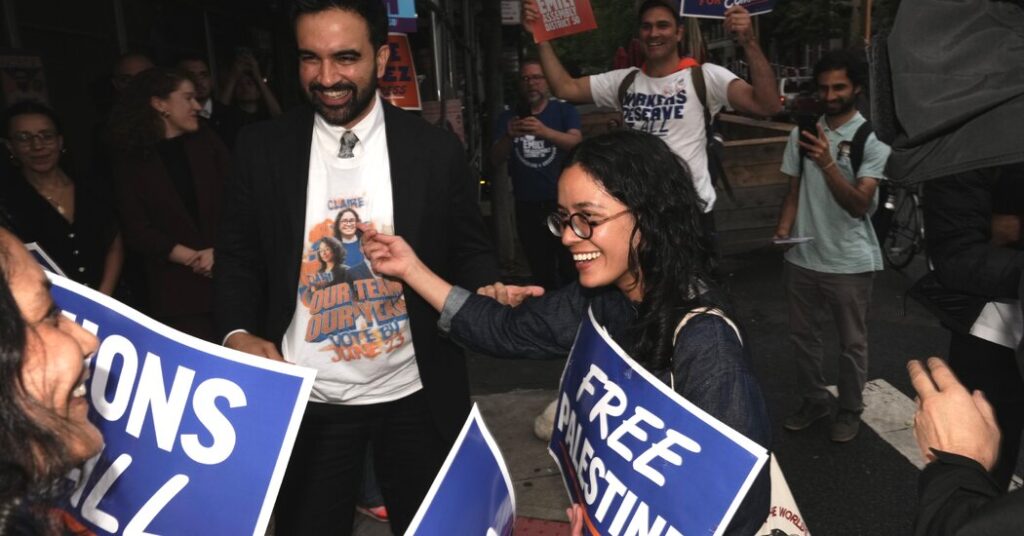
At two separate victory parties after the Democratic House primaries in New York City on Tuesday night, the same chant echoed from the crowd: “Free, free Palestine!”
In Harlem, Darializa Avila Chevalier was celebrating her triumph over Representative Adriano Espaillat, a steadfast supporter of Israel in his decade in Congress. In East Williamsburg, Claire Valdez addressed supporters after defeating Antonio Reynoso, the Brooklyn borough president, and promised, “We will stand up to the genocide.”
The election results in New York became the latest evidence of a swing against Israel in public opinion that is fast eroding the foundations of U.S. support for the Jewish state. In a third race on Tuesday, Brad Lander, the former New York City comptroller, defeated the incumbent, Representative Dan Goldman, after staking his campaign on opposing Mr. Goldman for being insufficiently critical of Israel.
The results underscore the deep fractures in support for Israel within the United States, a trend that already has profound political implications for Republicans as well as Democrats. If the erosion of support continues, it could reshape one of the nation’s closest alliances, one that nonetheless remains bolstered by generations of ties, the influence of Israel’s remaining supporters and the complexity of U.S. interests in the Middle East.
Polls show that the anti-Israel mood is increasingly bipartisan, especially among young people — a dynamic that is being reflected in politics, left and right. While progressive Democrats were long the most critical voices, it was Vice President JD Vance who delivered a remarkable rebuke from the White House Briefing Room lectern last week. President Trump, Mr. Vance warned, “is the only head of state in the entire world who is sympathetic to the nation of Israel at this moment in time.”
Mr. Vance said he wanted to remind the Israelis that two-thirds of the weapons that “protected your homeland” were American-made and paid for by U.S. tax dollars, raising the possibility that the Trump administration could in the future condition aid on Israeli actions.
For now, Mr. Trump has not suggested he could take such a step, even as he has angered pro-Israel figures in his base by trying to rein in Israel’s war in Lebanon. But Mr. Vance’s starker rhetoric, along with the anti-Israel stance of “America First” right-wing figures like Tucker Carlson, has underlined that the country can no longer count on the Republican Party as a uniform bastion of support.
Then there are the Democrats, whose voters began to turn against Israel in large numbers during the Gaza war and now are four times more likely to sympathize with Palestinians than with Israel, according to a New York Times/Siena poll in May.
“The real demand is for a reckoning,” said Daniel Biss, the mayor of the Chicago suburb of Evanston, who has been opposed by the pro-Israel lobbying group AIPAC in his campaign for Congress. “Unrestricted military aid is an absurd policy for any country to have with any country,” he said.
In a written statement, a spokesman for the American Israel Public Affairs Committee described the U.S.-Israel relationship as “a mutually beneficial partnership that gives America a priceless strategic advantage.”
“While there is a more challenging political and policy environment, we are confident that there is strong bipartisan support on the policy issues we most care about,” said Patrick Dorton, a spokesman for the United Democracy Project, AIPAC’s super PAC, which has spent millions in Democratic primaries this year. He added that Tuesday’s winners were part of a “new and alarming trend” of the “rise of anti-Israel leftists.”
Still, Democrats who are strong supporters of Israel have won in primaries throughout the country, including in Utah and Maryland this week.
In recent years, Prime Minister Benjamin Netanyahu of Israel largely bet on Republicans — with their hawkish foreign policy tradition and their pro-Israel base of evangelical voters — as his political backbone in the United States. Analysts say he will look to Mr. Trump’s backing as he faces an election this fall.
But Mr. Netanyahu has also benefited from the backing of much of the Democratic establishment, as was the case when President Joseph R. Biden Jr. did far less to push back on Israel’s conduct in the Gaza war than what progressive voters were calling for.
Now that bipartisan backing is quickly crumbling. For example, roughly three-quarters of Senate Democrats in April backed a measure to cancel arms sales to Israel — up from about half of the caucus voting for a similar resolution last year. The measure failed amid Republican opposition, but it was the latest indicator of declining Democratic support.
Several Democrats who have been outspoken critics of Israel in their competitive primary races are also Jewish and have ties to Israel. They have repeatedly said they are steadfast supporters of the Jewish state, but have condemned the current government and also support the rights of Palestinians. If their party wins the House, they are likely to take on prominent roles in the majority to help shape changes in foreign policy.
“I think that the era of aid without conditions is over,” said Scott Wiener, a California state senator who is running to succeed Representative Nancy Pelosi in her San Francisco district. Mr. Wiener, a co-founder of the Jewish caucus in the California Legislature, came under attack this year after saying he believed Israel had committed a genocide in Gaza.
“We’re going to see more progressive Jewish voices in Congress who are not going to put up with Netanyahu’s behavior,” Mr. Wiener said.
Philip H. Gordon, who served as the national security adviser to Vice President Kamala Harris, said public opinion on Israel has changed in a way that “no one could have imagined years before, even months or years before.” But the Israeli government long assumed that U.S. support was a given, he asserted.
“Maybe it’s too late,” he said. “They’ve just taken it for granted for so long.”
Mr. Gordon predicted that the 10-year, $38 billion package of military aid signed by the Obama administration, set to expire in 2028, could prove to be the last of its kind.
“A couple of years ago, it would have just been a given,” he said. “Now I think it’s highly likely that it doesn’t get renewed at all.”
But a break in the U.S.-Israel relationship is by no means ordained.
The political backlash against Israel comes at a time when the links between the defense and security establishments of the two countries, by some measures, appear stronger than ever. In their bombardment of Iran in March and April, the U.S. and Israeli militaries displayed a previously unseen level of integration. And as Israeli defense and cyber technology advances, proponents of the relationship argue, the United States will have no choice but to continue to seek close ties.
“Israel has been key to our fight against terror and democracy in the region protecting our interests in the region,” said Representative Josh Gottheimer, Democrat of New Jersey, a staunch supporter of Israel.
Mr. Gottheimer predicted “a massive war in the Democratic Party” over Israel policy. Democrats who have shaped their campaigns around criticizing Israel, he said, are “going to make a major rift in the party on full display for the country.”
U.S. policy toward Israel has wide-ranging implications — as has been visible this month as Israel’s war in Lebanon has emerged as an obstacle to Mr. Trump’s efforts to negotiate a peace deal with Iran. Stephen Wertheim, a historian of U.S. foreign policy at the Carnegie Endowment for International Peace, cautioned that the consequences of a major shift in that policy remain hard to predict given the depth of the ties to Israel.
“We could reach a tipping point where all of a sudden, the relationship changes profoundly,” Mr. Wertheim said. “We could then underestimate the velocity and depth of the change in U.S. policy that might result.”
Robert Jimison contributed reporting.
The post In New York Election Results, More Evidence of Eroding Support for Israel appeared first on New York Times.