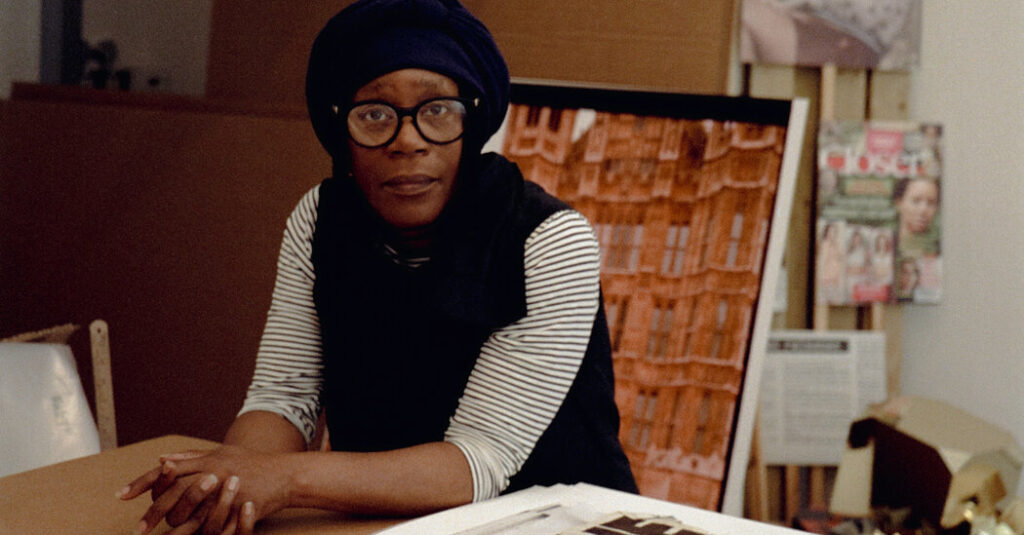
Over two days at the Queens Museum in October 2025, the British Afro-Caribbean artist Sonia Boyce recorded many of the different activities taking place within its walls, part of her decades-long exploration of art as a social practice.
She captured the creation of a Día de los Muertos (Day of the Dead) community altar. A gathering of members of Hope TGNC Latinx — transgender, gender nonconforming and L.G.B.T. people in the Corona section of Queens. The artist Koyoltzintli playing a five-point water whistle, an instrument inspired by the Chorrera people of Ecuador. A procession of singers in the Resistance Revival Chorus through the building, ending at the panorama of the City of New York. And more, besides.
For the filming, Boyce stuck to her usual method of giving few instructions to the camera operators or the participants. “Spontaneity, improvisation, bringing groups of people together, people negotiating spaces together has become the material — the real material — that I’m working with,” she said in a recent interview, speaking from her art studio in London.
The result is “Demonstrate,” an immersive installation that opens on June 27 at the Queens Museum, Boyce’s first solo museum exhibition in the United States, another first in a 40-year artistic career marked by them. In 1987, she was the first Black female artist to have work — a pastel and charcoal drawing — enter the collection of the Tate. In 2016, she became the first Black woman elected to the Royal Academy of Art in its more than 200-year history. And in 2022, she became the first Black woman to represent Britain at the Venice Biennale. For all of her achievements, she was named a dame commander of the Order of the British Empire in 2024.
Her show at the Queens Museum consists of six films that unfold over seven screens in an architectural space papered with her signature kaleidoscopic prints, whose images are drawn from the photographs and films on view — the crumpled tinfoil from a middle-school art project Boyce found in one of the museum’s storage spaces, marigolds laid on an altar to memorialize a loved one. For the films, Boyce transformed the original footage into sometimes trippy layerings of interview subjects, text and op-art patterns.
At the same time, Boyce, 64, is showing “Transform,” a takeover of the digital billboards in Times Square nightly, 11:57 p.m. to midnight, organized by Times Square Arts, through June 30. Drawn from the same original footage, “Transform” homes in on the artist Koyoltzintli leading a workshop of “Andean Animal Movements” — like animal yoga — for community members, set against mirrored patterns. “While it’s pulled from documentary footage, it doesn’t feel very documentary,” said Anna Starling, director of Times Square Arts. “It’s more like transfixing patterns that transform across the screens.”
Music plays a key role in much of Boyce’s work. “Feeling Her Way,” her presentation for the British Pavilion at the Venice Biennale, for which she won a Golden Lion, was a tribute to forgotten British female singers of African, Caribbean and Asian heritage. “Silent Disco,” a work she presented in her first gallery show for Hauser & Wirth, in New York in 2025, involved people dancing to music they heard through headphones.
“Something that Sonia always talks about is the idea of the voice and collective song or singing together as a way that reduces the emotional distance between people,” said Lindsey Berfond, the curator of the Queens Museum exhibition.
ArinMaya Lawrence, one of the Resistance Revival Chorus’s musical directors, said the group met with Boyce for only about five minutes before the procession began. “She understood what our approach was going to be, and from there it was just like, OK, we’re in the moment, we’re trusting the moment,” Lawrence said. “We were creating a space for a moment to arrive.”
Members of the chorus translated lyrics on the fly so that the many Spanish-speaking visitors present that day could participate in a call and response. “It was electric,” Lawrence said. “People were fully activated, fully engaged with each other even though they didn’t know each other.”
Film and sound recordings were radically transformed in the studio. “With the filming, I want to see how people negotiate each other, and if they find moments of freedom or moments of play,” Boyce said. “And then the material comes to me, and I play.” What results is less a documentation of a performance than an attempt to “unhinge the relationship between how something came into being and what it can be,” she said.
Boyce grew up in a working-class area of London, the daughter of a Guyanese father and Barbadian mother — members of the Windrush generation of Caribbean immigrants invited to England to rebuild the country after World War II. She said that her decision to become an artist was made for her by teachers who recognized her talent. “Neither my mum or anyone in my family had a sense that art could be a profession,” Boyce said. “But my mum was of that generation where, if your teacher says you have to do something, you have to go and do it.”
She became a key figure in the British Black Arts Movement in the late 1970s and ’80s, alongside Lubaina Himid (who is representing Britain in this year’s Venice Biennale), Keith Piper and Eddie Chambers, among others.
When Boyce was in art school, she was one of the few students of color, and many of her professors were practitioners of a politically inflected conceptualism. A watershed moment occurred when she attended the student-organized First National Black Art Convention at Wolverhampton Polytechnic in 1982, where she met Afro-British artists working through issues of identity.
“For me it was like lightning,” she said. That, along with an early and formative encounter with the work of Frida Kahlo at a Whitechapel Art Gallery exhibition the same year, convinced her that it was possible to make figurative work that grappled with social and political questions related to race, class and gender.
“The moment I decided I was going to be an artist was when I learned about the feminist art practice that was happening in the late 1970s, and realized I could talk about the real world through art,” Boyce said. “And then I learned that there was a kind of bubbling, emerging Black Arts Movement happening.”
She most often used herself as model for her large-scale pastels, including works like “She Ain’t Holding Them Up, She’s Holding On (Some English Rose)” in 1986, which were influenced by female artists of the past. “It sounds really dramatic to say it, but basically Frida Kahlo saved my life,” Boyce said. “She gave me a language through which to speak about my own position, and through speaking about my own position, to speak about a wider context.”
After finishing her education in 1983, she taught at art schools around Britain, establishing her credentials as an educator; she is currently professor of Black Art and Design at University of the Arts London. At the same time, she began to show her work, at the urging of Himid, who was curating exhibitions of other Black female artists. “I had no confidence in what I was doing, and Lubaina just kept sending me these postcards with ‘SEND ME YOUR SLIDES’ written in red on the back,” Boyce said, laughing.
In the 1990s her work took a very different turn. “I started to realize that people were very comfortable with me speaking only about myself,” Boyce said. “But do I have a right to speak about anything else?” She describes her move away from having her own figure be the protagonist of her work as a “paradigm shift.”
Pastels gave way to photographs and videos in which she would ask other people to take part in her scenarios. For a piece called “The Audition” (1997), she sent out advertisements inviting people to be photographed wearing an Afro wig. Eighty people, Black and not, showed up, opening up a conversation about the way identity is constructed by stereotypes and visual markers.
At one point she proposed a project to a pair of identical twins who were actors. “That was the moment that I realized I had no idea how to direct anyone,” she joked.
“I was so fascinated by how they took up their own agency in that scenario,” Boyce said. What they were doing was far more interesting than what I asked them to do.”
As Boyce’s work with video has developed, wallpaper became a grounding presence in her installations. “I create these moments that can seem kind of chaotic, with lots of bits of visual information in them,” she said. “Pattern becomes a way to put them in order somehow, to give them a shape.”
“Demonstrate,” which runs through Jan. 31, 2027, is something like a love letter to the Queens Museum. When Boyce was developing her ideas, she said, “everyone at the museum thought I would go out into the community. But I became really fascinated by the different communities that convened in and through the museum.”
“We tend to think of museums as a kind of arm’s length experience where objects are in glass vitrines,” she said. “But this is a place where people demonstrate their artistic, imaginative and technical skills literally every day. They’re demonstrating their imaginative capacity collectively and individually.”
The title of the show alludes as well to the idea of protest, of politics of action. For Boyce, collective making is a profoundly political act, she said. “We are creative beings. We make our world. Let’s make our world the way we want it to be.”
The post An Artist Creates Moments for Play, and Solidarity appeared first on New York Times.